
 Jackson Lane
Before the logo loads and before the tagline is displayed, the .org domain has already conveyed a message on your behalf. That’s not luck. It’s decades of nonprofits, foundations, and open-source projects earning the extension its reputation, one honest website at a time. Flashier extensions can’t buy that kind of head start.
Registering the domain is the straightforward part. Protecting it, renewing it on schedule, and pairing it with scalable cloud hosting determines whether an organization builds lasting momentum online or loses ground within the first year. This article breaks down what a .org domain really means, why it still earns its reputation, and which providers actually deserve a spot on your shortlist.
Table Of Content
What Is a .org Domain?
Nobody needs a certificate to claim one. That’s the first surprise about .org domain registration: anyone can register it, whether they run a global foundation or a five-person community project. What is .org domain used for, then? Mostly for causes, not companies. Non-profits, advocacy groups, schools, and open-source communities use it because the letters alone hint at purpose over profit.
Knowing the .org domain meaning early helps set realistic expectations. Open eligibility removes the usual filter. Since anyone can complete the org domain register process, the registrar you pick becomes the deciding factor instead. That single detail decides how smoothly everything else, including renewals, DNS changes, and support tickets, goes from here.
What Are the Benefits of a .org Domain?
Choosing this extension shapes more than a first impression. It alters the perception of donors, volunteers, and search engines regarding the organization, particularly for NGOs and nonprofits establishing a public identity from scratch. Some of these benefits show up immediately. Others compound quietly over several years.
01
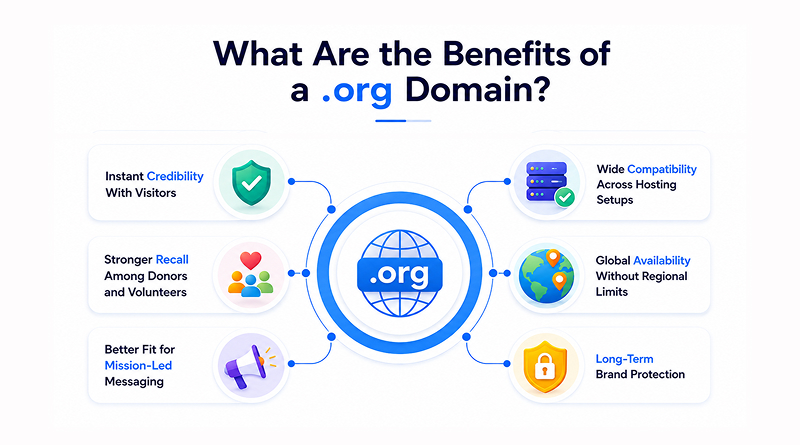
Instant Credibility With Visitors
A .org website reads as purpose-led, not commercial. That single impression buys a few extra seconds of trust before anyone scrolls further.
02
Stronger Recall Among Donors and Volunteers
People remember cause-driven extensions faster than generic ones. That recall pays off every fundraising season.
03
Better Fit for Mission-Led Messaging
A domain that signals intent early takes some of the pressure off the design and copy to explain it. Marketing teams spend less time explaining the mission and more time communicating it.
04
Wide Compatibility Across Hosting Setups
The extension runs cleanly on shared plans, dedicated servers, or managed environments. Nothing locks a technical team into one setup.
05
Global Availability Without Regional Limits
Unlike most country-code extensions, .org isn’t tied to any borders. That suits organizations running international chapters or fully remote teams.
06
Long-Term Brand Protection
Holding the matching .org next to a primary domain blocks lookalike websites from stealing traffic. That protection matters more as the brand grows.
Related Read: Top .net Domain Name Providers
Who Are the Top 5 .org Domain Name Providers?
Picking a registrar isn’t about the flashiest dashboard. It’s about domain renewal pricing transparency, support quality, and whether the platform fits where the organization is headed next. Here are five worth comparing, each built around a different priority.
1. MilesWeb
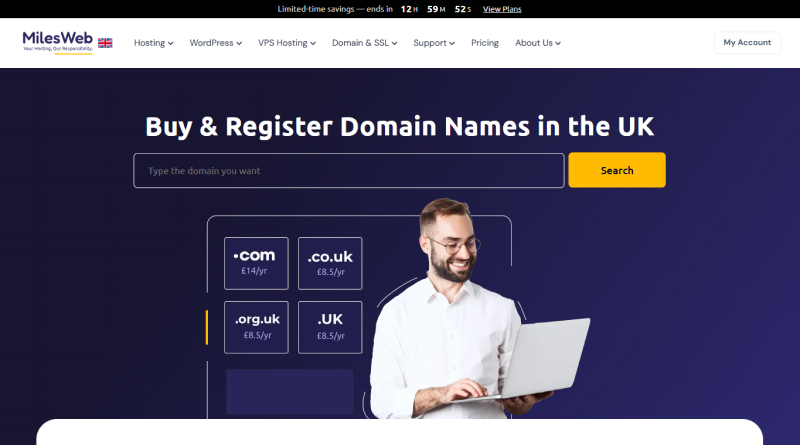
MilesWeb is a hosting-first registrar built for teams that expect to outgrow a basic website. Org domain name registration here comes with real technical backing, not just a checkout page. DNS management stays granular. WHOIS privacy is free on every plan. Domain renewal pricing stays visible upfront, so there’s no unpleasant surprise when the first billing cycle ends, and the support desk operates around the clock with engineers who understand server-side configuration rather than reading from a fixed script. That technical depth becomes the deciding factor over time for organizations planning to layer business email, staging environments, or a content delivery setup on top of the domain later.
Key Features
- Free WHOIS privacy on every plan
- 24/7 support with real server-level expertise
- Transparent, upfront renewal pricing
- One-click upgrade path to VPS and cloud hosting
- Simple DNS and nameserver management
- Free SSL security
2. Zoho
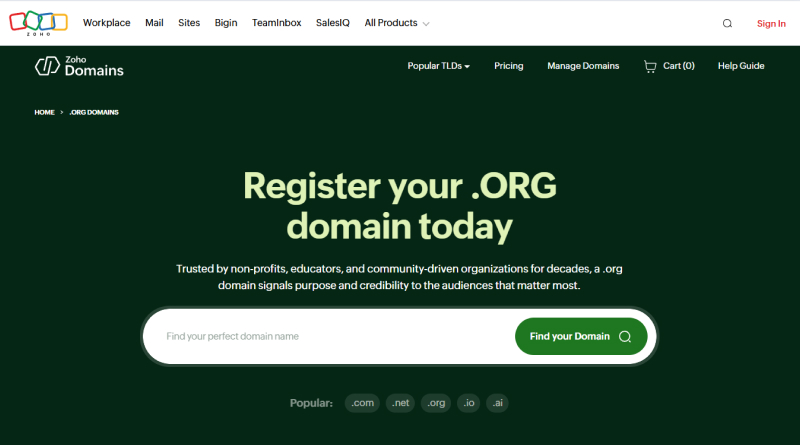
Zoho treats domain registration as one piece of a bigger productivity puzzle. Anyone already running Zoho Workplace will feel at home instantly. A freshly registered name connects to a custom .email domain and business inbox inside the same dashboard. That means one less vendor to manage and fewer logins to remember during setup. It suits small teams that want registration and email handled in one place, without stitching together separate accounts.
Key Features
- Bundled business email setup
- Integration with Zoho Workplace apps
- Basic DNS management tools
- Two-factor authentication on accounts
- Straightforward renewal reminders
Related Read: What is .email domain?
3. Hostinger
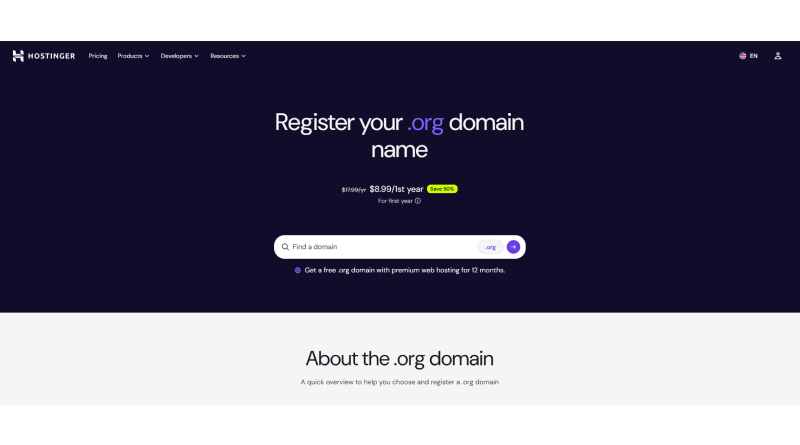
Hostinger established its reputation by offering low prices while still providing essential features. Teams running a store alongside their .org website often add WooCommerce hosting to the mix. Checkout speed and plugin compatibility work well right out of the box. The control panel stays simple enough for a first-time buyer to navigate without help, which shortens the learning curve for teams without a dedicated technical hire.
Key Features
- Competitive entry-level pricing
- Free SSL certificate included
- Beginner-friendly control panel
- WooCommerce-optimized hosting bundles
- Email forwarding on select plans
Realted Read: Top WooCommerce Hosting Providers
4. GoDaddy
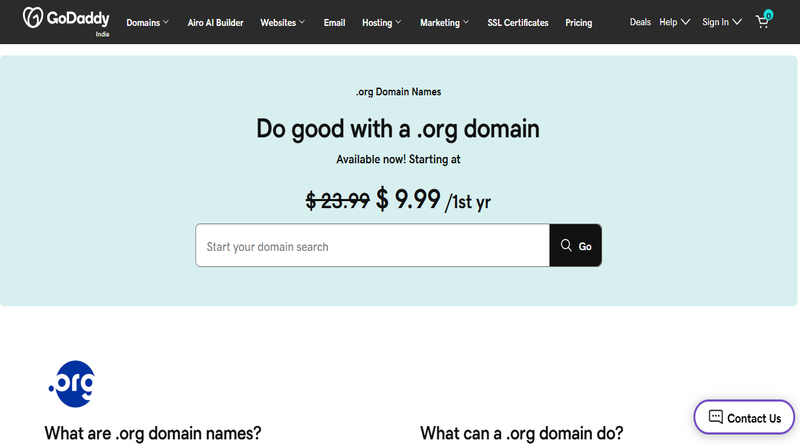
GoDaddy remains one of the most recognizable names in the registrar space, largely due to scale rather than deep specialization in any single niche. Its marketplace covers dozens of extensions, including a secondary .io domain for a side project or product arm. That convenience comes at a cost, though. Renewal pricing on .org names tends to jump once the introductory discount disappears, so the real cost only shows up after the first year ends.
Key Features
- Wide extension marketplace
- Domain privacy add-on available
- Basic auto-renewal settings
- Aftermarket domain marketplace
- Mobile app account management
5. BigRock
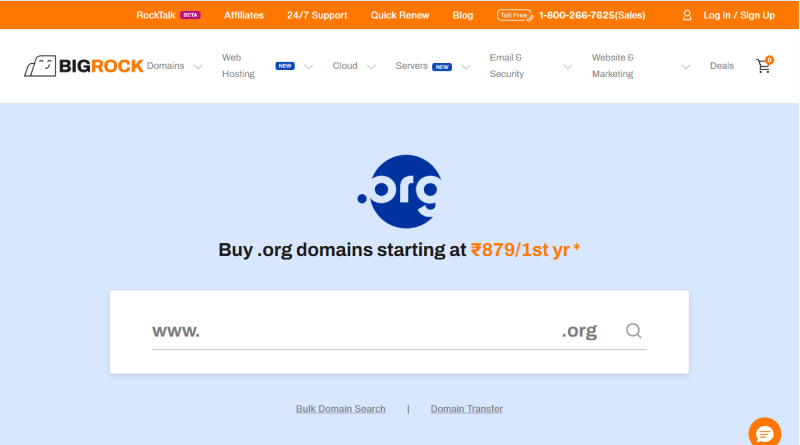
BigRock focuses almost entirely on the Indian market. Local payment options and support hours built around Indian business needs make it the easier choice for domestic buyers. Anyone comparing a .org name against .in domain name providers for a parallel presence usually starts the search here. Pricing in rupees removes the currency-conversion guesswork, which simplifies budgeting for smaller domestic non-profits.
Key Features
- Local payment gateway support
- Regional customer service hours
- Bundled hosting discounts
- Domain lock and transfer protection
- Multi-year registration discounts
How Do These Providers Compare at a Glance?
Every registrar page reads differently, and comparing five of them one by one gets tedious fast. This table puts the differences in one place.
| Provider | Standout Feature | Support | Best For |
|---|---|---|---|
 |
Free WHOIS privacy, one-click VPS upgrade | 24/7, engineer-led | Organizations planning to scale |
 |
Domain and business email in one dashboard | Ticket-based | Existing Zoho Workplace users |
 |
Lowest entry price, WooCommerce-ready | Live chat | Small stores, tight budgets |
 |
Wide extension catalog, one account | Phone & chat | Buyers registering multiple domains |
 |
INR pricing, India-based support hours | Regional phone | Domestic buyers comparing .org and .in |
What Would MilesWeb’s Recommended Domain Strategy Look Like?
Registering the name is step one, not the finish line. Lock in WHOIS privacy the same day, before the domain even goes live publicly. Match it with hosting built to scale, ideally something with a clear upgrade path to VPS rather than forcing a full migration later. Set a renewal reminder sixty days out, not on the exact expiry date, since relying on a grace period introduces unnecessary risk.
Layer SSL certificate before launch, not after a visitor’s browser flags the website as unsafe. Use a dedicated email domain for donations and support requests, ensuring they land in a business inbox rather than a personal email. Fixing it after launch always costs more time than setting it up correctly on day one. Treat the first week after registration as setup time, not launch time, and the rest of the rollout tends to go far smoother.
What Common Mistakes Should You Avoid While Choosing a Provider?
Most of these mistakes have nothing to do with the domain itself. They show up later, inside a renewal email or a support ticket; nobody answers fast enough.
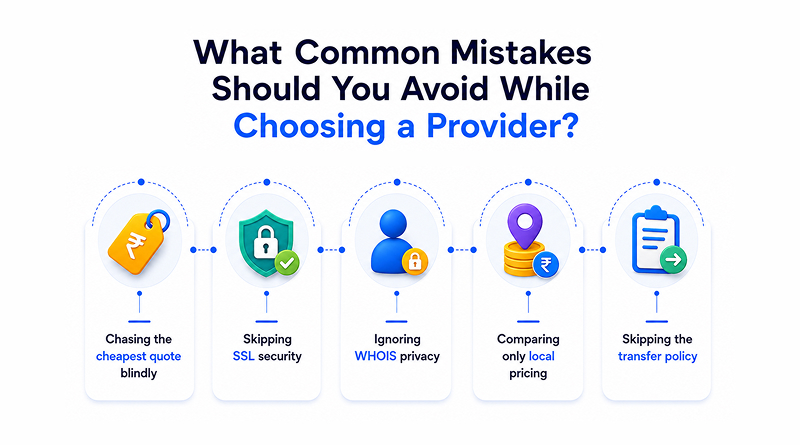
Mistake 01
Chasing the cheapest quote blindly
A cheapest .org domain price often hides a steep renewal jump in year two.
Mistake 02
Skipping SSL security
A website meant to represent trust shouldn’t leave visitor data exposed.
Mistake 03
Ignoring WHOIS privacy
Exposed contact details lead to spam calls and, in rare cases, someone attempting to hijack the domain.
Mistake 04
Comparing only local pricing
Checking the .org domain price in India alone, without global support hours, can leave a team stranded outside business hours.
Mistake 05
Skipping the transfer policy
A routine registrar switch turns into a multi-week delay without one quick read beforehand.
Concluding Insights
Budget, portfolio size, and the tech stack needed eventually should drive this decision, not brand recognition alone. Providers with real infrastructure depth keep paying off well past the first renewal, while smaller-scale providers still hold up fine for a website that’s likely to stay small.
Before signing anything, please compare renewal terms and inquire about support hours to ensure they will be available when needed. When it’s finally time to buy a .org domain and start building, that early groundwork carries forward, setting the mission up for steady, lasting growth.
Frequently Asked Questions
1. Who should use a .org domain?
Non-profits, foundations, advocacy groups, schools, and open-source projects are the natural fit. Anyone building something people need to trust before they even scroll down the page benefits from it.
2. Can I transfer my .org domain to another registrar?
Yes, and it’s a fairly standard process. The domain needs to be unlocked, past its initial registration lock period, and you’ll require the transfer authorization code from your current registrar to move forward.
3. How much does it cost to register and renew a .org domain?
Registrars set their own rates, and those rates rarely stay flat; first-year pricing often looks nothing like what shows up at renewal. The safer approach is checking the actual cost directly with whichever provider you’re leaning toward, rather than trusting a number that was accurate somewhere else, at some other time.
4. What is the primary purpose of a .org domain name?
It exists to represent organizations built around a cause, not a product. That distinction is precisely why it reads differently than a .com the moment someone sees it.