
 Jackson Lane
Somewhere between the tap of a link and the moment a page appears on your screen, Linux has already done most of the work, quietly powering well over 90% of the world’s active servers today. A website loads faster, handles traffic spikes better, and stays secure with a simpler setup underneath, which is precisely why so many website owners actively search for the best Linux hosting provider before committing to a plan.
What is Linux hosting? In simpler terms, it means that your website’s files, databases, and applications are hosted on a server that operates on Linux rather than Windows. That one shift is what lets PHP, MySQL, and almost every open-source stack run the way developers expect, and it’s a big reason Linux hosting plans hold up better as a project grows. In this post, we’ll explore what actually separates a dependable Linux hosting from an average one and take a closer look at five providers currently active in the domestic hosting market to help you make a clear, informed decision.
Table Of Content
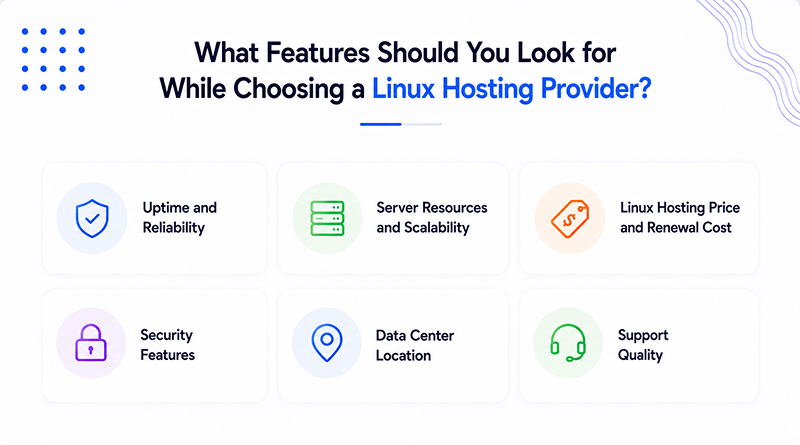
What Features Should You Look for While Choosing a Linux Hosting Provider?
Not every hosting plan delivers what its landing page promises, and comparing raw Linux hosting plans side by side remains the only reliable way to confirm that. Before making a commitment, run through these six factors to make sure your final choice actually matches what your website needs.
Which Are the Best Linux Hosting Providers?
The web hosting market has no shortage of options, but only a few consistently deliver on speed, uptime, and real value for money. Here are five providers worth a closer look if you’re comparing options for the best Linux hosting provider has right now.
1. MilesWeb
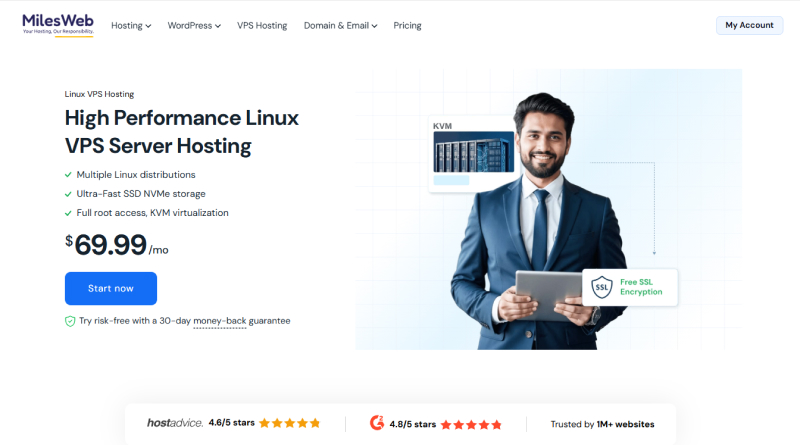
MilesWeb has built its reputation around genuinely strong Linux VPS infrastructure rather than surface-level marketing, and that technical depth becomes obvious the moment you look under the hood. Our shared hosting runs on LiteSpeed by default, which significantly speeds up load times for websites after migration. Our Linux VPS options, meanwhile, are hosted in Tier-4 data centers with full root access at a much lower price than competitors charge for similar features.
For developers who want granular control without paying dedicated server prices, our KVM-based virtualization, NVMe storage, and choice of specific Linux distributions during provisioning stand out. Together, these choices place MilesWeb among the best Linux VPS hosting provider options currently available for developers who need real technical depth.
Core Features
- Runs on a LiteSpeed-based server stack
- Linux VPS with full root access
- Tier-4 high-security data centers
- NVMe SSD storage across every tier
- 99.95% uptime guarantee
- Free SSL and daily automated backups
2. Hostinger
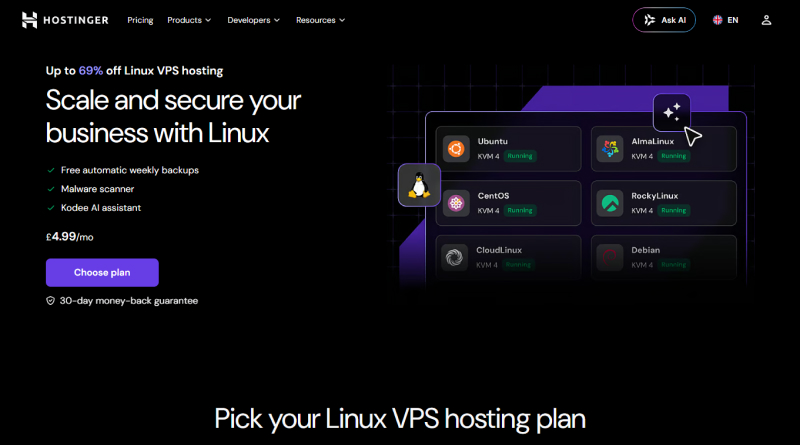
Hostinger has a different approach, focusing on making things simple and using AI to help manage services rather than just having the best technical specs. Its KVM-based Linux VPS plans offer full root access and NVMe storage and, unlike other providers, separate management for Linux and Windows VPS into different dashboards. Hostinger keeps everything, like provisioning, snapshots, and firewall setup, in one user-friendly hPanel, making it much easier for beginners to learn server management.
The built-in Kodee AI assistant walks users through common configuration tasks in plain language, and that guidance explains why Hostinger continues attracting first-time buyers who want VPS-level power without needing deep Linux expertise upfront.
Core Features
- Unified hPanel control panel
- Kodee AI assistant for server management
- Free weekly automated backups
- Real-time server snapshots included
- Multiple global data center regions
Related Read: What Are the Benefits of Windows VPS Hosting?
3. Verpex
Verpex earns its place on this list through infrastructure choices that punch above its price point, particularly its combination of LiteSpeed, NVMe storage, and CloudLinux account isolation across every shared hosting tier. Its VPS and dedicated hosting options go beyond just virtual servers, offering real bare-metal servers for businesses that need more power, and customers can choose from over twelve global data centers, including local ones, which is a big advantage over hosts that limit you to one location.
Verpex also stands out for offering unlimited free migrations, a detail that matters considerably more than it initially sounds once downtime and technical back-and-forth enter the picture during a provider switch.
Core Features
- LiteSpeed, NVMe SSD, and CloudLinux stack
- 12+ global data centers
- Unlimited free website migrations
- VPS and dedicated server options
- Free SSL on all shared plans
4. BigRock
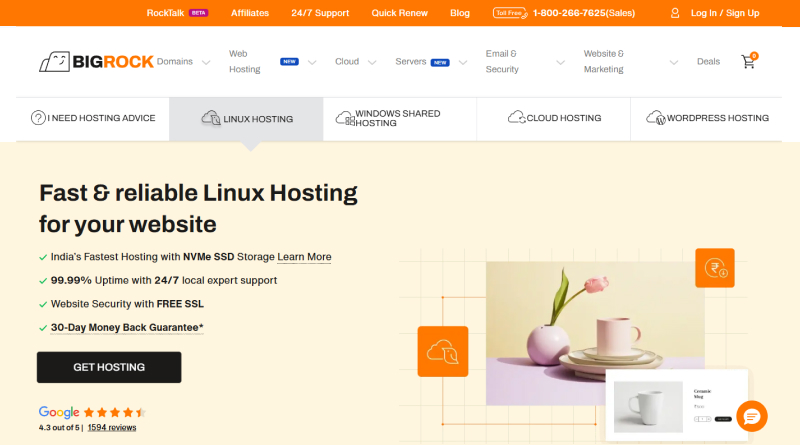
BigRock has spent over a decade building its position as one of the most recognizable domain and hosting brands. Its Linux shared hosting plans reflect that scale through Dell rack server infrastructure running dual quad-core Xeon CPUs, paired with CloudLinux for account isolation. Every shared plan comes with free SSL security through Let’s Encrypt as standard, and customers on longer-term Ultimate plans get upgraded to a Comodo Positive SSL certificate with a warranty attached, which gives BigRock a real edge for buyers who care about certificate-level trust as much as price.
Its entry-level plan sits among the cheapest in the global market, though renewal costs climb noticeably once the promotional window closes, so it works best for buyers ready to commit long-term from the start.
Core Features
- Dell rack servers with Xeon CPUs
- CloudLinux-based account isolation
- Free Let’s Encrypt SSL on all plans
- Unmetered SSD storage on advanced tiers
- 99.9% uptime guarantee
Related Read: What are the main differences between desktop and server Linux distributions?
5. HostingRaja
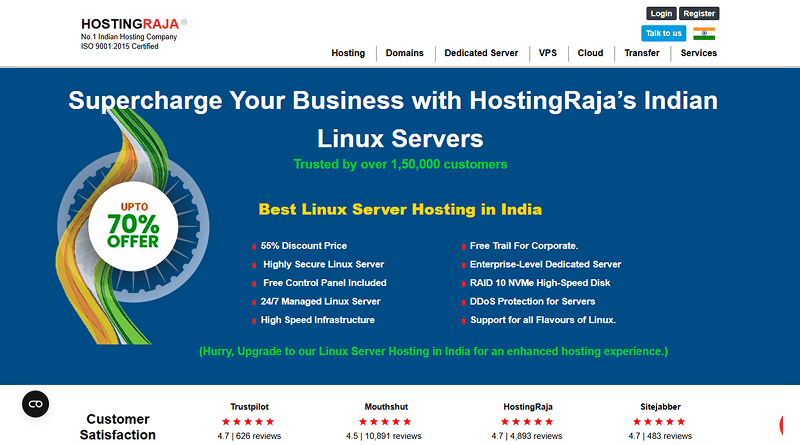
HostingRaja takes a narrower but focused approach by operating exclusively within the domestic hosting market. That focus lets it optimize every layer of its infrastructure specifically for domestic latency rather than balancing international data center priorities. Its Linux VPS plans pair AMD EPYC processors with NVMe storage, giving resource-heavy applications a real edge in data access speed. The LiteSpeed setup with the QUIC protocol, meanwhile, keeps WooCommerce hosting deployments steady on database response times even when traffic spikes hit.
Support in Hindi, Tamil, and English adds another layer of distinction, since most providers stop at English-only assistance, and that gap matters a lot for regional businesses setting up their first Linux environment.
Core Features
- AMD EPYC-powered Linux VPS
- NVMe SSD storage across VPS tiers
- LiteSpeed with QUIC protocol
- Multilingual support in Hindi, Tamil, and English
- Free SSL with Cloudflare integration
Related Read: Top WooCommerce Hosting Providers
Which Linux Hosting Provider Should You Choose for Your Use Case?
The right pick depends less on brand reputation and more on what you’re actually building.
- Resource-heavy applications: MilesWeb’s VPS lineup lets you pick a specific Linux distribution and configure the server manually, at a genuinely competitive price.
- No command-line experience: Hostinger’s AI-guided interface handles most configuration decisions for you.
- Agencies managing multiple client sites: Verpex’s unlimited migrations save real time when moving accounts between servers.
- Tight budget, first website: Few providers beat BigRock on entry price, which is precisely why it’s a common first pick for bloggers and small businesses just starting out.
- Domestic audience and regional support: HostingRaja is built specifically for this case.
Top Linux Hosting Providers : Side-by-Side Comparison
Reading through five detailed comparisons is informative, but sometimes the numbers alone tell you what you need faster. Here’s a quick side-by-side snapshot to speed up that decision.
| Provider | Technical Stack | Data Center | Uptime | SSL | Migration |
|---|---|---|---|---|---|
 |
CloudLinux OS, NVMe SSD storage, Softaculous | Tier-4 global facilities (India, USA, UK, Australia) | 99.9% guaranteed | Free certificates included | Free professional website transfer |
 |
CloudLinux, LiteSpeed Web Server, RAID-10 NVMe | Interconnected global Tier-3 data centers | 99.9% targeted | Let’s Encrypt integration included | Automated in-house migration service |
 |
Linux OS, SSD storage infrastructure, Softaculous | Multiple global server locations | High availability | Free certificates provided | Free manual and cPanel data transfer |
 |
Linux OS, robust infrastructure options | Multiple domestic and international data centers | Standard guarantee | Free SSL on eligible plans | Assisted transfer support available |
 |
Linux OS environments, standard storage options | Data centers optimized for Indian regions | Standard guarantee | Included on eligible plans | Assisted transfer support available |
What Common Mistakes Should You Avoid While Choosing Linux Hosting?
Most hosting regrets don’t come from picking a bad provider; they come from skipping the fine print. A few checks upfront save a lot of frustration later.

- Ignoring the renewal rate: Many providers double or triple their charges once the promotional offer ends, so check the renewal rate before you check the discount.
- Assuming “unmetered” means unlimited: Fair-use limits are usually buried inside the terms of service, even when the plan advertises unlimited storage or bandwidth.
- Chasing a free Linux hosting server: Genuinely free infrastructure rarely holds up once a project needs real reliability.
- Skipping the data center check: Confirm that the server is actually hosted locally before hosting Linux server infrastructure meant for a domestic audience, since some providers default to international regions unless asked otherwise at checkout.
- Taking uptime claims at face value: A provider’s own web hosting page will always claim 99.9% uptime; independent server monitoring tools are what actually confirm them.
Final Verdict: Which Provider Should You Choose?
Linux hosting isn’t just a technical checkbox tucked away in a signup form; it’s the foundation that decides how your website behaves under real traffic, real growth, and real budget limits. Each provider covered in this comparison solves a different piece of that equation, and knowing which piece applies to your situation turns a confusing decision into a fairly simple one.
Best for Enterprises: MilesWeb, built on Tier-4 data centers and VPS infrastructure that scales without friction.
Best Budget Option: BigRock, for the lowest realistic entry price in the domestic market.
Best Managed Hosting: Hostinger, where the AI-assisted hPanel and automated backups handle most of the routine maintenance for you.
Best for Agencies and Migrations: Verpex, since unlimited free migrations come standard on every single plan.
Best for Regional Support: HostingRaja, the rare host that actually talks to you in Hindi or Tamil when things go wrong.
None of these five are the wrong choice; they’re simply built for different journeys. Pick the infrastructure that matches your roadmap today, and your hosting decision will quietly keep working for you long after this comparison fades into the background.
Frequently Asked Questions
1. Which is the best Linux hosting provider?
Each of the five providers here handles a different priority well: Hostinger for interface simplicity, BigRock for entry price, Verpex for migrations, and HostingRaja for regional support. MilesWeb, though, edges past the rest on technical depth, VPS performance, and global data center coverage, which makes it the strongest overall pick in this comparison.
2. Why should I choose Linux hosting over Windows hosting?
Price is usually the deciding factor, since Linux runs on open-source software and skips the license fee that comes attached to Windows Server. PHP, MySQL, and most CMS platforms just work on Linux from the start, nothing extra to install or configure. Windows hosting only becomes worth it when a project is actually built on ASP.NET or MSSQL.
3. Is Linux hosting suitable for WordPress websites?
WordPress is built on PHP and MySQL, both of which are Linux-native technologies. That’s why nearly every managed WordPress plan on the market, including the providers covered here, runs on Linux by default rather than Windows.
4. Which businesses should use Linux hosting?
Bloggers, small businesses, agencies, and e-commerce stores typically run on Linux hosting because the platforms they use, WordPress, WooCommerce, and various open-source tools, are built for it. Companies running custom PHP or Python applications also lean toward Linux, largely because it keeps infrastructure costs lower at scale.