
 Jackson Lane
Web Application Firewalls (WAFs) and traditional firewalls both filter incoming website traffic, yet they protect APIs in entirely different ways. While they share the ultimate goal of data security, their inspection methods, traffic layers, and defense capabilities diverge significantly. Choosing the right firewall setup is an essential step when configuring secure web hosting for modern applications.
This paper looks into a comparison between WAFs and firewalls and their differences. An understanding of these distinctions allows you to work out how well you need to shield your business from cyber-attacks.
Quick Answer
- A network firewall operates at Layers 3 & 4, checking IP addresses and ports — it’s the guard at the gate. A WAF operates at Layer 7, reading the actual HTTP content — the guard inside the building.
- Firewalls stop network-level threats (DDoS, port scanning, unauthorized access); WAFs stop application-level exploits (SQL injection, XSS, malicious bots).
- Neither replaces the other — a firewall can’t inspect encrypted HTTP payloads for SQL injection, and a WAF doesn’t manage general network access or ports.
- WAFs come in three deployment types: cloud-based (scalable, low maintenance), software-based (highly customizable), and hardware-based (lowest latency, highest cost).
- Using only one creates real security gaps — most production environments need both working together as layered defense, not a choice between them.
Table of Content
What is a Web Application Firewall (WAF)?
A Web Application Firewall (WAF) protects web applications and Application Programming Interfaces (APIs). They most commonly protect unstructured corporate web applications by blocking threats. They do not provide protection for all forms of traffic for an entire network.
WAFs operate at the application layer of the WAF and review all HTTPS requests that reach a web application and API to find and block SQL injections and other similar attacks.
Also Read: Top WAF Vendors
What is a Firewall?
A firewall is a network security device to monitor, control, and filter an organization’s incoming and outgoing network traffic based on pre-established security policies. It filters the traffic between the private internal network and the public internet, allowing a secured browsing experience.
A WAF uses several techniques to determine whether traffic should be allowed to pass through to an application or be blocked. Some of those techniques are part of a negative security model, which is based on block lists of known signatures, while some belong to positive and negative security models.
Also Read: Why Is It Important For Every Website To Have A Web Application Firewall?
Firewall vs. Web Application Firewall (WAF): Core Comparison
Feature
Network Firewall
Web Application Firewall (WAF)
Main job
Locks down the network perimeter to keep unauthorized users out.
Shields public-facing websites, APIs, and web apps from malicious requests.
How deep it looks
Glances at the envelope — IP addresses, port numbers, basic connection rules.
Reads the actual letter inside — HTTP headers, URL parameters, code payloads.
Where it operates
Network & Transport layers (Layers 3 & 4).
Application layer (Layer 7).
What it stops
Network overload attacks (DDoS), port scanning, spoofed IPs, unauthorized network access.
Web exploits like SQL Injection (SQLi), Cross-Site Scripting (XSS), malicious bots, and web scraping.
How rules work
Blocklist approach — blocks known bad ports or IPs, allows almost everything else.
Hybrid approach — blocks known exploit patterns and learns “normal” web behavior to block the rest.
Where it lives
On the network edge, right at the entry point to your infrastructure.
Directly in front of web servers — as a cloud service, reverse proxy, or software plugin.
Also Read: WAF vs Reverse Proxy
WAF and Firewall: Do You Need Both?
Securing your network from modern, sophisticated cyberattacks becomes crucial for data-intensive operations. Here is how you can use both to get specialized security.
- Layered Defense: A network firewall acts as the first security guard at the gate. A WAF acts as a special security guard inside websites and APIs.
- Different Targets: A firewall protects servers and internal IT infrastructure from general intrusion. WAFs protect your web apps from targeted hacks and data theft.
- Complete Coverage: One cannot replace the other because of different protection layers available in the system.
Can a WAF Replace a Firewall?
WAF is not a network firewall but oversees traffic for web applications, and a network firewall is used to monitor network traffic. Having a WAF does not eliminate the need to restrict unnecessary ports, services, or network access.
Similarly, a network firewall cannot conduct a thorough analysis to detect application-level attacks, like SQL injection or XSS. They address various security issues, and it’s crucial to use the appropriate tool for each layer.
Also Read: AWS WAF vs. AWS Shield
Types of WAFs
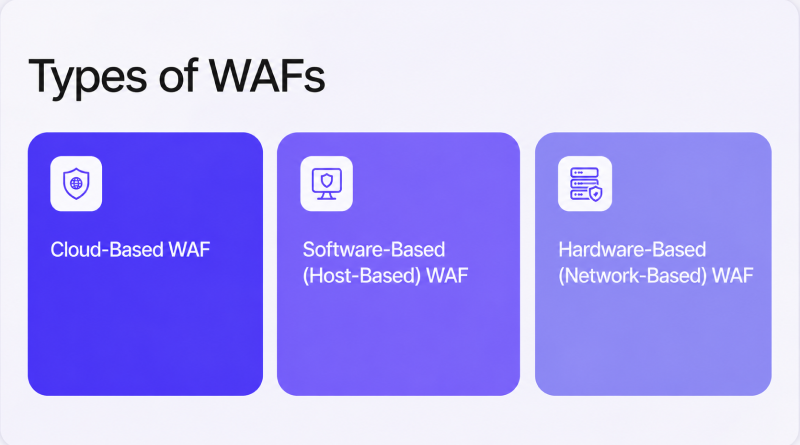
1. Cloud-Based WAF
Cloud-based WAFs allow you to outsource your security to a vendor. These WAFs offer a service that you can deploy either in-line or as an API call, allowing you to manage your updates, deployment, and scalability.
Who Is It For?
- Every business of every size. From small startups to enterprise businesses.
- Hassle-free, subscription-based solutions are ideal for the multi-cloud market.
👍 Pros
Scalable and cost-effective
There is no overhead or maintenance
Central management is guaranteed.
⚠️ Cons
Higher latency
Third-party reliance
2. Software-Based (Host-Based) WAF
A virtual appliance or software agent can be installed on a physical device, a virtual device, or a cloud device using these WAFs. This solution is ideal for companies that want to have a high level of control for web security.
Who Is It For?
- On-premise or cloud applications that require high levels of security.
- Businesses capable of configuring and managing compliance.
👍 Pros
Highly customizable
Cost-effective compared to a hardware-based WAF
Deployable in containerized environments.
⚠️ Cons
This solution is resource-intensive.
Steep deployment cycle
3. Hardware-Based (Network-Based) WAF
This WAF is a solution you deploy on-premises as a physical device. It is typically installed between a web server and outside traffic. This type of WAF is best suited for large enterprises with a high volume of traffic.
Who Is It For?
- Enterprises and government organizations that value faster performance.
- Organizations handling sensitive data that need a higher level of compliance.
👍 Pros
Lower latency
Full control of the security policies
Has backup and safety measures
⚠️ Cons
It has a high cost of implementation.
The solution demands a high level of IT expertise.
Type of Firewalls
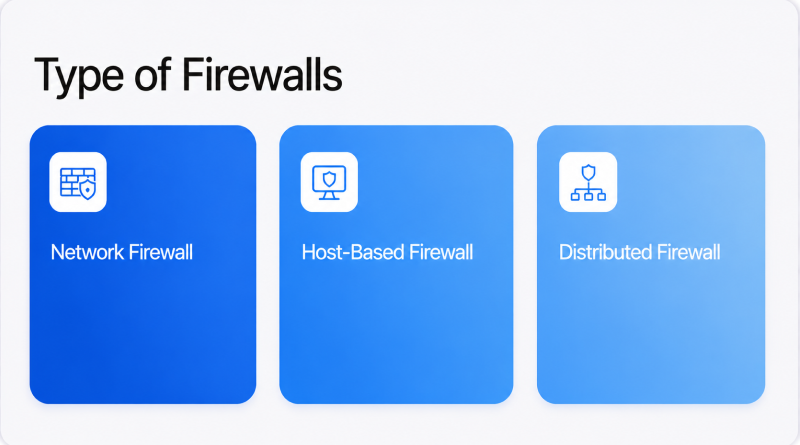
1. Network Firewall
A network firewall is installed at the interface of a trusted network (internal and private) and an untrusted network (internet). A network firewall monitors, controls, and makes validation decisions on all traffic that wishes to enter or exit the trusted network. Communication rules are set to protect the network.
Who Should Use It?
- Those who utilize hardware and/or software to thoroughly investigate all traffic.
- Those who wish to block unpredictable data streams.
👍 Pros
Built on hardware
Monitoring logs
Thorough traffic inspection
⚠️ Cons
Requires continuous rule maintenance
Will be a single point of failure
2. Host-Based Firewall
A host-based firewall is a software firewall installed on a single computer in a network. It is installed on each device for a layer of protection and controls the traffic entering or exiting the device. It operates on the principle of inspecting the traffic of the device.
Who Should Use It?
- Organizations with remote employees or those who connect to external networks should use it.
- Organizations that need a higher level of network protection.
👍 Pros
Protection at device level
Additional layer of protection
Effective against threats coming from the network
⚠️ Cons
Managed on device
Limited resources on device
3. Distributed Firewall
Distributed firewalls run over a network, rather than a node or device. Unlike traditional firewalls, distributed firewalls enforce security across multiple points within the network rather than at a single node. This is a protection system that uses several devices to watch and control the traffic to provide full protection.
Who Should Use It?
- Expanding companies that require scalable security solutions.
- Business that is worried about internal/lateral threats.
👍 Pros
Monitor internal/external traffic
Scale effectively
Minimizes single point of failure
⚠️ Cons
Complex configurations
Demand more resources/expertise
How to Select a WAF?
- Quick Setup: Instant provisioning and scalability deliver complete control—deployment can be cloud- or AWS-based for best performance.
- Advanced Protection: Standard protection from SQL injection, XSS, and much more against the advanced threats: bot traffic, API misuse, and DDoS.
- Customizability & False Positives: Make sure that tools are customizable, or the sensitivity can be adjusted to minimize spam users.
- Logging and Compliance: Ensure that it has logging capabilities and generates reports for compliance.
Also Read: Mastering DDoS Protection: A Step Toward Cyber Resilience
How to Select a Firewall?
- If your IT department is small, you may want to see user-friendly interfaces, auto-responses, or managed security services.
- Use GPS (geo-location devices) and network-based IP addresses to secure the geographical area before logging in, ensuring that users in restricted countries cannot access the system.
- The time factor limits an account’s access to specific hours or shifts, helping reduce the risk of data breaches outside normal business hours.
Conclusion
It’s difficult to determine the proper winner between WAFs and traditional firewalls since both are indispensable and complementary to form a secure strategy. A WAF is a specialized firewall that inspects the content of real application traffic, whereas a network firewall is used to block unauthorized access to the network. Using only one creates major gaps that today’s malicious cyber-attacks readily exploit.
FAQs
1. Is a WAF the same as a firewall?
WAF is not a generic firewall with a specific purpose to protect web applications and APIs against code-level exploits. A regular firewall controls traffic on a network using ports and IP addresses, while a WAF specifically blocks more complex attacks at the application level by looking at the actual content of HTTP/HTTPS traffic.
2. Do I need a WAF if I already have a firewall?
Yes, you do need a WAF, because regular network-level firewalls will not be able to decrypt or inspect the deep application-level traffic where SQL injection and cross-site scripting (XSS) take place. Without a network firewall, contemporary application-specific attacks can completely compromise your public-facing web applications.
3. What layer does a WAF operate at?
A WAF is a security solution that can be found at Layer 7 (Application Layer) of the Open Systems Interconnection (OSI) model. Layer 7 is the particular position that allows one to be able to analyze human-readable protocols such as HTTP, HTTPS, and WebSocket traffic and identify any malicious actions before the web server sees them.