
 Jackson Lane
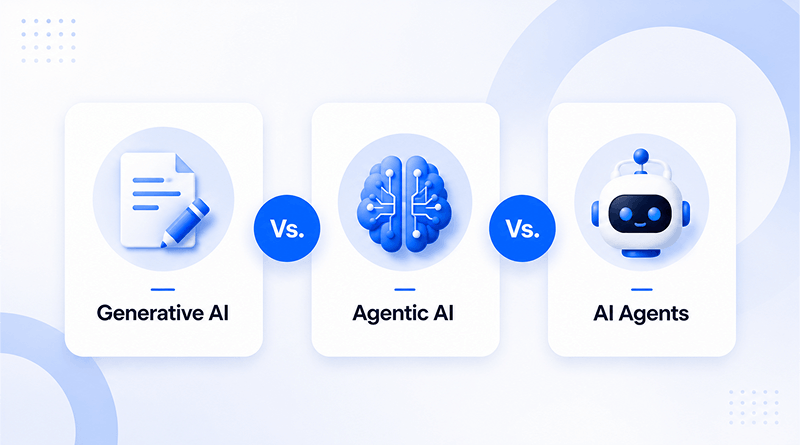
Generative AI, agentic AI, and AI agents sound like three flavors of the same idea, yet each one unlocks an entirely different capability once a team understands where it truly fits. Getting this choice right saves real money once a team starts building on cloud hosting infrastructure and picks the correct architecture for the job.
Generative AI, agentic AI, and AI agents solve three distinct classes of problems, and knowing exactly which one fits unlocks faster builds, smaller budgets, and confident engineering decisions. In this post, we will explore what actually separates these three approaches, how each one works in practice, and which one fits a real project without turning a five-minute task into a month-long build.
Table Of Content
What Is Generative AI?
Generative AI describes a model that takes a single prompt and produces new output, whether that output is text, an image, or a block of code. A request goes in, an answer comes back, and the interaction ends there, which is generative AI explained at its simplest. The model keeps nothing from one call to the next. Generative AI in daily practice shows up in summarizing documents, drafting emails, classifying tickets, and translating text. Each of these fits into one request and one response, the same way an AI content generator turns a single input into a finished piece of writing. Models such as GPT-4, Claude, and Gemini sit in this category, and their strength comes from staying simple rather than autonomous.
What Are AI Agents?
An AI agent wraps three additional capabilities around a generative model: planning, memory, and tool access. AI agents break a goal into steps, remember earlier steps within a task, and reach beyond the conversation to call an API or query a database. A coding assistant that reads a repository, writes a fix, and runs a test suite behaves like an agent, since it observes results and adjusts its next move. AI agent examples already exist in research assistants that gather sources on their own and in support bots that pull real account data before replying to a customer. Tools such as Agent Zero AI follow the same reasoning, action, and verification loop that most engineers refer to when they use the term “AI agents.”
What Is Agentic AI?
Agentic AI operates one level above a single agent. Instead of one system completing one task, it coordinates multiple agents and workflows toward a shared goal, often without a person triggering each step. A monitoring system that watches server load, notices a spike, and reroutes traffic before anyone opens a laptop shows the idea well. Agentic AI examples already run inside supply chain platforms that adjust orders based on shipping data, without any manual prompt starting the process. Platforms such as Agenta AI help teams manage these multi-step systems, since coordinating several moving parts introduces failure modes a single agent never faces.
Generative AI Vs. Agentic AI Vs. AI Agents: What Are the Key Differences?
Generative AI vs. Agentic AI vs. AI Agents separate cleanly along three lines: autonomy, cost, and complexity. It starts with a simpler question first: Does the system answer once, or does it keep acting afterward without help? A team managing its own web hosting infrastructure runs into this distinction quickly, since a chatbot that drafts a response is a very different tool from one that can actually restart a server on its own. The table below breaks down where each approach stands.
The distinction between AI agents and agentic AI primarily lies in whether a single system manages a task independently or multiple systems collaborate to achieve a common goal.
How Does Generative AI Work?
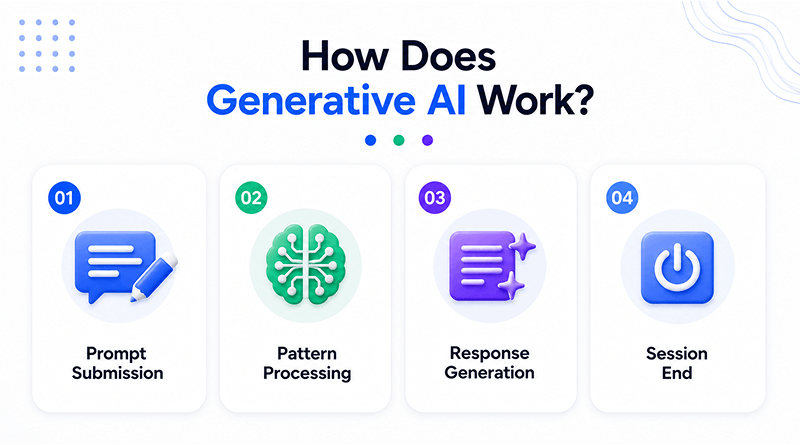
A generative exchange consists of four steps, beginning and ending within a single request.
1
Prompt Submission
A person submits a prompt describing the desired output.
2
Pattern Processing
The model measures the new prompt against patterns already stored in its training, then decides how to respond.
3
Response Generation
The model builds its answer piece by piece, word after word, until the response is complete.
4
Session End
The interaction ends, and no memory of that exchange carries over to the next one.
How Does Agentic AI Work?
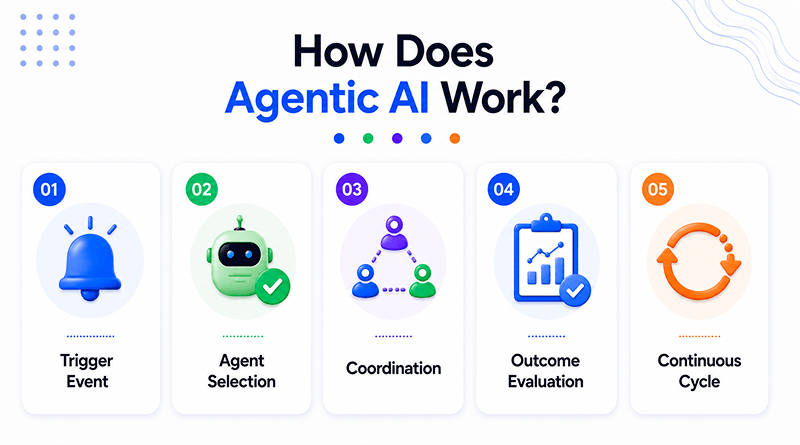
A working agentic system follows a continuous loop rather than a single exchange.
1
Trigger Event
A schedule or a live data change starts the process without human input.
2
Agent Selection
The system matches the incoming situation to whichever agent or workflow can handle it.
3
Coordination
One agent handles pricing, another checks inventory, and a third confirms shipping, with no one supervising the handoff.
4
Outcome Evaluation
Results from all three are compared against the goal, and a tool such as Ackee usually logs what happens.
5
Continuous Cycle
A price change, a stock drop, a delayed shipment, or any of it restarts the loop without a manual trigger.
↻
Loops back to trigger event, no manual restart needed
How Do AI Agents Work?
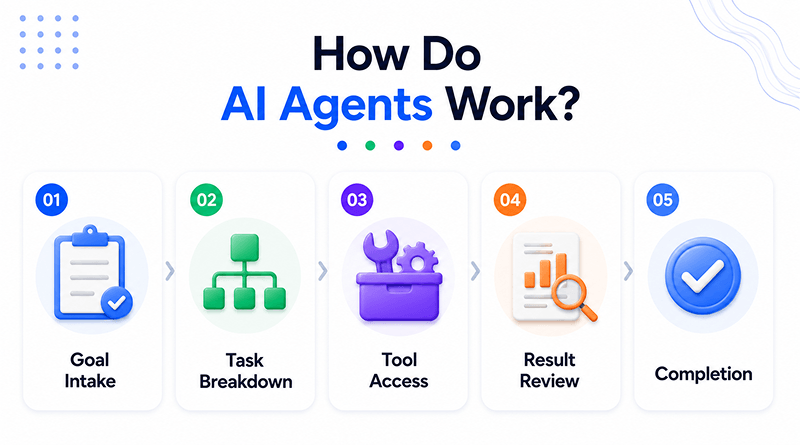
A single agent works through a set number of stages, one after another, until the assigned goal is complete.
1
Goal Intake
It receives a goal rather than a narrow prompt.
2
Task Breakdown
A broad goal usually becomes specific quickly. The agent splits it into smaller, ordered steps before touching a single tool.
3
Tool Access
Each step pulls in whatever it needs, an API call, a database query, or an external tool, usually through a dedicated application server built to handle that load reliably.
4
Result Review
Before moving to the next step, the agent checks what the last one actually produced. A mismatch here alters the plan immediately.
✓
Completion
It stops once the original goal is reached.
Which One Should You Actually Use?
Choosing between these three approaches depends on how much autonomy a task actually needs, not on which term sounds most advanced. A simple decision framework keeps that choice honest and prevents an afternoon task from becoming a multi-week build.
When Should You Use Generative AI?
A single, well-crafted prompt handles most single-turn tasks where a person reviews the output directly. Speed is more relevant than autonomy in this scenario.
- Writing product descriptions or marketing copy
- Summarizing call transcripts or documents
- Classifying incoming support emails
- Powering a straightforward AI website builder feature
When Should You Use Agentic AI?
Agentic AI earns its cost when a process needs to run continuously without a person starting each cycle. Reliable VPS hosting infrastructure supports this kind of continuous coordination well.
- Monitoring infrastructure and reacting to spikes automatically
- Adjusting inventory or supply orders based on live data
- Coordinating several specialized agents across a longer workflow
- Running always-on operations without manual triggers
When Should You Use AI Agents?
One agent takes on a single task at a time. The boundaries are clear from the outset, and no question arises about when the work is done. A person still initiates the task and reviews the outcome, which keeps the risk contained.
- Researching a topic across multiple sources
- Debugging a script and running its test suite
- Migrating data between two systems
- Completing a bounded research task through a framework such as Hermes Agent
Related Read: Best Hermes Agent Hosting Providers
Can Generative AI, Agentic AI, and AI Agents Work Together?
These three approaches rarely operate in isolation inside a well-built system. A generative model handles the initial content, an agent gathers supporting data through a tool like Airtable, and an agentic layer triggers the pipeline based on incoming requests. Agentic AI vs. AI agents are ultimately a question of scale rather than capability, and treating all three as building blocks rather than competing categories opens up architectures where each layer earns its keep.
Related Read: Airtable vs Baserow vs NocoDB
What Are the Benefits and Limitations of Each Approach?
The choices we make about infrastructure impact everything, and having a stable environment with excellent SSL security keeps all layers safe while agents share information between different tools and services.
Concluding Insights
Generative AI, agentic AI, and AI agents represent three points on the same spectrum rather than three separate products competing for the same job. Each one solves a different scale of problem, and the strongest engineering teams treat the choice as an architecture decision rather than a trend to chase.
Making the right decision involves aligning effort with actual needs, rather than choosing the most impressive term.
Generative AI earns its place when a single answer is all a task needs.
AI agents step in when a task needs planning and tool access to finish on its own.
Agentic AI takes over when several agents need to coordinate continuously without a person restarting the process.
Teams that match the right approach to the right problem build systems that stay predictable, debuggable, and easy to scale as needs grow.
Frequently Asked Questions
1. What is the difference between generative AI and agentic AI?
Generative AI takes one prompt and returns back one answer. Nothing happens after that unless someone sends another prompt. Agentic AI works differently. It keeps running, coordinating several agents toward a goal without anyone pushing a button each time a new step is needed.
2. Which is better: generative AI or agentic AI?
Neither approach ranks above the other in absolute terms, since each solves a different situation. Generative AI suits single-turn tasks such as drafting content or summarizing text. Agentic AI earns its higher cost and complexity only when a process needs continuous, autonomous coordination across multiple agents.
3. What is the difference between agentic AI and AI agents?
An AI agent gets assigned one job, works through it using planning and tool access, then stops once that job is done. Agentic AI doesn’t stop at one job. Several agents operate together under it, and the whole system keeps working toward a goal long after the first task wraps up.
4. Why is Agentic AI becoming popular?
Fewer people want to manage repetitive processes. Inventory checks, server monitoring, routine approvals—these operations used to need someone clicking a button every time. Agentic AI takes that step out of the picture, and teams are adopting it fast because the time saved shows up almost immediately.