
 Grace Cornish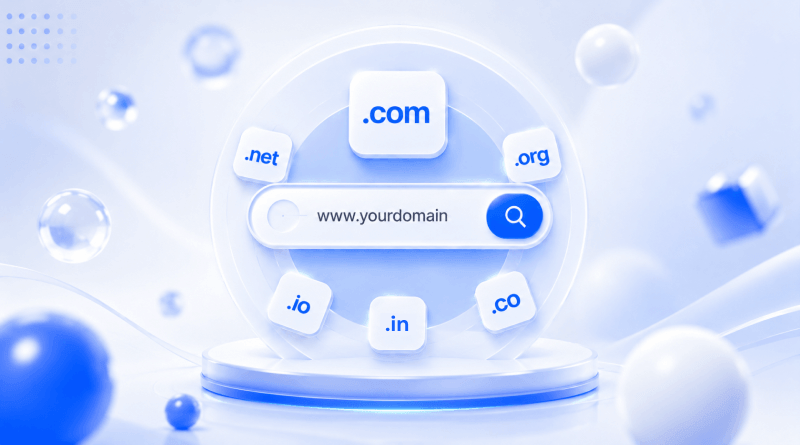
Choosing a domain name is important—but choosing the right TLD is the critical step.
The suffixes at the end of your website addresses (.com, .org, .ai, .store) are known as top-level domains (or TLDs). Although they are only a minor detail about your business, these TLDs help to create an overall impression of your brand. The type of TLD provider (domain registrar) you select suggests how you present yourself to the world—both locally and globally.
In the past, registering a domain name the decision was based on domain name options available to you Prominently, the .com version was the most preferred one. If your chosen domain was available, you could easily register your name under this suffix. The reason? The .com domain name is the most established TLD used worldwide.
But now with multiple options available, many people are using TLDs other than .com. Startups are rapidly adopting .ai or .io as their new TLD, while the e-commerce hosting companies prefer using .store as the TLD. Creators have also started to form communities with the use of .blog.
Of course, legacy TLDs like .com, .org, and ccTLDs (country code TLDs) are still an integral part of creating a recognized level of trust for a website or business.
But the question remains the same. How do you choose the right one?
This guide will provide detailed explanations about the different types of TLDs, outline which TLDs are the most popular for this year. It further highlights TLDs based on your business/audience/branding strategy and growth plan needs.
Related Read: What Is a TLD?
Table Of Content
What are the types of TLDs?
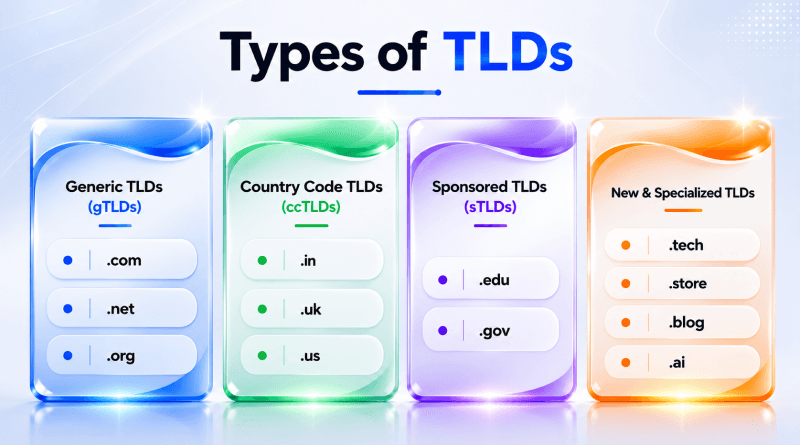
A top-level domain, commonly referred to as a TLD, is the end of a URL that you see. In simple terms, it’s after the last dot in a URL. So, for example, the TLD in www.milesweb.com is “.com.”
TLDs are important because they tell people your website’s category, the target audience, and its overall purpose. All TLDs have the same overall purpose, but using certain TLDs helps you establish your company’s brand image. Thus, finding out the ideal TLD options indirectly helps you in selecting the best domain. The following are the top TLDs along with their respective use cases.
1. Generic TLDs (gTLDs)
Generic TLDs, or gTLDs, are the most commonly used on the internet. They are not limited to a specific country, so they are beneficial for a company targeting customers around the world.
.COM
The World’s Most Popular TLD
The .com extension is the world’s most popular TLD. It was created for commercial organizations; however, it is now being used by small businesses, blogs, e-commerce companies, new startup companies, and individuals who want websites or blogs. Because so many people are familiar with .com websites, the public trusts and remembers .com websites more easily than the other ones.
Best Suited For:
Example: milesweb.com
.NET
A Popular Alternative to .COM
Originally designed for technology-related organizations, the .net extension is now a popular alternative to .com. Although .net is widely recognized and generally carries a good level of trust, in terms of authority, it is not as powerful as .com.
Best Suited For:
Example: speedtest.net
.ORG
Built for Trust & Mission-Driven Organizations
.org is the traditional domain extension of choice for nonprofits, community-based organizations, education programs, and public interest projects. While anyone can obtain a .org domain, its primary purpose is associated with trustworthiness, transparency, and mission-driven organizations.
Best Suited For:
Example: Wikipedia.org
2. Country Code TLDs (ccTLDs)
Country Code TLDs are designed to be used for specific countries or territories to provide businesses with a strong local presence and increased local awareness.
.IN
India’s Trusted Country Code Domain
The .in domain name extension is India’s Country Code TLD and has become an increasingly popular extension for businesses seeking to target Indian customers. Using a .in domain immediately shows that you have a local presence and relevance to Indian customers.
Best Suited For:
Example: milesweb.in
.UK / .CO.UK
Trusted Domains for UK Businesses
UK-based companies can use the .uk or .co.uk domain, which builds trust with customers in the United Kingdom and promotes a local presence.
Best Suited For:
Example: milesweb.co.uk
.US
Built for American Audiences
The US country-code generic TLD is .us. While the majority of businesses in the United States still utilize .com, the use of .us is beneficial for websites that want to reach out specifically to American users.
Best Suited For:
Example: zoom.us
.AE
The Trusted Domain for UAE Businesses
The .ae domain is considered the ccTLD for the United Arab Emirates, or the UAE. In general, businesses registered in the UAE typically use .com; however, the use of a .ae extension for your website will create a stronger sense of locality and trust for customers/users who are located in the Middle East or UAE.
Best Suited For:
Example: milesweb.ae
3. Sponsored TLDs
Sponsored TLDs have stipulations, conditions, and restrictions around their use. They can be used by specific organizations or communities only.
.EDU
Reserved for Accredited Educational Institutions
The .edu extension is only available to accredited educational institutions. Due to the extremely limited criteria for obtaining an .edu domain, these domains convey a significant amount of trust and authority to the user.
Best Suited For:
Example: academia.edu
.GOV
The Trusted Domain for Government Organizations
The .gov extension is limited to use by government entities. Users view government websites as trusted and credible sources of information.
Best Suited For:
Example: india.gov.in
4. New and Rare TLDs
Several types of new TLDs have emerged in the last decade, giving users ample opportunities for more memorable and specialized domain names in their industry. With the increasing trend, demand, and acceptance of these domain name extensions, they are getting popular, especially with startups and digital-first brands.
.TECH
Made for Innovation & Technology Brands
The .tech extension is intended for technology-oriented startups and businesses. It is used by website owners who want to indicate a relationship to innovation, software, and digital products.
Best Suited For:
Example: startup.tech
.STORE
Built for Online Selling & E-Commerce Brands
The .store extension clearly conveys that a website is selling products through the internet. It serves as an alternative option if the .com extension of the domain name is unavailable.
Best suited for
Example: your brand. Store
.BLOG
Built for Content Creators & Publishers
The .blog extension is distinctively created for content creators, publishers, and personal brands. The .blog extension clearly communicates the purpose of the website, helping visitors instantly recognize it as a blog-focused platform.
Best suited for
Example: news.blog
.AI
Preferred Domain for Artificial Intelligence Companies
The .ai extension was assigned to the country-code top-level domain (ccTLD) of Anguilla; however, it has become the domain name extension of choice for AI (artificial intelligence) startups and companies. The rise in AI usage has made the .ai domain extension very desirable for founders and investors.
Best suited for
Example: perplexity.ai
There are no right or wrong choices for your website’s TLD. Ultimately, it should all come down to your target audience, your industry niche, your branding objectives, and your location.
For businesses and organisations catering to a large number of consumers, the best choice for a TLD is still the good old .com domain extension. However, many of the newly introduced TLDs, such as .ai, .tech, .store, .blog, etc., are becoming more popular. These TLDs allow companies to communicate effectively with their audiences and obtain unique and memorable domains that are no longer available for registration under the traditional TLDs.
Factors to consider: Why your TLD choice matters?
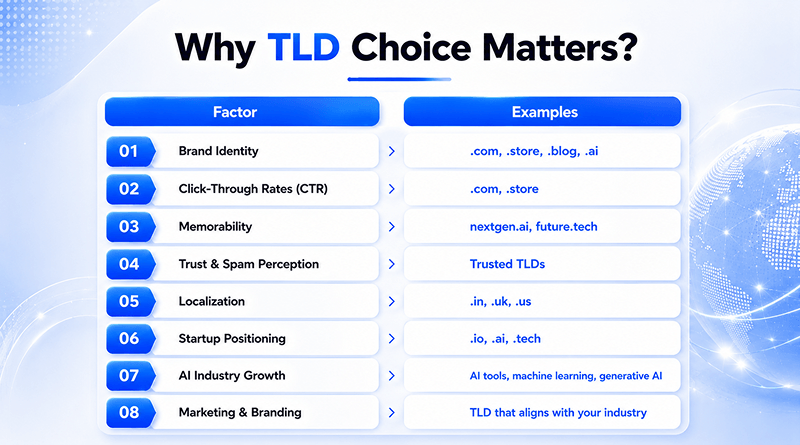
Choosing a TLD was once easy – most companies wanted a .com domain name and regarded anything else as a last resort or second-best option. However, the world has changed significantly since 2016.
In the recent years, companies (including startups, entrepreneurs, and e-commerce retailers) have had access to hundreds of different TLDs. Although the domain name provider you select still has significant value, researchers find that the TLD you pick affects how customers view you, whether they trust your website, and click through to the links you provide.
Related Read: Domain Name Trends
Here’s why your TLD choice matters for your business’s success:
1. TLD Shapes Your Brand Identity
The top-level domain (TLD) is one of the first elements that visitors notice on your website.
Common examples are .com, which implies professionalism; .org, denoting a non-profit organisation; .store for e-commerce; and finally, .ai for businesses operating in artificial intelligence. In addition to being an online address, in some instances, the TLD blends into the brand’s identity.
Here are some examples:
- A law firm will come across as more formal using the .com domain name extension.
- An AI startup gets more reach by using the .ai domain name extension.
- An online retailer generates more sales using the .store domain name extension.
- A content creator can promote their work using the .blog domain name extension.
Your brand message can often be reinforced by the TLD before a user even reaches your site.
2. TLDs Impact Click-Through Rates
A large number of search results, ads, and social media links on websites have become so common that people quickly determine the legitimacy and trustworthiness of websites.
Higher recognition of a TLD gains more user confidence, which results in more clicks. Users have become accustomed to seeing .com as a TLD. This has resulted in .com domains consistently performing well across various industries (no matter what niche your business is).
On the other hand, niche TLDs can influence clicks when they clearly relate to the intent of the user. In these cases, the TLD provides further context about a user’s intent upon reaching a website.
3. Memorable Domains Are Easier to Revisit
Easy-to-remember domains bring in repeat visitors to your website. Businesses use relatively short and relevant domain names that are matched with suitable TLDs to create memory-friendly brands.
This is one of the main reasons startups select modern extensions when the preferred .com domain name is not available.
Example:
- nextgen.ai
- future.tech
These domain names are much easier to recall than a longer .com domain name consisting of unwanted and unnecessary repeating letters and hyphenated characters.
4. TLDs May Have Spam Association
Over the past years, TLDs that are cheap to register have witnessed a high correlation to spam, phishing, and poor-quality websites. While it does not indicate that every domain name registered under a TLD is not trustworthy, an individual’s perception is essential.
Businesses need to focus on being credible and not choosing a TLD just because it is cheap. Remember that a domain is a long-term business asset, and it’s difficult to re-establish trust once lost.
5. Localization for Improved Relevance
By using ccTLDs, businesses create a strong local identity in the countries they serve. With relevant ccTLDs, local customers easily identify business websites, relate them to their local preferences, and trust them more easily.
Some examples of popular ccTLDs are:
- .in = India
- .uk = United Kingdom
- .us = United States
6. Startup Positioning Changes
Modern startups are increasingly moving beyond traditional .com domains and embracing a wider range of TLDs to strengthen their brand identity and online presence. They want to associate with trending terms of businesses like innovation, software firms, software as a service (SaaS), and new technologies. Thus, your choice of TLD should also consider your targeted audience and the trends they follow. This format is especially evident within venture-backed tech organizations and companies focused on artificial intelligence.
There are many new types of TLD extensions, such as:
- .io
- .ai
- .tech
Within startup ecosystems, many companies now prefer to use other TLD extensions like the three above to position themselves as being modern and innovative.
7. Drive Towards AI Growth
In the recent years, one of the biggest domain trends has been the rapid growth of AI tools, featured and ultimately .ai TLDs.
The reason for the tremendous growth is quite simple: the rapid expansion of artificial intelligence in the mainstream industry, machine learning platforms, and generative AI.
In short, the .ai domain primarily positions you as a strong brand. If your business is related to tech, innovation, IT, and other related fields, .ai domain users recognise your website as an authoritative one instantly.
Today, the decision of which TLD to choose has become more than a technical choice; it is now a branding, marketing, and positioning choice as well. When choosing your TLD, ensure you select the domain extension that aligns with your audience, supports your business goals, and allows potential customers to immediately understand who you are and what you offer.
Key criteria: How to choose the right TLD for your website?
There are different TLDs present on the web, so finding the right one may seem tricky. Fortunately, you do not have to evaluate every TLD. Remember these key elements mentioned below to make your TLD search more streamlined.
1. Your Business Type
Your industry or type of website should strongly influence your choice of domain name.
E-commerce Businesses
Selling online becomes easier when the domain clearly signals commerce intent.
.com
.store
.shop
Software & Technology
Modern tech brands use innovative extensions to reflect their digital identity.
.com
.io
.ai
.tech
Local Businesses
Country-based domains help build trust in regional markets.
.in
.uk
.us
Nonprofit Organizations
Trust and credibility are key for mission-driven organizations.
.org
.com
Personal Portfolios
Creators and freelancers benefit from personal branding domains.
.com
.me
.blog
.art
2. Target Market
Before you choose a TLD, consider the location of your audience you are trying to reach.
🌍 Global Audience
If your goal is to attract visitors from different points of the globe, then choosing a well-known TLD that is recognized worldwide is the best option.
gTLDs are globally recognized and suitable for international businesses.
Examples of globally recognized TLDs:
.com
.net
.org
📍 Local Audience
If your business targets customers in a specific country, a country-code TLD helps build local trust and relevance.
Example usage:
India → .in
UK → .uk
US → .us
India → .in
UK → .uk
US → .us
CC TLDs create stronger regional identity and improve local engagement.
.in
.uk
.us
3. Branding Considerations
Your domain name should accurately represent your brand’s desired image.
🏆 Premium or Established
If you want your business to be perceived as trustworthy, professional, or established, you should use a .com or .org TLD.
These domains have been trusted for decades and build instant credibility.
.com • .org
🚀 Contemporary and Inventive
Modern businesses and startups can explore newer extensions to build a fresh identity.
These TLDs reflect innovation and creativity in fast-growing industries.
.ai • .io • .tech
🏢 Corporate and Professional
Enterprise-focused companies benefit from traditional, stable extensions that convey reliability and structure.
.com • .net
🎯 Niche Positioning
Targeted extensions help clearly communicate your website’s purpose and strengthen brand identity.
They are widely used for e-commerce, blogs, and content-driven platforms.
.store • .blog • industry TLDs
4. Availability & Brand Access
Modern TLD Advantage
A challenge faced by most businesses is acquiring a memorable .com domain. This is where modern TLDs provide a strong advantage.
Instead of choosing long or complex domain names, modern TLDs allow shorter, more brandable, and easier-to-remember alternatives.
Instead of choosing long or complex domain names, modern TLDs allow shorter, more brandable, and easier-to-remember alternatives.
💡 Modern TLDs help create shorter, brand-focused domains that improve recall and branding impact.
future.ai
techworld.tech
yourbrand.store
5. SEO Considerations
Do TLDs Affect SEO Rankings?
Website owners are curious as to whether TLDs affect ranking. Search engines treat most generic TLDs the same; however, there are still situations where the TLD that you choose can impact your visibility.
In general, most gTLDs are treated equally, but factors like user trust, click-through rate, and geographic targeting (ccTLDs) can indirectly influence visibility and performance in search results.
6. Geographic Relevance
Companies targeting a specific country benefit from a country code for the TLD. For example, business customers in Canada should use the .ca domain extension. Using these TLDs helps users and search engines to understand where the company is located.
Global Reach
For websites that want to reach multiple regions around the world, typically the best TLDs for those websites are globally recognized TLDs. These TLDs are not geographically tied and give your business the potential to expand internationally.
For websites that want to reach multiple regions around the world, typically the best TLDs for those websites are globally recognized TLDs. These TLDs are not geographically tied and give your business the potential to expand internationally.
If you are struggling with the right TLD, consider evaluating the following:
- Your type of business
- Who your target audience will be
- Branding goals
- Availability of a domain name
- Your local and/or international SEO goals
Choosing the right TLD is essential for building your brand, aiding your marketing strategy, and allowing users to remember and trust your website.
Which is the best TLD for your website?
Every website has different goals, target audiences, and brand requirements, so not all TLDs work the same for your business. A .io (which was originally associated with the British Indian Ocean Territory) TLD may be appropriate for a tech startup but not for an online retailer or local service provider.
Finding a TLD that fits your industry and meets the expectations of your visitors ensures long-term success for your company and brand.
Before getting into newer and niche-specific domain name extensions, it’s worth noting that traditional top-level domains dominate the Internet. Examples include .com, .net, .org, .edu, .gov, .ai, .tech, .store, .blog, and country-code domains (such as .in, .uk, and .us). All of these serve a different purpose: building trust and credibility; targeting an industry; or targeting a geographic area.
| TLD | Category | Common Use Case |
|---|---|---|
 |
Generic TLD | Businesses Brands E-commerce General websites |
 |
Generic TLD | Technology companies Networks Online services |
 |
Generic TLD | Nonprofits Communities Education initiatives |
 |
Sponsored TLD | Universities Colleges Educational institutions |
 |
Sponsored TLD | Government agencies Public services |
 |
Niche TLD | AI startups Machine learning AI tools |
 |
Niche TLD | Tech startups SaaS companies Software businesses |
 |
Niche TLD | Bloggers Content creators Publishers |
 |
Country-Code TLD | Indian businesses Local services |
 |
Country-Code TLD | UK businesses Regional services |
 |
Country-Code TLD | US businesses Government services |
| TLD | Category | Common Use Case |
|---|---|---|
 |
Niche TLD | SaaS platforms Developer tools Startups |
 |
Niche TLD | Mobile apps Web apps SaaS products |
 |
Niche TLD | Cloud services Hosting companies |
 |
Niche TLD | Developers Open-source projects |
 |
Niche TLD | Online businesses Freelancers Personal brands |
 |
Niche TLD | Small businesses Landing pages |
 |
Niche TLD | Startups Creative projects |
 |
Niche TLD | Freelancers Portfolios Personal brands |
 |
Niche TLD | Marketing agencies Consulting firms |
 |
Niche TLD | Design studios UI/UX designers |
 |
Niche TLD | Fintech startups Investment firms |
 |
Niche TLD | Healthcare providers Wellness brands |
1. .io
The .io domain extension has become one of the most popular TLDs used by tech startups and software companies alike. For many tech companies, using the .io extension communicates a modern, short, and inventive style to their respective companies or products.
Best Suited For
SaaS platforms
Developer tools
Software companies
Tech startups
Related Read: Why Hosting on a .io Domain Is a Strategic Branding Move
2. .app
The new .app TLD, intended specifically for applications and software products, is owned by Google. For instance, if someone wanted to create a mobile application, develop a web-based application, or start a SaaS business, they would benefit from utilizing the .app extension.
Best Suited For
Mobile apps
Web applications
SaaS platforms
Software products
3. .online
With .online being one of the most versatile TLD options available today, it’s suitable for most industries. Any niche business trying to sell physical or digital products can use this domain extension. Thus, it is also serving as an alternative to traditional domains that are often mostly unavailable.
Best Suited For
Online businesses
Personal brands
Freelancers
Service providers
4. .site
As an extension offering simplicity and flexibility, .site suits nearly any type of website. When compared against traditional extensions, .site is often used by companies and people searching for short/easy-to-understand domain alternatives.
Best Suited For
Small business websites
Portfolios
Landing pages
Personal projects
5. .cloud
As cloud computing continues to grow, the .cloud extension has become popular with technology providers and cloud-based services.
Best Suited For
Cloud service providers
SaaS companies
Hosting businesses
Technology startups
6. .dev
The .dev extension is targeted towards developers, programmers, and software teams. Similar to apps, it requires HTTPS, making it an attractive option for modern development-based websites.
Best Suited For
Developers
Open-source projects
Software documentation
Technical communities
7. .xyz
Due to its flexibility and the strong adoption among startups, the .xyz domain extension has become one of the fastest-growing generic TLDs. Because the xyz extension does not restrict your website to a particular type of business/industry, it has excellent branding potential.
Best Suited For
Startups
Personal brands
Creative projects
Modern digital businesses
Related Read: Why .XYZ Domain Is Trending Now?
8. .me
The .me extension is very popular with individuals for their personal brands and portfolio websites. It creates domain names that are easy to remember, feel personal to you, and have a personal connection.
Best Suited For
Freelancers
Consultants
Personal brands
Portfolio websites
9. .agency
The .agency extension clearly communicates the type of business associated with it. This is important for service-based businesses in the marketing, design, recruitment, and consulting industries.
Best Suited For
Marketing agencies
Creative agencies
Consulting firms
Recruitment businesses
10. .design
For someone who works or wants to work in a creative field, the .design domain extension is an ideal branding tool for immediately identifying the type of business (i.e., brand).
Best Suited For
Graphic designers
UX/UI designers
Design studios
Creative professionals
11. .finance
With the FinTech and digital banking industries growing rapidly, .finance domain names are a good way of identifying what a website provides in services related to finance.
Best Suited For
Financial advisors
Fintech startups
Investment firms
Accounting services
12. .health
As the healthcare and wellness industries continue to grow, .health provides an industry-specific way to identify your business in these growing sectors.
Best Suited For
Healthcare providers
Wellness brands
Medical practices
Health-tech startups
What are the common errors while selecting top-level domains?
A top-level domain represents more than your website’s URL. It impacts how your customers view and trust your company. For example, choosing the wrong TLD creates confusion and hinders any branding efforts. Furthermore, it makes it difficult for customers to locate your business online.
Though there are many TLD options available, several of them continue to negatively affect companies and websites today. By avoiding the most common mistakes, such as using hard-to-remember domain names, missing out on opportunities for geo-targeting, and creating duplicate domains, you can make the difference between building a greater and more efficient online presence.
| Mistake | Why It’s a Problem | Better Approach |
|---|---|---|
| Too-long / uncommon TLDs | Can be difficult for users to remember or share | Use recognizable, easy-to-recall TLDs |
| Hard-to-spell domain names | Increases the chance of typos and lost traffic | Choose simple, memorable names |
| Spam-associated TLDs | May reduce trust and credibility | Use reputable extensions |
| Irrelevant TLD choice | Creates confusion about website purpose | Match TLD to industry/type |
| Ignoring regional targeting | Misses local audience opportunities | Use ccTLDs like .in, .uk, .us |
| Weak brand clarity | Harder to remember and market | Prioritize simplicity & brandability |
| Excess hyphens/numbers | Looks unprofessional and hard to communicate | Keep domain clean and simple |
| Only focusing on cost | Cheap domains may reduce trust | Balance price with branding value |
Checklist: How to choose the perfect TLD?
Don’t rush to choose a TLD. Choosing the right TLD can greatly enhance your brand image, improve brand recognition, and help you meet your long-term business objectives. By considering your industry, your target audience, and your plans for future growth, you can make sure that the TLD you will be using will be a good match for your business.
A good TLD should not only be easy to remember for users; it should also give users an impression of trustworthiness and correspond to the type of site you are developing. Use the below checklist to evaluate whether or not your potential domain range is appropriate for your brand.
| Checklist Factor | What to Consider | Why It Matters | Good Example |
|---|---|---|---|
| Industry Relevance | Does the TLD fit your business or website type? | Helps visitors immediately understand your website’s purpose | .com for businesses .ai for AI startups .store for e-commerce |
| Memorability | Is the domain short, simple, and easy to recall? | Improves direct traffic and word-of-mouth sharing | yourbrand.com short & simple names |
| Easy Pronunciation | Can people easily say and share the domain? | Makes recommendations easier in conversations, videos, and podcasts | natural-sounding names |
| Trust & Credibility | Will users recognize and trust the extension? | Familiar TLDs often inspire more confidence | .com .org .net |
| SEO Alignment | Does the TLD support local or global visibility goals? | Helps align your domain strategy with your target market | .in for India .uk for UK .com for global |
| Geographic Reach | Is the TLD suitable for your current and future markets? | Supports regional targeting or global expansion | ccTLDs for local business .com for global brands |
| Brand Consistency | Is the domain aligned with your brand identity? | Strengthens recognition across platforms | same name everywhere |
| Social Media Availability | Are matching social handles available? | Creates a consistent online presence | same domain + username |
Remember this quick final checklist before registering your domain name:
- Does it make sense for my industry?
- Can I remember and say my domain name easily?
- Will I be able to build trust with users through this domain name?
- Does this domain name support my SEO goals and growth plans?
- Is this domain name appropriate for my target audience?
- Can I use this name for my brand name on the major social media platforms?
If the answer is “yes” across the board, you’ve likely found a TLD that will serve your website well for years to come.
Strategic Note
When you’re looking to select the perfect TLD, it’s important to remember that choosing a domain isn’t as simple as just finding one that is available. The type of domain extension that you choose impacts your brand.
Today, the most common TLD extension is still .com; however, there are many new modern domains available (especially with new extensions such as .ai, .tech, .store, and .blog). These extensions give businesses unique and specific identities within their industry. Country code top-level domains can also be used by local businesses to reach out to prospective customers within specific areas.
Selecting the best TLD is about more than just what works best for your type of business; it’s about what meets your brand’s needs, meets your audience’s needs, and helps meet your future growth goals. By using a credible name along with the right TLD, you’ll build a solid foundation for establishing a successful online brand.
FAQs
1. Is the .com still the preferred top-level domain extension?
For the majority of businesses, yes. The .com extension is still considered to be the standard and most trusted top-level domain extension used by websites throughout the world. Also, it’s widely recognized across the globe and can be used on almost all categories of websites. Note that there are other TLDs available, such as .ai, .tech, or .store, which are rising as effective .com alternatives.
2. Are .ai domains a good fit for startups?
Yes, .ai domains have quickly become one of the most used domain extensions for tech- and development-oriented businesses, including startups, SaaS companies, and technology-related businesses. It’s a trend where the use of artificial intelligence and innovation is increasing for branding effectiveness.
3. Is it possible for a new TLD to rank?
Yes, search engines typically don’t provide a preference between generic TLDs. Therefore, a website that uses any of the modern types of TLDs, such as .tech, .store, or .blog, will have the same ability to rank as a .com as long as high-quality content, good technical search engine optimization (SEO) related aspects, and links to it are in place.
4. What’s the best TLD for e-commerce?
The best TLD to use for e-commerce is dependent on your specific goals. The .com domain remains a reliable choice for e-commerce business. .store and .shop TLDs have a very direct impact and indicate a strong association with an online store.
5. Are there any legitimate TLDs in the niche TLDs group?
Yes, several niche domain name TLDs are already widely considered and trusted by users. Extensions like .ai, .tech, .store, and .blog are all examples of TLDs that are already being used by legitimate companies and creators today.