

If you are building a data-driven application, choosing the right database hosting provider determines the long-term success of a product. PostgreSQL, also known as Postgres by the global developer community, has positioned itself as a powerful, reliable, and feature-rich open-source relational database system. But even the best database engine is only as good as the infrastructure it runs on.
Whether you are a startup founder launching your first SaaS product or a backend developer optimizing a high-traffic platform, choosing a reliable PostgreSQL hosting for developers plays a pivotal role in your online presence. Any wrong selection decision in choosing PostgreSQL hosting process could lead to sluggish performance, unexpected downtime, inflated costs, and painful migrations.
In this guide, we have presented a detailed breakdown of PostgreSQL hosting providers, what it means, why it matters, and the crucial features to evaluate before considering one.
Key Summary — PostgreSQL Hosting Providers
- 1 PostgreSQL hosting is known as managed or unmanaged server environments, specifically architectured to host PostgreSQL databases.
- 2 By 2026, selecting the appropriate host in the PostgreSQL database will be important due to growing data compliance needs, AI/ML workloads, and the need to provide high availability at scale.
- 3 Critical features to prioritize are automated backups, high-availability (HA) clustering, scalability, security certifications, performance benchmarks, developer-friendly tooling, and transparent pricing.
- 4 Managed PostgreSQL services (such as MilesWeb, AWS RDS, Supabase, Neon, and Railway) are cheaper than operating full-fledged databases but remain more expensive than the alternative options in the marketplace.
- 5 Don’t simply pursue the lowest price option. Consider the total cost of ownership (TCO), quality of customer support, and uptime SLAs before committing.
💡
This article comprehensively discusses about PostgreSQL hosting and its providers.
Table of Content
What is PostgreSQL Hosting?
PostgreSQL hosting is a service that manages a PostgreSQL database seamlessly. Instead of fiddling around with hardware, configuring servers, or juggling that tiny detail in your system, you simply get an environment where you can install your database.
– Self-Managed PostgreSQL Hosting
First, there’s self-managed hosting. You rent a server from a VPS hosting provider, then install PostgreSQL yourself, tweak the configs, manage updates, set up backups, and manage security updates. It’s cost-effective, and you get total control, but you really need to know what you’re doing, since there’s no safety net.
– Managed PostgreSQL Hosting
Companies like MilesWeb, Amazon RDS, Google Cloud SQL, Azure Database for PostgreSQL, Supabase, Neon, and Render are popular managed PostgreSQL hosting providers. They handle everything: setup, updates, backups, failover, monitoring, and even scaling. You just connect to the database and start building without worrying about all the technical overhead.
Why PostgreSQL Hosting Matters in 2026?
PostgreSQL has been a popular database in the Stack Overflow Developer Survey. It supports advanced data types (JSON, arrays, hstore), full-text search, geospatial queries through PostGIS, and row-level security among several other enterprise-grade features. Here’s why:
1. New Data Workloads Soar
Current applications produce more volumes of data than ever. Databases are expected to handle complex query workloads, vector embedding (through pgvector), and simultaneous connections from globally distributed users.
2. AI and Vector Search Integration
Using extensions such as pgvector to transform PostgreSQL into an AI-native database is one of the largest PostgreSQL trends in 2026. Applications for semantic search, recommendation systems, and Retrieval-Augmented Generation (RAG) are increasingly storing and querying high-dimensional vector embeddings directly inside PostgreSQL. Not every hosting provider supports these extensions, further increasing the impact of the service provider.
3. Data Privacy and Compliance Pressure
In a world where data is controlled globally, with stricter data regulations in Europe, Asia, and the US, the location of your data physically and the level of encryption applied are a big deal. Your PostgreSQL host should provide data residency controls, encryption at rest and in transit, and audit logging features to ensure that you keep your promises.
4. Downtime is Unaffordable
Users will not tolerate any downtime in 2026. Even a few minutes of database unavailability can result in lost revenue, damaged brand image, and SLA breaches. Features such as high availability, automatic failover, and read replicas are basic technical prerequisites.
Key Features to Look for in the Best PostgreSQL Hosting Providers
1. Automated Backups and Disaster Recovery
Data loss is catastrophic for database-oriented businesses. PostgreSQL hosting providers must offer automated data backup and restoration with the defined retention window (ideally 7-35 days). Look for:
- Configurable backup schedules
- One-click restore functionality
- Cross-region backup replication for disaster recovery
2. High Availability (HA) and Automatic Failover
Hosting providers must offer production databases with built-in automatic failover mechanisms. Look for providers that offer:
- Rapid automatic failover mechanism
- Read replicas to distribute read-heavy workloads.
- Uptime SLAs of 99.9% or higher
3. Performance and Scalability
The database grows with the application’s demand. Evaluate:
- Vertical scaling of server resources with near-zero downtime
- Horizontal scaling through the read replicas mechanism
- Auto-scaling to prevent downtime
- SSD NVMe storage to foster maximum performance and uptime
4. Extension Support
The main advantage of PostgreSQL is its extensibility. Make sure your PostgreSQL hosting provider is able to support extensions your application is relying upon, such as:
- Pgvector: to use AI/ML vector search
- PostGIS: for geospatial data
- pg_cron: to schedule jobs
- uuid-ossp, hstore, citext, and others
5. Developer Experience and Tooling
An intuitive developer’s experience mirrors enhanced productivity. Look for:
- Complete CLI and API access
- Simple interoperability with industry-leading frameworks (Prisma, Drizzle ORM, SQLAlchemy)
- Staging/dev environments branching the database
After discussing key features, let’s examine examples of leading PostgreSQL hosting companies and what they offer.
Which are Top PostgreSQL Hosting Providers?
| Provider | Infrastructure | Database Features | Key Strength | Pricing Model |
|---|---|---|---|---|

|
NVMe SSD storage with Tier IV data centers | Supports PostgreSQL 10–13 with root access | Free migration & high uptime | Managed Plans |

|
3-AZ isolated infrastructure | pgvector & automated backups | AI-ready architecture | Hourly Billing |

|
UK-based managed hosting infrastructure | Dedicated hosting, managed cloud, enterprise security | Business Reliability | Custom Enterprise Pricing |
 |
European cloud infrastructure with SSD storage | Domain integration, VPS hosting, scalable cloud servers | SMB Hosting | Subscription Plans |

|
Cloud-native scalable infrastructure | PITR backups & pgvector support | Developer-friendly ecosystem | Usage-based |
Features and pricing may vary depending on PostgreSQL deployment configuration and selected plan.
1. MilesWeb
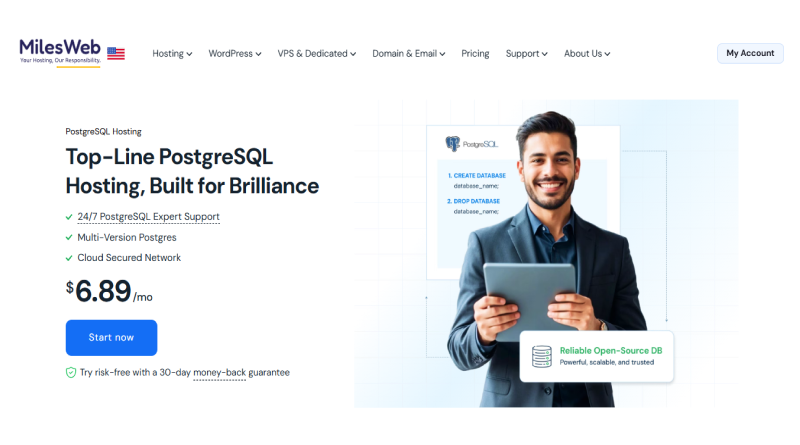
MilesWeb PostgreSQL hosting leverages SSD NVMe drives across global server locations, integrating KVM virtualization with full root access. Their VPS environment supports PostgreSQL versions 10 through 13 and includes advanced data encryption.
Dedicated and VPS hosting services offered by MilesWeb are the best options for SaaS platforms, e-commerce stores, and enterprise workloads where full server control is important. It offers a strong balance between price and quality, enabling businesses to host with dedicated PostgreSQL resources without bearing the overhead cost of large enterprise solutions.
Key Features
- SSD NVMe storage over 32 or more server locations around the world
- Full root access, KVM virtualization
- Supported versions of PostgreSQL 10 to PostgreSQL 13
- At-rest encryption and sophisticated security measures
- No downtime, free migration
- 99.9% uptime with ISO 27001-certified Tier IV data centers
- 1 Gbps network with 24/7 support from experts
- 30-day money-back guarantee
👍 Pros
Several supported PostgreSQL versions
Competitive billing
Local data centers
⚠️ Cons
No free trial available
2. OVHcloud
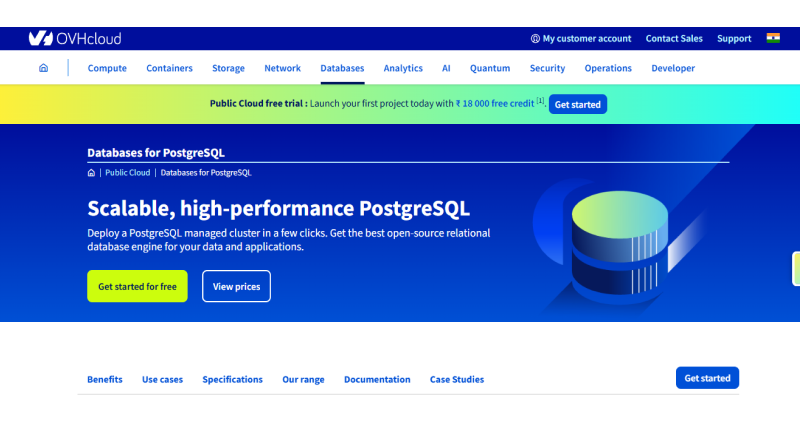
OVHcloud delivers managed PostgreSQL hosting services with the provider handling configuration, maintenance, automated backups, security, and scalability. Three service tiers include Essential, Business, and Enterprise, which differ in node count, SLA, and backup retention.
OVHcloud’s Multi-Availability Zone (3-AZ) regions are architected with true fault isolation, and geographically separated zones introduce independent power, cooling, and network systems. The service is powered by Aiven, ensuring production-ready PostgreSQL capabilities without operational overhead, with an SLA of up to 99.99%.
Key Features
- Database-as-a-Service (DBaaS) managed by public cloud instances.
- Three levels: Essentials (single node), Business (two nodes), Enterprise (three nodes)
- Single Availability Zone with Isolation (3-AZ)
- Automatic daily backup facility
- Support for pgvector and pgvectorscale extensions for AI applications
👍 Pros
SLA guarantees up to 99.99%
Suitable for AI operations with pgvector/pgvectorscale extension
Simple cost calculation per hour or month without any commitment
⚠️ Cons
Challenging upgrade procedures
3. Storm Internet
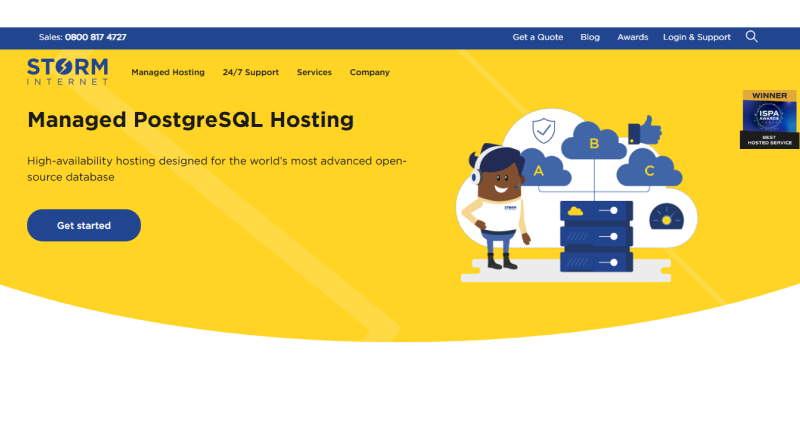
Storm Internet has been one of the renowned British-managed hosting providers since 2004. They craft PostgreSQL hosting services specifically for SMEs and enterprises demanding enterprise-level environments and resources.
The web host offers a cloud environment with dedicated resources and a comprehensive SLA and 100% guaranteed uptime. Each PostgreSQL hosting plan of Storm Internet is backed by 24/7 customer support. Their in-house engineer proactively monitors server resources and fixes security patches.
Key Features
- 100% UK-based Tier 4 ISO 9001, 14001, and 27001-certified data centers
- Dedicated 24/7 Support
- Quarterly Security Metrics: PCI external vulnerability scans
- 75+ global hosting locations
- Powered by 100% renewable energy
👍 Pros
100% UK-based with multiple ISPA Best Hosting awards
Dedicated support pod of 6 engineers
PCI DSS compliant
⚠️ Cons
Premium pricing is not suitable for beginners
Geared toward SMEs and enterprises
4. IONOS
IONOS is a German-based PostgreSQL hosting provider and one of Europe’s largest IaaS/PaaS platforms, offering completely managed PostgreSQL as a Database-as-a-Service (DBaaS) through its UK cloud data centers. As a GDPR-compliant, ISO 27001-certified European cloud alternative designed for data sovereignty.
IONOS Cloud supports PostgreSQL versions 14, 15, and 16, offering fully managed clusters with scalable multi-node high availability, automatic node failure handling, daily backups with point-in-time recovery for one week, and TLS-encrypted client connections through Let’s Encrypt certificates. Maintenance windows are customer-defined to minimize disruption, and clusters can be cloned through backups.
Key Features
- PostgreSQL v14, v15, and v16 compliant
- Daily automated backups
- Multi-node clusters
- Customer-defined maintenance
- 99.95% availability SLA backed by data centers
👍 Pros
GDPR-compliant European infrastructure
Multi-node higher availability
Per-minute billing
⚠️ Cons
No superuser access for PostgreSQL
Log storage shares disk space with the database
5. DigitalOcean
Managed PostgreSQL by DigitalOcean, now on v17 and v18, is available on enterprise-class hardware with automated daily backups, point-in-time recovery (PITR), automated failover, end-to-end encryption using a Secure Socket Layer (SSL), VPC deployment, and query insights such as cached hits percentage, number of connections, and throughput metrics.
DigitalOcean delivers the best developer experience with a clean user interface, simple API, and predictable pricing. It supports pgvector and pgvectorscale extensions, which enable similarity search on vectors and allow AI/RAG workloads to run directly within PostgreSQL clusters.
Key Features
- PostgreSQL v17 and v18 compatible
- Daily backups and point-in-time recovery (PITR)
- Automated failover mechanism
- Autoscaling up to 30TB
👍 Pros
Sleek UI and APIs
pgvector and pgvectorscale are built in and ready to use with AI
Most recent versions of PostgreSQL (v17/v18)
⚠️ Cons
No native billing
No data center in Asian Pacific region has been found
How to Choose the Best PostgreSQL Hosting Provider?
1. PostgreSQL Version Support
Prioritize the PostgreSQL hosting provider offering the latest version support. MilesWeb empowers you to break free from legacy constraints and technical limitations by supporting multiple PostgreSQL versions.
2. Data Center Location
For Asian users, an Subcontinental-based data center that significantly reduces latency. Providers such as MilesWeb offer Tier IV data centers with strong uptime.
3. Security and Compliance
Don’t rely solely on SSL/TLS-based encryption plans; also prioritize role-based access control and compliance with native data residency regulations for controlled industries.
4. Scalability
When your data grows, make sure you get a provider that has autoscaling storage, read replicas, and flexible plan upgrades.
Backups and Recovery
A minimum is automated daily backups. If production workloads are involved, it is best to prioritize Point-in-Time Recovery (PITR) to reduce the risk of data loss.
What Are Different Use Cases for PostgreSQL Hosting?
Use Case
Providers
Resource-intensive platforms demanding peak uptime, redundant power, and fast query response. MilesWeb and CloudClusters are suitable for customers during high-traffic sales events.
Scalable, multi-tenant databases with strong availability. Autoscaling and read replicas become critical once the user base grows. MilesWeb and DigitalOcean meet the higher-concurrency demands of SaaS applications.
AI-powered apps increasingly store vector embeddings in PostgreSQL directly using pgvector. This saves the cost of a separate vector database and simplifies the infrastructure stack. MilesWeb and Storm Internet support AI/ML applications built on PostgreSQL.
Startups require cheap, easy-to-manage PostgreSQL with capacity to scale. Flexible pricing of Kamatera and a money-back guarantee of MilesWeb minimize financial risk and help test product-market fit.
The lowest-priced plan usually does not include automated backups, PITR, or failover services. A database outage or data loss will always cost more than the savings gained through cheap hosting.
1. E-commerce Stores
E-commerce platforms are resource-intensive assets that demand peak uptime, redundant power, and fast query response. Low-latency PostgreSQL hosting providers such as MilesWeb and IONOS are suitable for customers during high-traffic sales events.
2. SaaS applications
SaaS applications demand scalable, multi-tenant databases with strong availability. Autoscaling and read replicas become critical once the user base grows. MilesWeb and DigitalOcean feature autoscaling and read replicas in their plans that meet the higher-concurrency demands of SaaS applications.
3. AI and Machine Learning Apps
The use of AI-powered apps is increasingly storing vector embedding in PostgreSQL directly using pgvector. This saves the cost of a separate vector database and simplifies the infrastructure stack. MilesWeb and Storm Internet are web hosting providers that support AI/ML applications built on PostgreSQL databases.
4. Startups and MVPs
Startups require cheap, easy-to-manage PostgreSQL with the capacity to scale. Flexible pricing of MilesWeb and a money-back guarantee of MilesWeb minimize financial risk for businesses and help them to test product-market fit.
5. Price-oriented Selection
The lowest-priced plan usually does not include automated backups, PITR, or even failover services. An event of database outage or data loss will always be more expensive than the savings gained through hosting.
Which are Common Mistakes to Avoid When Choosing PostgreSQL Hosting?
1. Ignoring Data Center Location
Placing your PostgreSQL database in Singapore or Europe when your users would introduce 100–200 ms of latency, which is significantly detrimental to application performance.
2. Not checking the PostgreSQL Version
There are also providers who continue to provide only PostgreSQL v10-v13. When your app uses more recent features, such as improvements in logical replication, JSON subscripting, or pgvector, an older version delivers performance bottlenecks.
3. Overlooking Backup and Recovery Options
Production workloads cannot be managed with just daily backups. In the absence of point-in-time recovery (PITR), a bug or accidental deletion can cause hours of lost data with no means of recovery.
4. Underestimating Future Scale
Beginning with an architecture that is scalable today and whose upgrade path is not well defined may necessitate a disruptive migration in the future. Single-node plans and fixed storage may become a bottleneck much faster than anticipated.
5. Bypassing the Refund and Trial Policy
Other vendors, such as Utho, do not provide refunds on cloud services. With no free trial or money-back guarantee, you do not have a lot of room to test performance before committing your production workload.
The Closing Line
Choosing the right PostgreSQL hosting provider depends on workload, budget, and where your users are. If your business is cost-conscious, MilesWeb, Storm Internet, and IONOS are reliable managed PostgreSQL providers with local data centers, which are ideal for global users. For SaaS platforms, AI applications, or enterprise workloads that demand the latest features and high availability, MilesWeb, and DigitalOcean are recommended PostgreSQL hosting providers.
Test workloads in the staging environment before any onboarding with a service provider. Verify backup, data recovery mechanism, and version support. A right web hosting provider always scales with applications, keeping data safe and reliable when it matters.
FAQs
1. What is Managed PostgreSQL Hosting (DBaaS)?
It is a database-as-a-service model where the provider manages server infrastructure, OS updates, monitoring, and backups, letting you focus on your data.
2. What is the best PostgreSQL hosting?
MilesWeb offers popular PostgreSQL hosting services stacked with premium features and support for multiple PostgreSQL versions.
3. How to choose a PostgreSQL host?
Consider factors like your budget, the need for high availability, automatic scaling features, database size limits, and ease of use.

The Author
Popular on MilesWeb
Simple Mail Transfer Protocol (SMTP) is one of the key methods used to send and receive emails through the internet. By understanding and utilising SMTP commands, one can troubleshoot delivery…

More articles like this