
 Jackson Lane
A Drupal website often reveals the quality of its hosting long before traffic reports and performance metrics do. As websites evolve, resource requirements, maintenance demands, and performance expectations often look very different from what they did at launch. New content, additional modules, and growing user activity gradually change what a hosting environment needs to handle, making the choice of provider more important than many teams expect.
You can observe these patterns when checking your server logs or timing your database queries. Providers that ignore these specific hardware needs often cause your website to lag when multiple users access content simultaneously. In this blog, we will explore the web hosting companies that provide the specific hardware configurations and dedicated resources Drupal websites often require.
Table Of Content
What is Drupal?
Drupal is an open-source CMS built for those who refuse to compromise on structure. Unlike platforms designed for simple blogging, Drupal hosting platform provides a highly granular, modular framework where you define exactly how your data lives and interacts. Startups and government agencies use Drupal to organize deep content structures, custom taxonomies, and multi-platform distribution.
When you open the backend, you find granular fields for every piece of data, which lets you map out connections between content types. Mapping a database involves organizing how information links and resides within tables. Because the interface handles these relationships directly, you spend your time defining content schemas instead of troubleshooting database limitations.
What Makes a Great Drupal Hosting Provider?
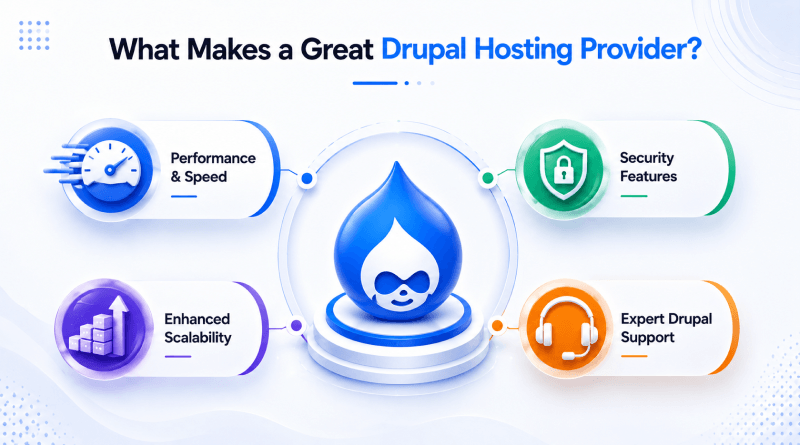
Two hosting plans can look almost identical on paper yet deliver a very different experience once a Drupal website is running. Small details such as storage type, caching support, software versions, and access controls often become far more noticeable after launch than during the buying process.
Performance & Speed
Drupal requires specific hardware to handle constant database reads. NVMe storage loads website files instantly, so you notice the difference every time you click a page or save a change. Using current PHP versions and Redis or Memcached stops your system from repeating complex queries, keeping your backend responsive under heavy traffic loads.
Security Features
Because Drupal powers sensitive enterprise data, security isn’t an afterthought. Your host must provide free SSL certificates, active malware scanning, and robust DDoS protection. Protecting your website means staying ahead of automated threats, and you need infrastructure that filters traffic before it reaches your application core.
Enhanced Scalability
As your traffic shifts, your infrastructure must adapt. You shouldn’t have to migrate your entire setup just to handle a traffic spike. Look for hosts that let you increase RAM, CPU, or storage when needed. If your website gets heavy traffic, you should be able to move to a VPS or dedicated server without much setup or delay.
Expert Drupal Support
Standard support tickets often trigger automated replies that miss the issue. You need engineers who troubleshoot module conflicts, fix database bottlenecks, and handle complex website migrations without losing your content.
Related Read : Top 10 Advantages of Drupal CMS
Which are the Top 5 Best Drupal Hosting Providers?
If you want to migrate to a new host, the companies listed below provide the hardware and support necessary for Drupal. They set the current standard for server response times and technical reliability.
1. MilesWeb – Feature-Rich Drupal Hosting Solution
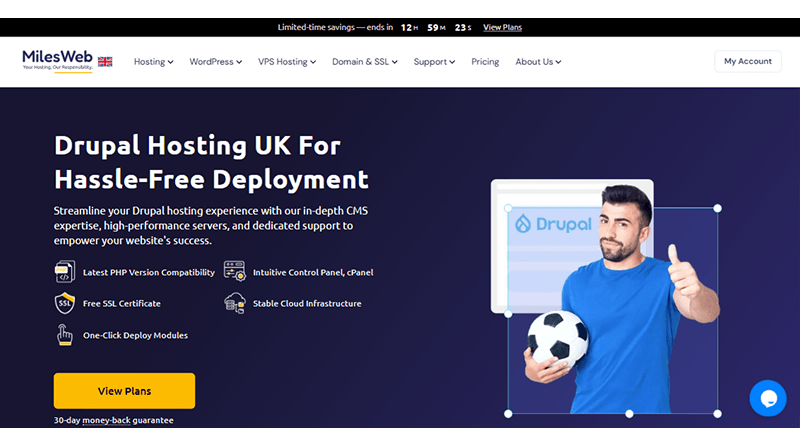
MilesWeb treats hosting as a precision-engineered utility rather than a commodity, making them an ideal partner for those who need high-performance stability without the overhead of complex manual configuration. Their setup comes ready for the specific way Drupal uses resources, as the NVMe storage reads your database files immediately. As a result of this, when you browse a website, the content appears right away.
MilesWeb engineers its infrastructure to absorb load spikes, ensuring your digital presence remains steady and responsive as your user base expands. Since they handle the security patches, updates, and background server settings, your team spends their time writing code instead of fixing server errors.
Key Features
- Drupal Optimized Environment
- SSD NVMe Storage
- Managed Drupal Support
- One-click Drupal installation
- Free SSL and malware removal
2. InMotion Hosting – Power and Precision
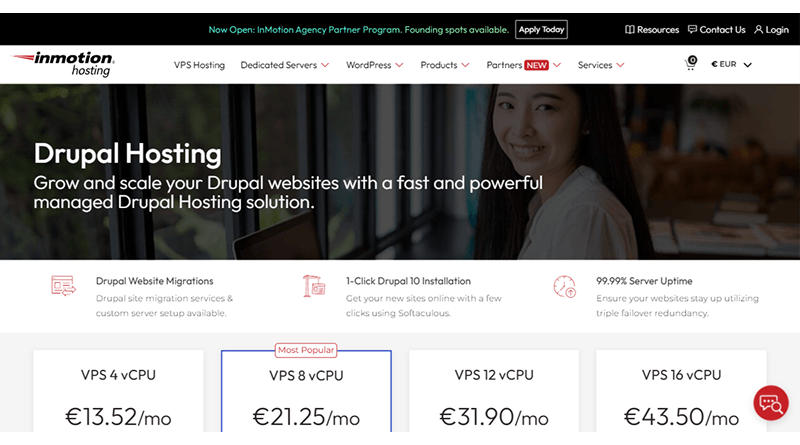
InMotion Hosting operates on a philosophy of “full control.” If your workflow requires the flexibility of a VPS or a custom environment to run the right ERP solutions, this is where you land. Since they own the hardware, you avoid the lag caused by extra middlemen. Your website keeps running even when traffic hits a high peak.
Their “Launch Assist” service helps teams move complex Drupal websites by setting up your configuration for high traffic from day one. Projects that depend on custom integrations and specialized configurations often fit naturally into this type of web hosting environment.
Key Features
- Triple failover redundancy
- Launch Assist Onboarding
- NVMe SSD Storage
- Full Root Access
- Always-on DDoS protection
3. Cloudways – Agility in the Cloud
Cloudways provides a dashboard that controls raw hardware like AWS and DigitalOcean. This avoids typical hosting friction, so the website stays fast as visitor numbers climb. Staging and Git work without needing a server expert. Resources can be scaled on demand to accommodate testing, database operations, or increased workloads without requiring infrastructure changes.
Drupal teams often work across multiple environments during a project. Cloudways keeps those environments easier to manage, whether the task involves reviewing updates, testing integrations, or preparing a new feature for release.
Key Features
- Vertical Scaling
- Choice of top-tier cloud providers
- Pre-configured Varnish, Redis, and Memcached
- Dedicated Firewalls
- 1-Click staging environments
Related Read: Best and Free Drupal Themes : Expert Guide
4. OVHcloud – Built for Large Drupal Deployments
When your Drupal project hits enterprise scale, you often need the pure performance of bare metal server. OVHcloud provides the hardware backbone that powers the world’s most demanding applications. OVHcloud provides the raw, single-tenant hardware needed to power databases for modern applications without interference from other users.
These dedicated configurations let you pick your stack parts, giving you the steady, high-speed CPU cycles needed to handle many Drupal requests at once. OVHcloud’s network and data center footprint also appeal to organizations serving users across multiple geographic locations.
Key Features
- Single-tenant hardware (Bare Metal)
- Global data center network
- Anti-DDoS Infrastructure
- Custom configuration options
- Enterprise-grade SLA
5. Hostinger – Accessibility Meets Power
Hostinger proves that the best Drupal hosting services doesn’t have to be prohibitively complex. This setup links modern hardware with a direct dashboard to make launching complex CMS websites easier. The combination of high-speed NVMe storage and AMD EPYC processors keeps your website fast, even when visitor numbers grow to reach a global scale.
Firewall and DDoS protection are already part of the setup when a project goes live. During routine website maintenance, teams typically move between backups, domains, files, and server settings. Hostinger groups these functions inside hPanel, reducing the need to jump across separate management screens.
Key Features
- AI-managed VPS infrastructure
- AMD EPYC processors with NVMe storage
- Built-in Docker manager
- Continuous security monitoring
- One-click deployments
How does Drupal Hosting differ from Standard web hosting?
A standard hosting plan treats Drupal much like any other PHP application. Drupal hosting starts with the assumption that the website will manage larger databases, more content relationships, and a greater number of background processes. The difference often appears during routine tasks. Publishing content, refreshing caches, installing modules, and running updates strain server resources that standard hosting plans simply cannot manage.
While most providers allow you to host Drupal, few actually optimize their environments to support its specific performance needs. Hosting companies that work regularly with Drupal usually tune their setups for Drupal’s actual workload instead of using a generic PHP setup.
How to choose the right Drupal hosting service provider?
Start with your traffic expectations. Many Drupal projects begin on one type of hosting and outgrow it as the website evolves. At that stage, development teams often need more control over the environment than cheap web hosting plans typically provide.
Bandwidth and storage metrics represent only a fraction of your hosting reality. It helps to review how the provider approaches caching, backups, PHP management, security, and day-to-day administration. Teams managing custom Drupal implementations often pay close attention to staging access, Git workflows, and the amount of control available over the hosting environment.
A hosting plan selected for today’s requirements may need to support a very different website in the future.
Quick Comparison of the Best Drupal Hosting Providers
Choosing the right foundation determines how your website handles growth and technical demands. Review the specs below to see which infrastructure matches your current project requirements.
| Provider | Free SSL | Managed Support | Drupal Optimization | Best For |
|---|---|---|---|---|
| MilesWeb | ✓ | ✓ | Yes | Businesses |
| InMotion | ✓ | ✓ | Yes | Developers |
| Cloudways | ✓ | Optional | Yes | Agencies |
| OVHcloud | ✓ | ✕ | Moderate | Enterprises |
| Hostinger | ✓ | Limited | Yes | Beginners |
Final Thoughts
Drupal hosting is rarely a decision you make based on storage and pricing alone. Your website’s specific build, maintenance routines, and update frequency dictate which hosting environment works best for you.
The providers covered in this blog offer different ways to run a Drupal website. The right choice often depends on the resources you need today, the level of control you expect over the environment, and the way the website is managed on a daily basis.
A hosting provider should support the way your Drupal website operates rather than force changes to your workflow. Syncing your hosting power with your site’s demands turns Drupal maintenance into a frictionless, long-term win.
Frequently Asked Questions
1. Which are the best Drupal hosting providers for comparison?
There isn’t a single provider that fits every use case. A Drupal site with a few hundred pages has different needs compared to a large portal with thousands of entries, custom modules, and multiple editors. The better choice is usually the provider that matches the actual workload behind the site rather than the one with the longest feature list, and in most cases teams consider MilesWeb for VPS and cloud hosting setups suited to that kind of Drupal load.
2. Which hosting is best for Drupal websites?
Many Drupal sites don’t run well on basic shared hosting once content and database activity start increasing. VPS or cloud setups are usually a better fit. MilesWeb’s VPS and cloud plans are often chosen for Drupal sites because they don’t fluctuate in resources the way shared hosting can, especially when the site is dealing with heavy database queries, caching, and regular admin work.
3. Do I need managed Drupal hosting?
Not always. If your team already handles updates, backups, and security, unmanaged hosting works. Managed hosting is a preferred choice for teams that want to eliminate the tasks like routine server maintenance, backups, and troubleshooting.
4. Is cloud hosting better for Drupal?
Cloud hosting solves some problems, but not every problem. Many Drupal websites run for years on VPS environments without issue. Focus on whether the hosting environment provides the specific resources and configuration your website’s usage patterns demand.