
 Jackson Lane
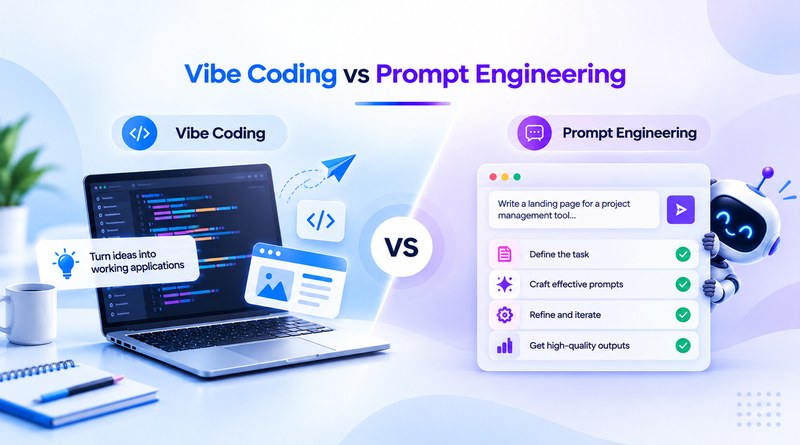
Every line of AI-generated code begins as a sentence in plain language. That sentence can be a quick impression of the desired result or a carefully structured specification, and the difference shapes speed, quality, and cost. Two methods now shape how people do these tasks: vibe coding and prompt engineering. Developers who can effectively utilize both methods and understand their appropriate applications will maximize the benefits of AI.
Each approach also relies on infrastructure that keeps generated code responsive after its launch. Reliable cloud hosting gives prototypes and production services the same stable foundation to grow on. Below, you’ll see what each approach does well, where it falls short, and which is best for your project.
Table Of Content
TL;DR
- Vibe coding converts conversational prompts into working software, and each round of feedback refines the result.
- Prompt engineering writes the rules a model follows, which gives teams answers in a fixed format and a way to test them.
- Vibe coding speeds up prototypes and internal tools. Prompt engineering protects the features that customers depend on daily.
- Teams reach strong results when they start with vibe coding for discovery and apply prompt engineering as requirements settle.
What Is Vibe Coding?
Vibe coding lets a developer state the goal in plain language while an AI model writes the code that delivers it. Andrej Karpathy coined the phrase in early 2025, and developers quickly picked it up as the name for software that builds from a conversation with an AI model. The vibe coding workflow follows a short loop. The developer states an intent, runs the generated result, reviews how it behaves, and sends a refined prompt. Since the loop rewards clear thinking over syntax recall, vibe coding for beginners has become a practical way to enter programming. Experienced engineers apply the same loop to draft features, test ideas, and produce first versions of internal tools in a fraction of the usual time.
What Is Prompt Engineering?
Prompt engineering is the practice of designing, testing, and refining the instructions that guide a language model toward reliable output. Practitioners define the role, context, constraints, and output format for each request, and they attach instances that show the expected result. They also build evaluation sets that measure accuracy across many inputs, so every revision can be compared with the previous version. The outcome is a prompt that behaves consistently across users, data, and model updates. Developers apply this approach to code generation, data extraction, support automation, and any product feature that calls a model through an API.
Related Read : Vibe Coding vs Traditional Coding: A Complete Comparison
What Are the Benefits of Vibe Coding?
The vibe coding benefits below explain why teams adopt the approach for early-stage work. Developers who explore the best Vibe coding tools often notice complete drafts appearing within minutes, which changes how quickly a team can validate an idea.
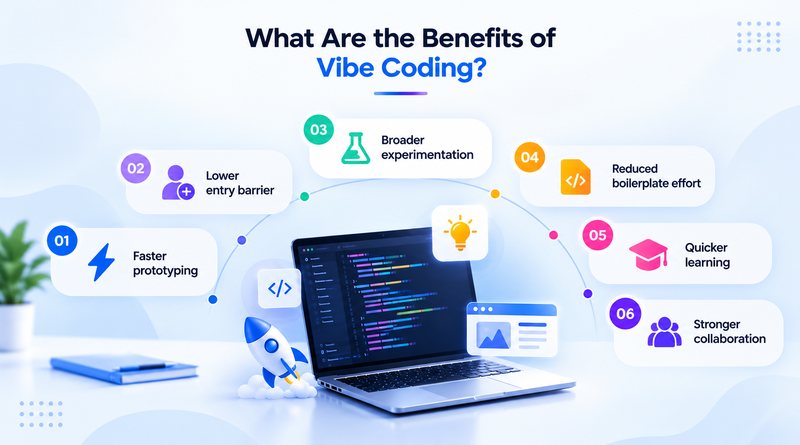
Faster prototyping
Working demos appear within minutes, which shortens the path from idea to feedback. Stakeholders react to a real product instead of a slide deck, so decisions arrive sooner.
Lower entry barrier
Natural language replaces syntax knowledge, so newcomers contribute from the first day. This opens software creation to analysts, designers, and founders who have strong ideas.
Broader experimentation
Teams test several ideas affordably before committing development time. Each experiment produces evidence that guides the next investment.
Reduced boilerplate effort
Routine pieces such as forms, routes, and config files arrive from the model already drafted. The hours saved go toward the parts of the product that set it apart, such as pricing logic, unusual cases, and the screens customers open every day.
Quicker learning
Each generated file is a working example that developers can read, adjust, and reapply. Each prompt becomes a short lesson in how a framework solves a common problem.
Stronger collaboration
Designers and product managers describe features directly and review results immediately. Shared prototypes keep every practice aligned with what the product should do.
Related Read : MilesWeb Launches AI Builder: Powered by Vibe Coding
What Are the Benefits of Prompt Engineering?
Prompt engineering delivers value wherever model output reaches users or connected systems. These six benefits explain why development teams treat prompts as maintained assets, reviewed and versioned like any other part of the codebase.
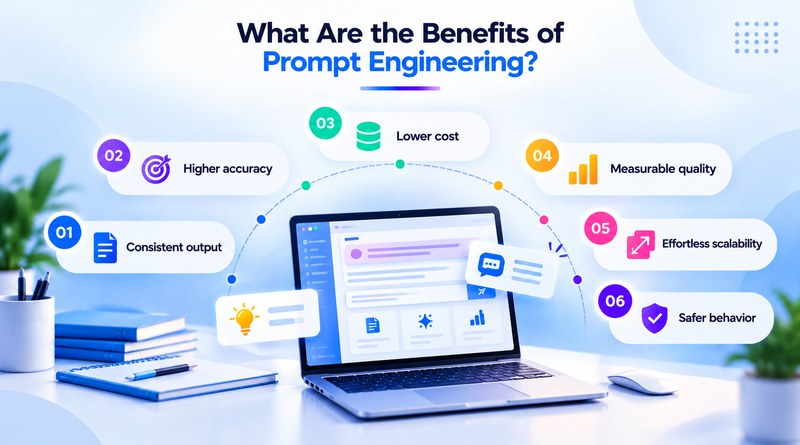
Consistent output
A well-written prompt locks in field names, order, and tone, so the thousandth response looks like the first. Other services in the pipeline can parse that output without special handling.
Higher accuracy
Adding two or three sample answers and a short list of limits tells the model what a satisfactory reply looks like. Reviewers then correct fewer responses, and that time goes back into the product.
Lower cost
Concise prompts and targeted context reduce token consumption per request. At high production volumes, these savings accumulate to provide a significant budget advantage.
Measurable quality
Evaluation sets turn every prompt change into a result that teams can verify. Release decisions rest on data rather than impressions.
Effortless scalability
Reusable templates serve many features, teams, and languages. A single tested prompt library supports growth across the organization.
Safer behavior
Clear limits in the prompt reduce bad responses and protect sensitive data, and they make behavior easier to audit and explain.
When Should You Use Vibe Coding?
Vibe coding performs best where speed and discovery carry more weight than long-term structure. An AI website builder gives teams a convenient workspace for these scenarios. Projects in this category usually have a short lifespan or a flexible scope, so rapid iteration delivers more value than detailed planning. Each scenario below follows that pattern and rewards quick feedback.
Rapid prototypes
Stakeholders review a clickable concept before the team commits to a roadmap. Early feedback shapes the specification while changes remain inexpensive.
Internal tools
A dashboard, admin panel, or helper script can reach colleagues the same day it is requested. Teams swap spreadsheets and repeat manual steps for small applications shaped around how they already work.
Hackathons and demos
Compressed timelines reward rapid iteration and visible progress. Participants spend their hours on the idea and the presentation instead of setup.
Learning projects
New developers build confidence through immediate, working results. Reading the generated code then teaches structure and naming habits.
Landing pages and microsites
Marketing teams launch campaign pages in hours instead of weeks. Copy, layout, and form changes arrive through a short conversation.
Idea validation
Founders test demand with a functional product before hiring a full team. Early feedback from users shows you which features are worth building out.
Related Read : Vibe Coding vs Agentic Coding: Key Differences
When Is Prompt Engineering a Better Fit?
Prompt engineering becomes the stronger choice once model output feeds customers, data pipelines, or automated decisions. The scenarios below share a need for predictable, documented behavior that holds steady as traffic and requirements grow.
AI features in production
A chat assistant or summarizer built on a tested prompt gives every customer the same quality of answer. That quality holds even when traffic doubles overnight.
Data extraction pipelines
A fixed schema with set field names lets each service read the model’s output without guessing. Parsing errors between systems drop as a result.
Customer support automation
Approved tone and policy language stay consistent across conversations. Support teams can focus on reviewing one prompt rather than thousands of replies.
Code generation standards
Prompts encode team conventions for naming, testing, and documentation. New contributors receive output that already matches the repository style.
Regulated environments
When prompts are documented and versioned, you can answer audit questions with a record instead of guesswork. Each release ties back to the exact instructions behind it.
Multi-model workflows
Tested prompts transfer across models with minimal rework. Teams switch providers or upgrade versions with confidence.
Vibe Coding vs Prompt Engineering: What's the Difference?
Security and deployment mark the clearest split between the two approaches. Vibe coding security tools and platform centers on reviewing every generated file, checking dependencies, and keeping credentials out of the repository before release. Prompt engineering security centers on validating user input, filtering model output, and limiting the data a prompt can reach.
Performance goals follow the same split. Vibe coding rewards how fast a team delivers a working version, while prompt engineering rewards how accurately the model answers once real traffic arrives.
| Aspect | Vibe Coding | Prompt Engineering |
|---|---|---|
| Primary goal | Working software through conversation | Reliable model behavior through structure |
| Performance focus | Speed of delivery and iteration | Accuracy, consistency, and token efficiency |
| Security focus | Code review, dependency checks, credential handling | Input validation, output guardrails, data privacy |
| Deployment point | Application release after testing | Model-powered feature inside a live service |
| Skill emphasis | Intent description and rapid review | Instruction design and evaluation |
| Best stage | Exploration and prototyping | Production and scale |
Vibe Coding vs Prompt Engineering: Which Approach Fits Your Project?
The project stage answers most of this question. A team that shapes a new concept, validates demand, or creates an internal tool benefits from vibe coding, because working software arrives within hours and feedback starts early. Small businesses and teams that launches a feature to thousands of customers benefits from prompt engineering, because tested and versioned instructions keep responses steady as traffic grows.
Many successful products pass through both stages. The first sprints rely on conversation to explore options, and the later sprints rely on structured prompts and evaluation sets to secure quality. Reviewing the current stage, the size of the audience, and the cost of an error gives a clear starting point for either choice.
How Does MilesWeb Support Vibe Coding and Prompt Engineering?
MilesWeb provides the infrastructure that carries both approaches from experiment to live service. Developers launch generated applications and prompt-driven services on a scalable cloud VPS that grows with traffic. MilesWeb pairs that flexibility with responsive technical support, so teams spend their energy on product decisions rather than server administration.
Scalable server resources
Hosting resources grow alongside application traffic, API calls, and model workloads. Teams raise CPU, memory, and storage within the same plan, so one environment supports every stage of growth.
Flexible environments
Developers configure runtimes, frameworks, and dependencies for generated code. Custom setups let a prototype and its production version share the same stack.
Steady performance
Stable hosting gives reviewers constant access to the staging website and customers constant access to the production website. Clients can count on the same page loading for every demo and release.
Expert support
A knowledgeable support team answers configuration questions while a project is in progress. Quick answers protect the release date and keep developers focused on the product.
Concluding Insights
Ultimately, the two approaches serve different stages. Production work depends on prompt engineering, because structured instructions keep an AI’s behavior consistent even as usage scales. Vibe coding is what you want in the discovery phase, where a rough idea becomes working software in minutes. Together they form a complete workflow that carries a concept from first draft to dependable service.
The next step is simple. Build a small project with vibe coding and save the prompts that work. Then test and refine them into reusable templates, and run everything on reliable hosting so that each release is faster and more predictable than the last. Do that once, and you’ll have a workflow you can trust.
Frequently Asked Questions
1. What is the difference between vibe coding and prompt engineering?
Vibe coding is building software by describing what you want in plain language and letting an AI write the code. Prompt engineering is writing structured instructions so an AI produces reliable, repeatable results. One is a way of building; the other is a way of controlling AI behavior.
2. Is vibe coding the same as prompt engineering?
No. Vibe coding is a way of building: you describe what you want, and the AI writes the code. Prompt engineering is about control. You write the instructions so the AI gives consistent answers. Most teams vibe code first to get something working, then tighten the prompts before real users get involved.
3. Which is better, vibe coding or prompt engineering?
It depends on what you’re doing. If you’re testing an idea or building a quick prototype, vibe coding gets you there faster. Once real users are involved, you’ll want prompt engineering so things don’t break or change from one day to the next. Most people end up using both: vibe code first, then turn the prompts that work into reusable templates.
4. Can I learn vibe coding without coding experience?
Yes. Pick a small project, like a to-do list or a simple landing page, and see what the AI builds. Reading through the result teaches you a lot. It also helps to learn a bit of basic logic, so you can tell when something’s wrong and ask for a better fix before you put it in front of anyone.