
 Jackson Lane
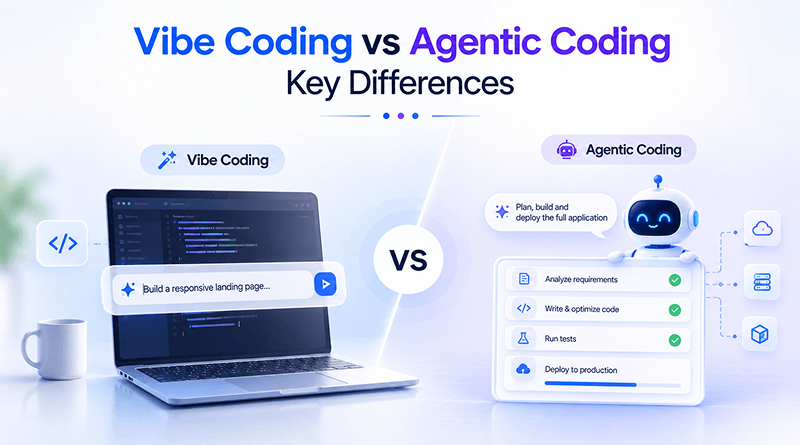
A developer types a rough description of what they want, and a working feature appears minutes later. Another developer sets a goal, steps away from the keyboard, and returns to find a completed task. Two very different pictures, yet both fall under the same broad umbrella of AI-assisted development, and both are reshaping how software is generated in 2026.
People often use these two terms, vibe coding and agentic coding, interchangeably, though each one solves a distinct problem. Teams evaluating cloud hosting environments for their next project need clarity on which approach fits their workflow, since the choice affects deployment speed and long-term code ownership.
In this post, we will explore what separates these two methods, how each one actually works, the practical benefits they bring to a development team, and the situations where one clearly outperforms the other.
Table Of Content
What Is Vibe Coding?
Vibe coding starts with a sentence instead of a specification. A developer describes what they want in plain language, and an AI model turns that description into code, refining it through short rounds of back-and-forth rather than manual, line-by-line construction. The person driving the session maintains control throughout, continuously adjusting tone, structure, and behaviour through follow-up prompts. A landing page or a quick internal dashboard can go from a random idea to something clickable inside one working session, which is why the method holds up best on smaller, self-contained tasks where mistakes cost little to fix.
What Is Agentic Coding?
Agentic coding hands the wheel to the system itself. A person sets a goal, maybe something as broad as “migrate this service to a new database”, and an autonomous agent works out the required steps on its own: planning the sequence, writing the code, running it, checking the results, and correcting course when something breaks. Reasoning across multiple steps, calling external tools, and deciding what to do next without asking for confirmation at every turn are what separate this process from a single prompt-and-response exchange. The payoff is evident in larger, multi-stage projects, which would otherwise demand a developer’s attention for hours at a time.
Related Read: Generative AI Vs. Agentic AI Vs. AI Agents: Key Differences Explained
Agentic Coding vs Vibe Coding: What Sets Them Apart?
Placing these two approaches side by side reveals where their philosophies diverge. The difference between vibe coding and agentic coding is about who stays in charge and how far the AI is allowed to run without checking in.
How Does Vibe Coding Work?
The process behind vibe coding platforms follow a loop rather than a rigid sequence, and understanding that loop makes the method easier to apply.
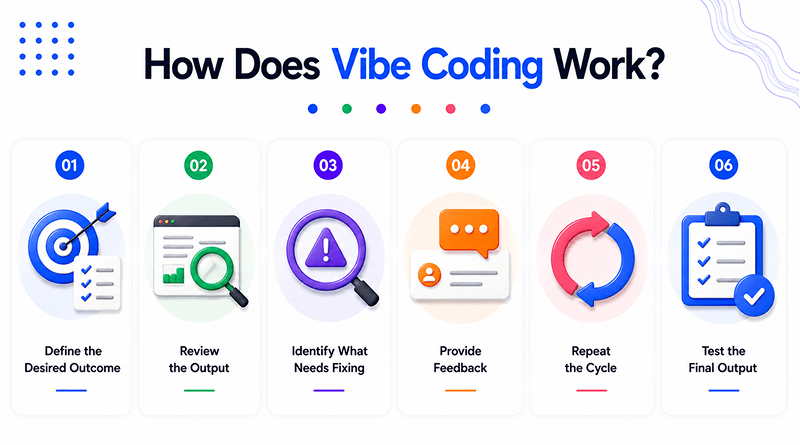
Define the Goal
Express the desired outcome in plain language alongside the required tone, functionality, and constraints.
Review the Output
Compare the generated code or interface against the original request rather than assuming accuracy.
Pinpoint Adjustments
Identify exact corrections needed for incorrect visuals, flawed logic, or absent features.
Deliver Feedback
Provide precise instructions to refine only the targeted section instead of rewriting the entire iteration.
Iterate the Process
Continue the refinement cycle until the result aligns completely with the initial objective.
Test the Final Output
Validate the finished implementation manually prior to public release.
Related Read: What Is Agent Zero AI? Complete Guide to Installation, Safety & Setup
How Does Agentic Coding Work?
Agentic workflows follow a longer arc because the system needs to plan before it acts, and that planning stage separates this method from casual prompting.
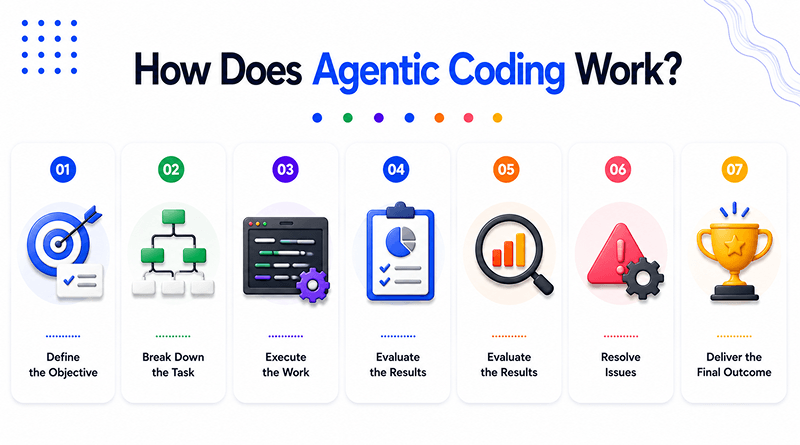
Define the Objective
Establish a clear objective along with any necessary constraints or success criteria.
Break Down the Task
Deconstruct the main objective into manageable, sequential subtasks.
Execute the Work
Write functional code for every subtask, leveraging external tools or APIs wherever required.
Evaluate the Results
Analyze execution outcomes upon completion and immediately flag any failures or discrepancies.
Resolve Issues
Address any detected roadblocks promptly before proceeding further down the pipeline.
Deliver the Final Outcome
Hand over the finished result accompanied by a comprehensive account of all completed actions.
Frameworks such as Hermes Agent demonstrate this pattern well, chaining planning and execution steps without needing a person present for each one.
What Are the Benefits of Vibe Coding?
Best Vibe coding tools brings a distinct set of advantages that explain why it has gained traction across product teams and independent builders alike.
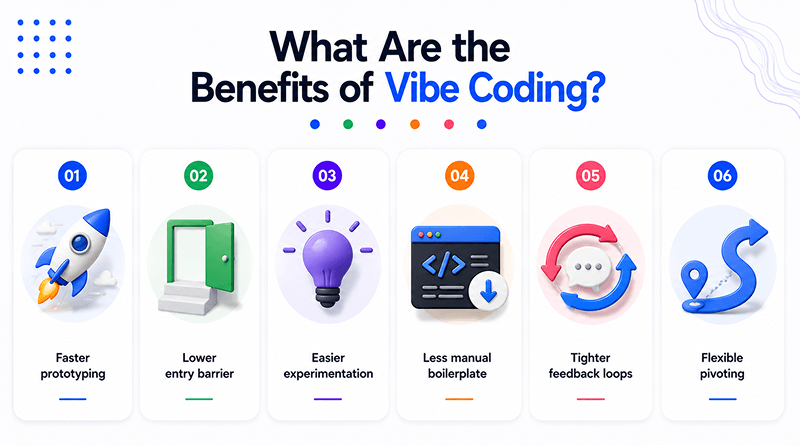
Faster prototyping
An idea can land as something clickable before the excitement around it fades, instead of waiting on days of manual setup.
Lower entry barrier
Someone with no coding background can still build a working feature, since the conversation itself replaces the syntax they’d otherwise need to know.
Easier experimentation
Three or four design directions can get tried out in an afternoon, with none of them costing the hours a rebuild from scratch usually takes.
Less manual boilerplate
The model builds the repetitive, tedious groundwork on the fly, which frees up time for the parts of a project that actually need a person’s judgement.
Tighter feedback loops
A weak idea gets caught within minutes of typing it out, not deep into a development cycle after real effort has already gone into it.
Flexible pivoting
Switching direction mid-project doesn’t cost much, because most builds haven’t accumulated more than a session or two of code by that point.
What Are the Benefits of Agentic Coding?
Agentic coding offers a different category of value, centered on scale and sustained autonomy rather than the raw speed of a single interaction.
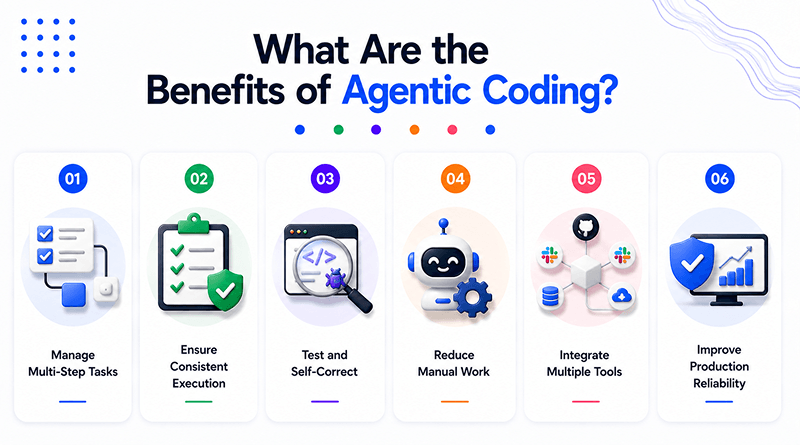
Manage Multi-Step Tasks
Handling of multi-step tasks without constant supervision, since the agent can plan out a sequence of actions and carry each one through before checking back in.
Ensure Consistent Execution
Consistent execution across large or repetitive codebases, applying the same logic and formatting rules everywhere instead of drifting between files or sessions.
Test and Self-Correct
Built-in testing and self-correction during the process, catching failures before they reach a person and adjusting the approach without needing a fresh prompt each time.
Reduce Manual Work
Reduced manual effort on maintenance and refactoring cycles, freeing developers from repetitive cleanup work that would otherwise eat into time spent on new features.
Integrate Multiple Tools
Ability to coordinate across several tools and services at once, moving between a codebase, a terminal, and external APIs without a person switching context for each step.
Improve Production Reliability
Stronger reliability for production-grade deliverables, since the agent verifies its own output against defined boundaries rather than handing over untested work.
Vibe Coding vs. Prompt Engineering: A Quick Comparison
The difference between vibe coding and prompt engineering lies in the outcome, since one produces a well-tuned instruction while the other produces a working application. These two terms often get confused, though they sit at different layers of the same process. The table below breaks down where prompt engineering ends and vibe coding meaning takes over.
| Aspect | Vibe Coding | Prompt Engineering |
|---|---|---|
| Primary focus | Shaping a working application through an ongoing conversation | Crafting precise wording to get the sharpest possible answer from a model |
| Output | A functioning piece of software | A well-tuned instruction or prompt template |
| Skill rewarded | Iterative judgement sustained across a longer build | Precision in language, structure, and phrasing |
| Role of iteration | Refining the product itself across many rounds of prompts | Refining the same prompt until it performs consistently |
| Typical use | Building an interface, feature, or prototype end-to-end | A single interaction meant to extract a specific answer |
Teams experimenting with platforms such as Agenta AI often blend both skills, refining prompts while shaping the broader product experience.
Vibe Coding vs. Real/Traditional Coding: How They Compare
Vibe coding vs. real coding becomes a trade-off between precision and pace, since natural language generation removes much of the manual typing but introduces less predictable control over the implementation. A system that needs exact performance tuning or heavy architectural customisation is still best built using traditional coding.
Vibe coding AI carries little advantage there; its value shows earlier, in the exploration phase before those requirements take shape. Teams often test rapid prototypes on flexible VPS hosting before promoting stable code to a hardened production environment.
| Aspect | Vibe Coding | Traditional Coding |
|---|---|---|
| Control | An AI model generates code from natural-language prompts | A developer writes every function and variable by hand |
| Precision | Less predictable control over the underlying implementation | Exact command over logic and performance |
| Speed | Much faster to a working result | Slower, since every line takes deliberate effort |
| Skill required | Clear, conversational prompting | Deep technical expertise built over time |
| Best suited for | Early-stage exploration and lightweight builds | Systems needing exact performance tuning or heavy architectural customization |
What is the Role of AI Agents in Vibe Coding?
AI agents increasingly operate inside vibe-coding workflows, not as replacements for the conversational process but as support systems that extend it. A vibe coding agent can hold context across a longer session, manage file structures automatically, or trigger tests without a person typing every command by hand. This blending of styles means the line between the two methods continues to soften, since a single project might start as a conversational prototype and gradually pick up autonomous elements as complexity grows. Developers exploring vibe coding AI agents often find that the agent handles routine housekeeping, freeing the human side of the collaboration for creative direction.
When Should You Use Vibe Coding?
Certain moments call for the speed vibe coding apps offers, mainly early in a product’s life or when a misstep won’t cost much.
- A prototype comes together fast enough to test whether an idea holds up at all.
- A landing page or marketing microsite gets built without a developer’s involvement.
- UI concepts get a real look before any engineering time is spent on them.
- Internal tools that won’t stick around long don’t need a heavier process behind them.
- A feature direction gets explored before a formal spec even exists.
- Syntax doesn’t hinder newcomers from grasping programming logic.
When Should You Use Agentic Coding?
Other scenarios call for the sustained autonomy and structure that agentic coding delivers, especially where scope or repetition would overwhelm a manual process.
- Migrating a large codebase to a new framework
- Running automated test suites across an entire application
- Managing recurring server maintenance tasks like dependency updates
- Coordinating multi-service deployments with several dependencies
- Handling data pipeline construction from source to output
- Executing long research-to-implementation cycles with minimal check-ins
Where Vibe Coding Meets Automation
The most intriguing developments happen where these two approaches overlap rather than where they stay separate. A prompt-driven session might start as pure vibe coding, then pass repetitive verification steps to an autonomous layer that runs tests and flags anomalies without further conversation.
Infrastructure teams already rely on tools like Zabbix to monitor systems generated in this manner, identifying irregularities before they impact end users. Vibe coding automation represents this convergence directly, pairing the creative strengths of one method with the discipline of the other and pointing towards a future where the two approaches collaborate within the same pipeline.
Related Read: Zabbix Dashboard & Templates: Building Custom Monitoring Views
Concluding Insights
Vibe coding and agentic coding answer different questions about how software is constructed and built. Vibe coding rewards a fast, conversational relationship between a person and a model, ideal for prototypes and early-stage ideas that need to move quickly. Agentic coding rewards a structured handoff of responsibility, suited to complex work where sustained autonomy saves more time than constant supervision ever could.
Neither approach replaces the other, and strong development teams will likely draw on both depending on the task at hand. As AI agents grow more capable of reasoning and executing without constant guidance, the boundary between a quick creative session and a fully autonomous build process will continue to narrow, opening space for developers to spend more time on the ideas that actually shape a product.
Frequently Asked Questions
1. Is agentic coding more advanced than vibe coding?
Not exactly. Agentic coding depends on the system’s own reasoning to plan and execute each step. Vibe coding depends instead on how well the model follows natural language, with a person still steering most decisions. They solve different problems, not a harder and easier version of the same one.
2. Can you combine vibe coding and agentic coding in the same project?
Yes. A project often starts as a conversational, prompt-driven build, then shifts towards autonomous agents once the scope grows. The two sit on a spectrum, so moving between them is common.
3. Is prompt engineering a prerequisite skill for vibe coding?
Not strictly. Vibe coding tolerates conversational instructions since correction happens along the way. Strong prompting just means fewer revision rounds, not a requirement to get started.
4. Which approach is closer to traditional software engineering?
Agentic coding. It mirrors the structured planning, building, and testing sequence of traditional engineering, just executed by an AI system. Vibe coding replaces that structure with an improvisational exchange instead.