

 Grace Cornish
Choosing the right programming language is like selecting the ideal vehicle for a journey. Each one serves a specific purpose, just as different modes of transport give you the best path to your destination.
- For example, C++ is like a Formula 1 racing car – it’s fast, powerful, and performs exceptionally well in the hands of an experienced driver, but it wouldn’t be the best choice for a single job.
- Python, on the other hand, is something like a good-quality, fuel-efficient family sedan – it’s easy to work with and will meet the majority of your needs.
- On the other hand, JavaScript is like a taxi in the city – it can be found 24 hours a day and can help you get where you need to go, especially in the area of web development tools.
- Similarly, Java is like a semi-truck built for long-haul transport, allowing you to make multiple shipments of identical items and thereby enabling your business to handle large volumes of items reliably over time. No one programming language is necessarily “best”; all exist because the problems they solve require unique tools.
Programming languages are no longer just a matter of preference for technical merit.
- They affect how quickly you can accomplish tasks.
- How much will they cost to create?
- How scalable will the overall solution be?
- The level of innovation that can occur through the use of each language.
This blog starts by moving beyond surface comparisons. Here, you’ll find an exploration of real-world use cases, scalability, developer experience, and career impact—empowering you to choose the right programming language for your goals.
In future, Python hosting will dominate the AI, data science, and automation space. JavaScript will continue to drive the majority of the web. Java will be the backbone of enterprise systems, and C++ will continue to excel in applications where performance is mission-critical, such as gaming and systems programming.
Useful Read: Top 15 Python Alternatives: Faster Programming Languages
Summary (TL;DR)
Choosing between Python, Java, C/C++, and JavaScript ultimately comes down to your project requirements and development priorities.
Python excels in simplicity, readability, and rapid development, making it ideal for AI, data science, and automation.
Java offers platform independence and robustness, making it a go-to for enterprise-grade and Android applications.
C and C++ deliver unmatched performance and low-level control, which is why they dominate system programming and high-performance computing.
Meanwhile, JavaScript is the backbone of modern web development, enabling dynamic, interactive front-end experiences and scalable back-end solutions via Node.js.
In practice, no single language is “best”—each serves a distinct purpose, and modern development often involves combining them based on performance needs, scalability, and use case.
Table Of Content
Core Comparison: Python vs. Java, C++ and JavaScript
| Language | Typing | Execution Model | Memory Management | Primary Strength | Learning Curve | Execution Speed | Syntax Complexity | Top Frameworks |
|---|---|---|---|---|---|---|---|---|
|
Dynamic | Interpreted | Automatic (Garbage Collector) | AI/ML, Data Science, Rapid Dev | Very Easy | Slower | Minimal, readable | Django, Flask, FastAPI |
 |
Static | Compiled to bytecode (JVM) | Automatic (GC via JVM) | Enterprise, Android, Backend | Moderate–Hard | Fast | Verbose, structured | Spring Boot, Hibernate |
 |
Dynamic | Interpreted / JIT | Automatic (GC) | Frontend, Full-Stack Web | Moderate | Fast (V8 JIT) | Flexible, quirky | React, Node.js, Vue |

|
Static | Compiled to machine code | Manual (Pointers) | Performance-critical Systems, Gaming | Hard | Fastest | Complex, low-level | Unreal Engine, STL |
Similar Read: Best Python IDEs: Top Tools Making Coding Easier for Developers
A. Python vs. Java
Picture two experienced boardroom professionals—Python brings a clear message articulated in plain English and can get the point across in minutes. Meanwhile, Java is a formal and structured presentation with a lot of detail and precision.
Also Read: The Best Free Java IDEs for Developers: Boost Your Productivity
1. Structure vs. Clarity in Syntax
The structure of Python resembles executable pseudocode, clean, concise, and easy to read, where a single code line is enough for printing. However, Java requires much more preparation than just a simple line of code to print. With Java, developers must create classes and methods and declare types before printing the output.
Thus, Java leads to longer statements, making it more verbose and potentially slowing you down as compared to Python. For large, complex systems, scale your application with Java to benefit from its design rigor, strong typing, and long-term maintainability.
Additionally, Java has its long-standing principle, “Write Once, Run Anywhere,”. This happens because through the Java Virtual Machine (JVM), your application can consistently run on any platform. Therefore, it is often chosen as an enterprise system due to this level of reliability.
2. Speed vs. Flexibility in Performance
Think about your application’s demands: if speed and multi-threading are priorities, explore Java’s JIT compiler.
Python executes code step by step and is limited by the Global Interpreter Lock (GIL), which restricts parallel execution. While this makes Python slower in raw performance, it remains sufficient for most applications with proper architecture.
3. Use Cases
Python has a large ecosystem hence, it’s widely used in AI, machine learning, and quick development. The strength of Java is in its use for big enterprises, server infrastructure, and high-performing applications.
As a result, Python is faster to develop with, less hassle, and straightforward, whereas Java is scalable, structured, and performance-based.
Useful Read: Laravel vs. Python vs. Node.JS: Understand Their Differences
B. Python vs. JavaScript
Both JavaScript and Python are extremely popular programming languages and have developed from their original applications into different business platforms.
Also Read: Best IDE for JavaScript: A Perfect Developer’s Guide
1. Frontend vs. Backend
What is Javascript? On the front end, JavaScript has virtually no competition. Approximately 98.9% of all websites use JavaScript for dynamic behavior within the web browser (e.g., updating an element on the web page without refreshing). The introduction of frameworks such as React, Vue, and Svelte has helped to further solidify JavaScript as the dominant player. It allows developers to create highly responsive user interfaces using JavaScript code.
Learning Material: How to Create a Website Using HTML
Since Python does not run in a web browser, its strength is in backend development, providing simplicity and productivity to developers building server-side applications. Frameworks such as Django, Flask, and FastAPI allow developers to build robust server-side applications rapidly. For example, Django has a great deal of built-in functionality.
For e.g., user authentication, object-relational mapping, and admin interfaces are extensively used as the foundation for businesses like Instagram. Flask is used primarily for building lightweight and flexible stand-alone applications. However, it is also used to build more complex applications once they have started.
2. Development Speed with Node.js
With the introduction of Node.js hosting, there has been a significant shift in the development landscape. Developers can now build full-stack applications using JavaScript on both the frontend and the backend. This approach saves developers time instead of switching between multiple programming languages. Thus, single-person development teams that use JavaScript can complete their projects much faster than their counterparts who are using Python or other languages for their frontend or backend development.
Read Also: Node.JS vs. Python: Which Technology Should You Go With?
When it comes to chat applications and live updates, there is arguably no better option than Node.js. Benchmark testing shows Node.js frameworks (e.g., Express, Fastify) can process upwards of 50,000 requests per second compared to roughly 8,000 to 15,000 by Python frameworks (e.g., Django, Flask) using the same hardware. That said, Python excels at CPU-bound work and large datasets because of its highly optimized libraries.
3. Collaborating JavaScript and Python
By the end of this year, Python and JavaScript will have become collaborators instead of competitors. Today, many modern applications are built using both: Here, Python handles the backend logic and data processing, while JavaScript is responsible for the front-end user interface, it also has the best JavaScript frameworks to work with.
Python development is on an upward trajectory, particularly with its use in artificial intelligence (AI), data science, and DevOps, along with tools like the OpenAI and Hugging Face APIs. On the other hand, JavaScript will dominate frontend-related development and will be the logical choice for full-stack web projects moving forward.
In summary, there is no longer a debate between JavaScript vs. Python; it is now simply determining how each language is best utilized.
C. Python vs. C++
C++ and Python differ significantly in philosophy when coding. Python is designed to give developers greater control, while C++ allows machines to control.
1. Memory Control: Simplistic versus Complicated
With Python, developers do not need to have any experience with memory allocation and deallocation. The built-in garbage collection handles these issues automatically, allowing developers to concentrate strictly on the development. As a result, development is faster with fewer mistakes. However, the drawback here is that it generates additional overhead that diminishes the performance of resources.
When working with C++, you have complete memory control available for your application. Thus, you can optimize and utilize resources efficiently. However, you need to manually allocate memory spaces for your resources, and you will be required to release that memory when no longer used. You can easily create memory leaks or other types of pointer-related mistakes if you do not manage your resources properly. C++ expects the developer to manage the system, while Python encourages the developer to trust it.
2. Speed: Processing vs. Productivity
C++ is by far the fastest of the two languages when raw speed is considered for performance. Since C++ is a compiled programming language, all code is converted directly to machine-readable code before it is executed. This is the reason why C++ is 10-100 times faster than Python code. C++ is used for high-frequency trading, AAA games, operating systems, embedded systems, and real-time applications, where ensuring that every microsecond matters is a requirement for the application.
Python is interpreted and usually has a slower speed than compiled languages when working on pure computation tasks. It works well for use cases where fast and maximum performance is required with optimized libraries.
3. Python Powered by C++
The most intriguing part about using Python for performance is that the speed of Python programs is reliant on code written in C++. The major scientific libraries utilized by scientists and data enthusiasts today, such as NumPy, TensorFlow, PyTorch, and Keras/VOS, are all built upon C or C++ code.
So, when running Python code that contains heavy computational operations (like performing operations on extremely large matrices), what you’re really doing behind the scenes is executing some highly optimized, compiled C/C++ code. This approach combines the best of both worlds, with Python as a “glue” language that enables simple and readable library interactions. At the same time, developers can rely on the raw performance of C/C++ under the covers to handle all the CPU-intensive work.
Thus, on one hand, you have the rapid development, iteration, and ease of use of Python, and on the other hand, the utmost performance and efficiency of C++. In day-to-day practice, they’re often used together—the rationale being to use Python to develop quickly and create interesting solutions while using C++ to execute at the highest possible speed when necessary.
Strategic Analysis: Which Language Wins Where?
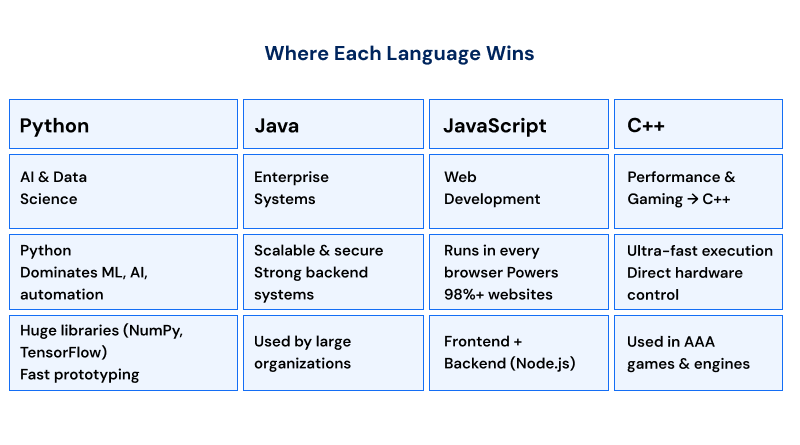
It is not enough to learn programming languages by benchmarks or syntax alone. They must be learned for their real-world industry dominance. Each language (Python vs. C++ vs. Java vs. JavaScript) not only exists but also dominates its own market.
1. Artificial Intelligence & Data Science
Python serves as a prime example of how a programming language can align with an industry. It is not known for raw execution speed, but it provides high development velocity. Developers take their ideas from the idea stage to a working model quickly because Python has developed a mature ecosystem over the decades.
Many foundational libraries, such as NumPy and Pandas, have been incorporated into machine learning libraries like Scikit-learn. This incorporation paved the way for deep learning frameworks such as TensorFlow and PyTorch. While TensorFlow is the most popular for building production AI systems, PyTorch dominates academic research, appearing in up to 85% of published deep learning papers.
The numbers reinforce this leadership:
- Python holds about 68% market share in data science.
- 84.6% of data science job listings require Python.
- 45.7% of recruiters actively seek Python developers
Additionally, Python is heavily utilized in contemporary artificial intelligence processes. It is used as a basis for building recommendation systems, real-time inference systems, and large-scale deployments of the systems. Furthermore, Python is compatible with a variety of tools, including OpenAI APIs and Hugging Face, making it highly relevant going forward in our future.
Bottom line: Python does not simply lead in terms of AI but also is the language through which contemporary AI has been built.
2. Video Game Development
As the foundation of high-performance game development, C++ remains the dominant programming language used by AAA developers. While many assume that this fact is based on past experience, it is actually due to technical constraints.
Modern video games represent some of the most complex pieces of software that have ever existed. Each frame processes tasks simultaneously, including rendering graphics, simulating physics, carrying out AI computations, establishing network connections, and producing sound effects. All of these occur within a span of milliseconds.
C++ excels here because:
- It compiles directly to native machine code.
- Offers deterministic memory control
- Provides low-level hardware access
Game engines such as Unreal Engine 5 utilize C++ as the primary programming language for core systems (e.g., rendering, physics, and real-time graphics). While many game development engines use higher-level programming languages (e.g., Unity uses C#), they still rely on C++ within their core runtime components.
C++ is also essential in:
- Real-time simulations
- VR/AR systems
- Embedded systems in gaming hardware
3. Enterprise Applications
When we think of enterprise software, Java is at the top of the hierarchy for software authoring. It’s the system behind almost everything in the world, from finance to healthcare to logistics to telecommunications. Java’s strength lies in stability, scalability, and a foundational base for constructing enterprise software.
Key reasons for Java’s dominance include the following:
- Strong typing and structured architecture
- Robust concurrency support
- Mature ecosystem and frameworks (like Spring Boot)
- Cross-platform compatibility via the JVM
The scale of its adoption is massive:
- 99% of enterprises use Java
- Nearly 70% run at least half their applications on Java/JVM.
Currently, a large proportion of enterprises run at least 50% of their applications in a Java/JVM-based environment.
Many enterprises, including financial institutions and cloud providers, are dependent upon the Java JVM as the primary system for their mission-critical systems. In addition, Java’s concurrency model enables it to affordably process large-volume workloads, making it an optimal platform for applications.
Learning Material: Learn Programming in Your Spare Time
4. Web & Interactive UX
JavaScript is an important programming language; it’s the only programming language that can run “natively” in the browser, meaning that it has complete control over web user experiences. As a result, JavaScript has become the most widely used programming language in the world.
According to a recent statistical analysis of development:
- 98.9% of all websites are built with JavaScript.
- 66% of all professional software developers use JavaScript as their primary language.
JavaScript powers all dynamic web experiences: animations, clicks, dynamic page updates, and interactive elements. No other programming language will ever replicate its capabilities on a web browser.
Current JavaScript frameworks have extended the capabilities of JavaScript:
- React has approximately 44.7% of the market for frontend development.
- Angular has almost 100% of the enterprise app market.
- Vue has created a niche for small development teams.
- JavaScript has also expanded its influence beyond the web browser:
- Node.js has emerged as the go-to solution for creating backend applications.
JavaScript is used to build mobile applications (React Native), desktop applications, and APIs. JavaScript also enables the creation of real-time systems using WebSockets. The biggest advantage of JavaScript is that all developers use one programming language for both frontend and backend development. This reduces development complexity and allows smaller development teams to become more productive.
Wrapping Up
All four languages are dominant in certain areas: Python is mainly found in AI and data science because it “exists” for rapid development. C++ is found in gaming/high-performance systems for real-time computing. Java is used to develop enterprise-level, mission-critical systems, and JavaScript is used to produce user interfaces or UX across front-end (web) and back-end coding.
The key point is that no single language has won customer usage throughout the technology economy. Each language (Python, C++, Java, and JavaScript) completely owns a manufacturing domain of its own.
Selecting any of these programming languages carries minimal risk; the real concern lies in making decisions based on the wrong criteria. You should not pick a programming language just because it is trendy right now. Similarly, do not copy a competitor’s technology stack without thinking.
If the language doesn’t fit your organization’s specific needs, you will lose more than just time and money—it can actually damage people’s careers. Instead, always base your choices on your organization’s specific goals, needs, and framework.
FAQs
1. Which language is better for beginners: Python vs. C++?
Of course, Python is the easy option. Python has easy code to read that even looks like plain English and has minimal “boilerplate” code. When new programmers work on writing their first coding project with Python, they take only minutes to write their first working project! On the other hand, C++ has a longer ramp-up time (weeks) just to write an acceptable program. Thus, with C++, the programmer first learns what “pointers” are and how to manage and track memory allocation, among other things.
2. How does Python vs. JavaScript compare for web development?
JavaScript is predominant on the client-side through frameworks like React and technologies like Vue.js and Svelte. While Python continues to excel at developing server-side applications on platforms such as Django, Flask, and FastAPI. The primary advantage of Python in web development is AI. It is considerably easier to incorporate intelligent, data-driven features into web applications using Python’s toolkit than it is with JavaScript.
3. Is Python faster than C++ in real-world applications?
The answer to Python vs. C++ depends on the application you are working with. When comparing execution times between C++ and Python, C++ is typically between 10 and 100 times faster, making it a necessary choice when microseconds matter. On the other hand, if your building process is key to your success, then Python is significantly faster than C++. If your concern is the app production speed, then select Python, and if it is the speed of the application, select C++.
4. Python vs. PHP: Which is better for web development?
For developing websites, PHP has always been the best tool, especially when creating CMS or web-based content. However, Python is a highly versatile, general-purpose language widely adopted for building data-driven and AI-powered applications. Thus, when planning for new projects requiring artificial intelligence integration, scalability, or the development of data pipelines, Python is ideal.