

 Grace Cornish
We all know that the internet never sleeps. While you’re reading this blog, dozens of new domain names have already been registered somewhere in the world.
By early this year, the global tally of domain name registrations reached approximately 386.9 million. This figure shows a rise of 6.2% in the past year, as approximately 62,000 new domains are being added on a daily basis, or around 22.7 million a year.
All types of companies and organizations know that having a corporate website is important for establishing their online presence. Both traditional websites ending with a .com extension and modern versions such as .ai, .app, and country extensions like .uk show ever-growing trends within this industry.
If you have questions such as how many were registered or what the total number of domains around the world is today, this guide reports the new numbers for the current year, development patterns in the domain market, and their interpretations.
Domain Registration Snapshot
Short answer: As of this year, there are approximately 386.9 million registered domain names worldwide, reflecting an annual growth of 6.2%, with nearly 62,000 new domain registrations every day.
Table Of Content
How Many Registered Domain Names Exist Right Now?
As per the statistics from this year, the total number of registered domains across the world is estimated to equal approximately 386.9 million. This figure is inclusive of generic TLDs (gTLDs), such as .com, .net, and .org, and many other country-code TLDs (ccTLDs) like .in domain extension, .uk, and .de, as well as hundreds of other new domain names such as .app, .shop, .tech, and the increasingly popular .ai.
Although the growth rate is not as rapid as it was during the early Internet era, the current number of registered domains indicates a stable interest in obtaining online identities. Every day new companies create new websites and reserve domain names. Many developers and individuals register domains for their applications, new blogs, portfolios, and web shops. However, expired domains are either lapsed or removed from the database, so the reported number represents a net registration rather than the total number of domains created.
Global Domain Registration Statistics (2026)
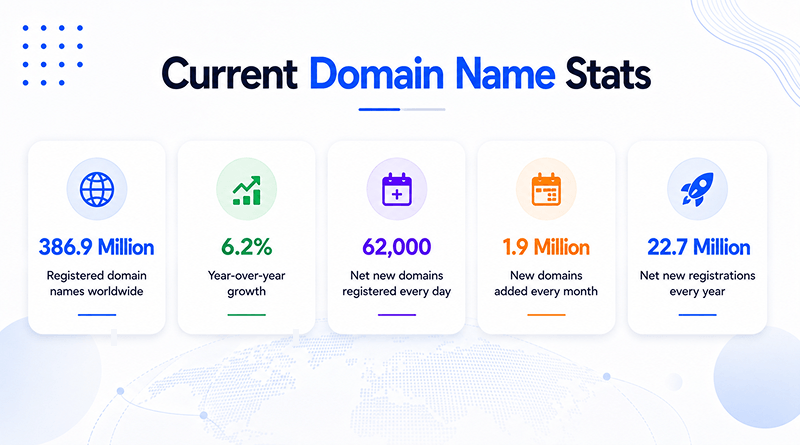
📌 Note: The statistics presented above were accurate at the time of writing this article and are intended for informational purposes only. Domain registration numbers, growth rates, and related metrics change continuously as new domains are registered and existing ones expire. Therefore, the figures may differ by the time you read this article.
📊 Source: Compiled from the latest Domain Name Industry reports and global domain registry statistics (2025–2026).
📊 Source: Compiled from the latest Domain Name Industry reports and global domain registry statistics (2025–2026).
What do these numbers actually mean?
When one inquires about “How many registered domains are there?” The response refers to the active domain registrations managed by domain name providers worldwide. A registered domain means that the users bought a specific name and applied it for their own purposes.
However, remember a registered domain does not necessarily mean it’s active on a live website.
Users register domain names for multiple reasons, including:
- Reserved for possible future business plans
- For communication via emails
- Directed to other domains
- For further reselling options
- To protect a brand from competitors
The domain industry has also changed significantly for the last decade. Though it is still accepted that .com is the most common extension, businesses currently use more than 1200 different extensions and choose an appropriate name that meets both their industry and country of operation.
The increasing roles of AI startups, e-commerce companies, personal brands, and SaaS initiatives are the main reasons for the high demand for new domain registrations.
Why Do Domain Registrations and Websites Differ?
It is widely believed that domain names and websites are basically the same things because they are closely related. Although they are connected to each other, domain names and websites are not identical. Therefore, the question of how many websites there are in the world differs from the question of how many domains exist.
Over 1.1 billion websites are available on the Internet this year; however, only about 18-20% of them are considered active. In simple terms only those websites perform their functions and are updated. The remaining websites are inactive, parked, not yet developed, or not maintained. Thus, you can understand the difference between the two figures: 1.1 billion websites with only 18-20% active ones, while there are roughly 386.9 million domain names in use around the world.
Understanding The Differences between Domains and Websites
The domain name gives a person a unique site address that is used in the browser, such as example.com. A website consists of the web pages, files, applications, information, etc., through that domain name. You don’t have to build a website for every purchased domain, and a single domain can also be used to host many websites.
Here is a simple breakdown.
- A domain name is similar to a street address.
- A website is a building located at that address.
Let’s understand in detail why there are differences between domain and website numbers.
1. One domain can host multiple websites
The role of technology and business reasoning in the situation is outlined in the following points.
For example:
- blog.example.com
- store.example.com
- support.example.com
- developers.example.com
Thus, every subdomain can work like an independent site with a specific design, material, and target, yet all the subdomains will remain parts of a single domain.
Many business giants like MilesWeb, Google, Microsoft, and Amazon actively use this approach to provide various services under one corporate umbrella.
2. Domains are registered without active websites
Although there are millions of registered domains, not all of them point to active websites.
The reasons for this situation include:
- Achieving brand protection (ensuring competitors don’t register similar domain names)
- Domain investment purposes
- Future projects
- Using domains only as email accounts
- Parking domains temporarily
In simple terms, a startup may register the domain name based on its brand long before the actual operation of the brand gets started.
3. Free website platforms
Many online resources function through shared platform domains rather than their own domain names.
Here are some examples:
- username.wordpress.com
- myshop.shopify.com
- username.github.io
- project.netlify.app
All of these web pages can work without registering a domain name.
Website vs. domain at a glance
Domain Name vs Website
| 🌐 Domain Name | 💻 Website |
|---|---|
| A unique internet address | The content or application users access |
| Must be registered through a domain registrar | Built using HTML, CMS platforms, or web applications |
| Can exist without a website | Usually requires a domain or subdomain to be accessible |
| One domain can host multiple websites | One website can also be accessible through multiple domains |
How Many Types of Domains (Top-Level Domains) Are There?
If you’ve ever wondered how many types of domains there are, the answer starts with a detailed review about top-level domains.
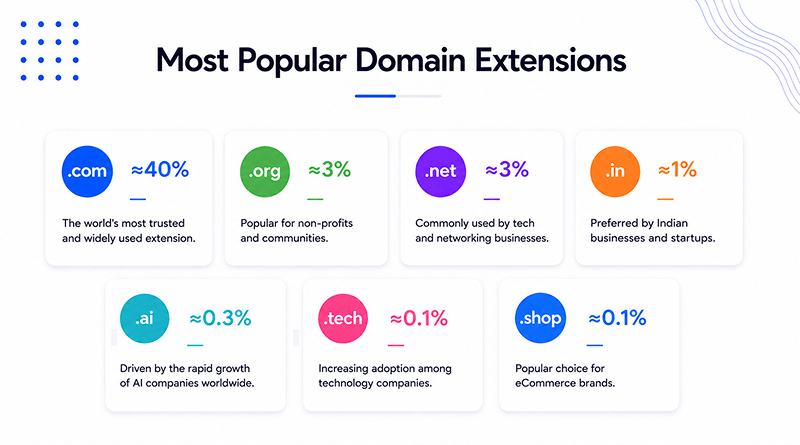
A top-level domain is that extension that appears at the end of a domain name, i.e., ‘.com’ in ‘milesweb.com‘ or ‘.org’ in ‘example.org.’ As per the current trend report, by this year, there will be more than 1,200 distributed TLDs worldwide.
All of them are overseen by the Internet Assigned Numbers Authority, and their use is coordinated through ICANN (Internet Corporation for Assigned Names and Numbers). These 1,200 TLDs include the most common commercial TLDs, country-specific ones, and several newer online industry-specific TLDs that have appeared in the past years.
Even though there are more than 1,200 of them, all TLDs can be divided into three major groups:
1. Generic top-level domains (gTLDs)
Generic top-level domains are the most popular and widely used types of TLDs that can be registered by basically anyone and are not country-specific.
Some of the most popular generic TLDs include:
Popular Generic-Level TLD Domain Extensions
.com
Businesses, brands, and personal websites
.org
Non-profit organizations and community websites
.net
Technology companies and networking services
.info
Informational websites and knowledge resources
.biz
Business and commercial websites
The .com domain extension continues to be the most prominent one, representing around 40% of total global domain name registrations. Its international appeal adds to its reputation and makes it the best choice for companies, big or small.
2. Country-code TLDs
Country-code TLDs consist of two letters that stand for a specific country or territory. While several of them are designed for local entrepreneurs or inhabitants, the others managed to become popular on the international market thanks to their branding potential.
Examples include:
Popular Country-Code Domain Extensions (ccTLDs)
Country-code domains help businesses establish a strong regional identity while targeting specific geographic markets.
| Extension | Country / Territory | Popular Use |
|---|---|---|
| 🇮🇳 .in | India | Indian businesses and startups |
| 🇬🇧 .uk | United Kingdom | UK organizations |
| 🇩🇪 .de | Germany | German websites |
| 🚀 .io | British Indian Ocean Territory | Tech startups and SaaS companies |
| 🤖 .ai | Anguilla | Artificial intelligence companies |
| 💼 .co | Colombia | Global business and startup branding |
Domain suffixes such as .io, .co, and .ai are now known internationally, although they are technically country-specific suffixes. The initial appeal of these suffixes lies in their catchy abbreviations, especially for technology-based companies and startups.
3. Sponsored and new generic TLDs
The new gTLD program led by ICANN began in 2012, introducing hundreds of domain suffixes based on specific industries and professions. The aim of this program was to avoid over-reliance on the .com suffix.
Popular examples include:
Popular New gTLD Extensions
Modern generic domain extensions designed for specific industries, businesses, and online communities.
| Extension | Best For |
|---|---|
| 📱 .app | Mobile and web applications |
| 🛒 .shop | Online stores |
| 💻 .tech | Technology businesses |
| ✍️ .blog | Blogs and content creators |
| 🌐 .online | General-purpose websites |
| 🏬 .store | E-commerce businesses |
| ⚙️ .dev | Software developers |
| ☁️ .cloud | Cloud computing companies |
The newer TLDs are great options to create stronger branding for businesses, especially if the preferred .com domain name is already registered. For instance, a software company may go with ‘company. tech domain name, while an e-commerce site can register a ‘brand.’ shop to better convey what they do.
Which type of domain should you choose?
Choosing the right TLD depends on your goals:
- Use .com if you want to obtain maximum global recognition.
- Choose a country-specific domain, such as .in or .uk, if the majority of your audience is based in a particular country.
- Go for .tech, .app, or .shop if you want a modern industry-type domain that is easier to find when .com is not available.
Although .com is considered the best option, many startup companies, app developers, e-commerce businesses, and artists are gradually adopting new TLDs as more viable alternatives.
How Many Domains are Registered Per Day?
Every day globally, around 62,000 net new domain names are registered. It’s important to understand that this value only shows net daily growth, not the total number of domain registrations. Daily, millions of domains undergo registration, renewal, transfer, and deletion. 62,000 registrations per day reflects only net growth after the removal of expired domains and deleted domains from newly registered ones.
The history of domain registrations
The internet’s domain name system has evolved from a single domain registration to hundreds of millions. Here are some key milestones of this process.
Domain Name Timeline
-
1985
Symbolics.com was the first domain name to be registered in the world.
-
1998
For the first time, more than 1 million domains have been registered globally.
-
2012
ICANN introduces the new gTLD program and hundreds of new domain extensions coming in addition to previously provided domain extensions.
-
2020
Almost 370 million domains registered around the world thanks to growing digitalization and business instances.
-
2026
Nearly 390 million domains registered globally (about 386.9 million).
Why are large number of domains being registered everyday?
The continuing increase in domain registrations is the result of the globalization of digitalization for industries and people.
A few of the popular reasons are listed below:
- The establishment of new companies that register their names before they launch their online presence.
- The rise of eCommerce as a sector, which implies opening online stores.
- The emergence of startups and SaaS firms that register different domain names for products, websites, and advertising purposes.
- Content creators are creating blogs, portfolios, newsletters, and personal brands.
- The formation of tech or IT firms like AI companies, which use extensive extensions like .ai, .io, and .tech.
- The creation of brand defense schemes by companies, which register different types of domain extensions to protect them from cyber-squatting.
In the early days of the internet, domain registration rates increased quickly, as firms rushed to launch their operations online. At present, this increase is more stable; this stability is because:
- There are more than 1,200 TLDs available; thus, people have multiple options to choose from apart from the classic .com.
- High increase in internet adoption.
- Digital-first companies now register domain names as per requirement.
Can One Domain Host Multiple Websites?
Yes. It is indeed possible to host your multiple websites on a single domain name. The number of websites on one domain depends on your website’s settings, hosting plan, and server capabilities.
Whether you are hosting your blog, many business-related sites, or several clients’ sites, a single domain helps run more than just one site, using either subdomains or subdirectories (similar to like having multiple free domains).
1. Subdomain
A subdomain is derived from the primary domain name, and it serves as a separate and independent website with its own content, design, users, and even hosting.
For example, if the main domain is: milesweb.com
You can create dedicated sections such as:
- blog.milesweb.com: Hosting tutorials and industry insights
- support.milesweb.com: Customer support portal and knowledge base
- developers.milesweb.com: API documentation and developer resources
- status.milesweb.com: Server status and maintenance updates
- careers.milesweb.com: Job openings and recruitment portal
2. Organizing with Subdirectories
Another way of organizing many sections of a website is by using subdirectories, which refer to subfolders, in other words.
For instance:
- site1.com/blog
- site1.com/shop
- site1.com/help
- site1.com/manual
These sections are hosted on the same website, unlike subdomains. Subdirectories are commonly used because they simplify the management of the website. These are best for:
- Company websites
- Blogs
- Manuals
- Small shops
- Content marketers
3. Multi-Site Hosting
Many web hosting and content management systems allow hosting several separate websites within one hosting account.
For instance, you can host multiple websites, such as:
- myportfolio.com
- myagency.com
- myblog.net
This hosting method allows multiple website hosting along with domain names to coexist on the same server. Additionally, there are platforms like WordPress Multisite that allow operating several sites from one installation, which makes maintaining them easier and more efficient.
Which hosting method should you choose?
Methods to Host Multiple Websites
| Method | URL Example | Best Use Case |
|---|---|---|
| 🌐 Subdomain | blog.example.com | Separate websites or applications |
| 📂 Subdirectory | example.com/blog | Organizing content under one website |
| 🗂️ Multiple Domains on One Hosting Plan | example.com + example.net | Managing different brands or projects |
| 🖥️ WordPress Multisite | network of websites | Schools, agencies, franchises, enterprises |
How Many Websites Can Your Hosting Support?
It’s true that the web host often has restrictions, even though there may not be a limit to the number of websites associated with a specific domain. In simple words, your domain can support multiple websites, but if your shared hosting plan allows only one website, you’ll need to upgrade your hosting before launching additional ones.
Dedicated Use Cases by Hosting Type
Shared Hosting
Shared hosting plans allow limited growth to host one website or very few separate domains.
VPS Hosting
VPS hosting is more flexible than shared hosting, it allows several different websites to run on one virtual server.
Cloud Hosting
Cloud hosting gives users flexibility to expand operations depending on the size of the websites.
Dedicated Servers
Dedicated servers allow individuals maximum control, with more than a few dozen websites. It further depends on the server specifications and web host’s capability to handle the traffic.
If you wish to host multiple websites, opt for a hosting plan that allows users to have multiple domains/subdomains while providing the required computational power, RAM, and storage.
How Many Domains Should a Business or Individual Buy?
There are no legal limitations on how many domains one can register under their name or business. While one domain is enough for most blogs and personal websites, businesses should use various domains for their marketing purposes. Decide on the number of domains based on your business goals, future growth plans, and budget for purchasing multiple domains.
Do not get dozens of unrelated domains, but rather get those that are useful. Get an appropriate domain associated with your brand. You may get even more domains if you intend on launching new products or running marketing campaigns.
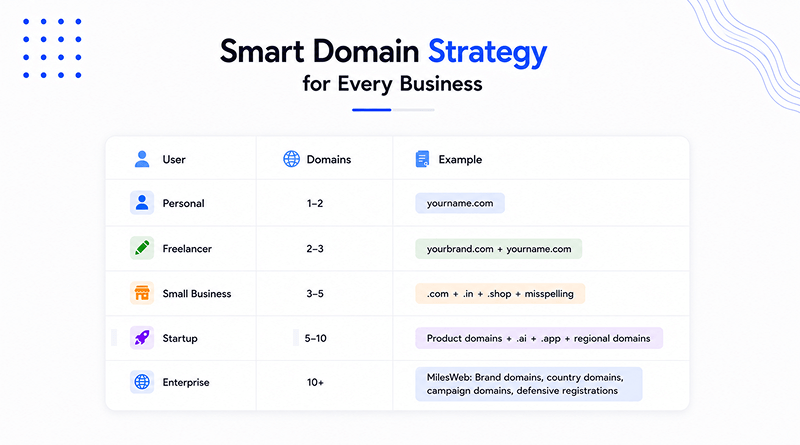
MilesWeb’s Recommended Domain Strategy
Choose the right number of domain names based on your website goals, business stage, and future growth plans.
| User Type | Recommended Domains | What to Register | Why It Matters |
|---|---|---|---|
| 👤 Personal website or portfolio | 1–2 | Primary domain, personal name variant | Build your online identity and secure your name. |
| 🎨 Freelancer or creator | 2–3 | Brand domain, personal domain, niche domain | Separate projects while strengthening your personal brand. |
| 🏪 Small business | 3–5 | Primary .com, common misspellings, key TLD variants | Protect your brand and prevent traffic loss. |
| 🚀 Growing startup | 5–10 | Primary domain, .net/.co/.ai, regional domains, product domains | Support expansion, branding, and future products. |
| 🏢 Large enterprise | 10+ | Global TLDs, country-code domains, campaign domains, defensive registrations | Protect trademarks, localize websites, and manage multiple brands. |
Conclusion
The entire domain name industry is growing alongside the internet, with a total of around 386.9 million active domains by 2023 and more than 1,200 TLDs. Nowadays, with increasing interest in .ai domains, choosing the right domain has become crucial for successful online performance.
Whether you are just starting a new website, trying to protect your brand, or trying to enter new markets, knowledge of various statistics and trends is vital in this process. A good domain is a memorable one, and with the right hosting partner, you can secure the extension that is right for your long-term goals.
FAQs
How many domains are there in the world in 2026?
This year there are approximately 386.9 million registered domain names in all top-level domains (TLDs) worldwide. This is an increase of 6.2% year-over-year and represents almost 22.7 million net new domains added in the last year.
How many domain names are registered every day?
Approximately, 62,000 new domain names are registered all over the world every day. This figure is for new registrations after expired and deleted domains are removed, so it works out to about 1.9 million new domains each month.
How many .ai domains exist?
In short, the answer is a total 44,000 .ai domains in all. The .ai domain extension has crossed the 1 million registered domains mark this year. It is one of the fastest-growing domain extensions in the past few years. This is possible due to the worldwide acceptance of artificial intelligence.
How much does a domain name cost per year?
The cost of a domain per year depends on the extension you pick. Standard domains like .com, .net, and .org usually cost less per year compared to premium extensions like .ai. Note that premium or aftermarket domains can be much more expensive depending on the popularity and demand.
Can one domain have multiple websites on it?
Yes. One domain can host multiple sites either through subdomains (blog.example.com and store.example.com) or by organizing content into subdirectories (example.com/blog and example.com/store). The domain itself doesn’t limit the number of websites you can run. It depends mostly on your hosting plan type and its resources.
How many domains should a business register?
There is no limit on the number of domains that a business can register. However, most businesses find value in owning 3–5 strategic domains, which include their primary .com, common misspellings, popular TLD variants, and country-specific domains if they do business internationally.