

 Jackson Lane
The internet operates on raw numerical data, yet human users require intuitive, memorable names to complete the request. DNS functions as the mandatory lookup system that translates your input into a translation layer your server can recognize. If this translation layer fails, the domain effectively vanishes from the network, regardless of the quality of your web hosting backend.
Managing your DNS strategy elevates your control beyond basic website ownership. It allows you to manage how your assets interact with the global network. When you understand the mechanics behind these lookups, you gain the ability to resolve configuration conflicts, harden your email deliverability, and stabilize your infrastructure before a bottleneck occurs.
Table Of Content
What Are DNS Records?
Think of DNS records as a basic list stored in a text file on your nameserver. These entries define the network path for your web traffic and designate mail servers for your domain. You adjust these mappings to change where a browser sends a request or where incoming email lands. Updating these lines directly alters how the internet locates your hardware.
DNS records categorize your network resources by function. A single zone file stores the pointers for your main website, subdomains for specific tools, and the security entries used to block spoofing. You use control panels to update these, but the underlying data follows rigid syntax rules. If the format deviates from these requirements, the network drops the connection attempt entirely.
Related Read: A Complete Guide To DNS Management
How Do DNS Records Work?
When a browser asks for a domain, it isn’t “searching”—it’s performing a recursive lookup. It starts at the root, bounces to a TLD registry (like .com or .net), and ends at your authoritative nameserver. Your nameserver holds the zone file containing the raw types of DNS records explained below, which dictate how your infrastructure functions. Once the resolver receives that payload, it hands the IP address to your browser.
The critical part is the cache. Resolvers don’t repeat this entire lookup for every single request. They respect the Time-To-Live (TTL) value you set. If you set a high TTL, you’re telling the internet to cache your IP for hours or days, which directly impacts your DNS propagation time. If you set it low, you force constant checks for updates. If your zone file is complex or your nameservers are slow to respond to that initial query, your website feels “slow” to load even if your server hardware is top-tier.
Why Are DNS Records Important?
DNS isn’t just about pointing names to IPs; it’s about control over how your infrastructure connects with the web.
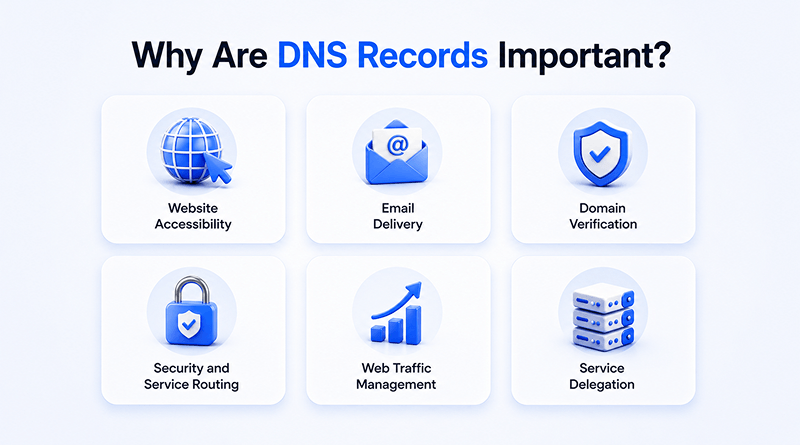
🌐
Website Accessibility
This is the base layer. If your A or AAAA record points to the wrong IP, the browser fails to reach the server. There is no fallback for a dead IP.
✉️
Email Delivery
Mail servers consult MX records to identify the correct destination for incoming messages. Misconfigured priority values cause mail to queue indefinitely or get rejected entirely.
🔍
Domain Verification
Services like Google Workspace or Microsoft 365 don’t check your website — they check your TXT records. If the value doesn’t match their expected string, they lock you out of the account.
🛡️
Security & Service Routing
SPF and DKIM records are non-negotiable. Without these TXT-based authentication records, your outgoing mail looks like spam and your delivery rate drops significantly.
📡
Web Traffic Management
If one server goes down, the DNS configuration remains the only thing keeping traffic from losing its path.
🔀
Service Delegation
You can host your website in one place, route email through another, and run your application backend elsewhere — all under the same domain name.
Related Read: How To Edit My DNS ?
What Are The Most Common Types Of DNS Records?
DNS zones aren’t just lists; they are the instruction manuals your servers follow. Each record type tells the network exactly how to handle a specific request. If you get these mappings wrong, the internet essentially loses the ability to reach your infrastructure.
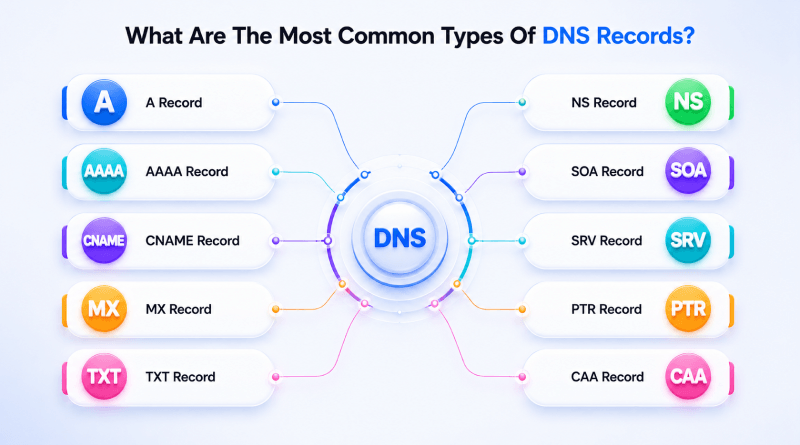
1. A Record (Address Record)
This is the workhorse of your zone file. A record binds your domain directly to an IPv4 address. This is the most essential entry in your zone file, as it enables browsers to map your domain name to the specific server address containing your website files.
- Purpose: Maps your hostname to a 32-bit IPv4 address.
- Use Case: Pointing a domain like example.com to your hosting server.
- Sample: example.com A 192.0.2.1
2. AAAA Record
The AAAA record is the IPv6 evolution of the standard A record. As IPv4 space saturates, this 128-bit format becomes the requirement for modern network compatibility.
- Purpose: Links a domain to an IPv6 address.
- Difference: A records map to 32-bit IPv4 addresses; AAAA records handle the 128-bit space of IPv6.
- Use Case: Scaling infrastructure for network environments that strictly require IPv6 connectivity.
Related Read: How to manage AAAA records?
3. CNAME Record
CNAMEs act as aliases. They don’t point to an IP; they point to another domain name. You use these to manage subdomains or redirects without updating every single pointer when your server IP changes.
- Use Case: Redirecting www.example.com to example.com.
- Management Efficiency: Since they point to a domain, updating the destination domain automatically propagates changes across all associated subdomains.
- Limitation: You cannot host other records (like an MX or A record) on the same hostname that holds a CNAME.
4. MX Record
MX records tell the world where to send your email. These records include priority values to manage failover if your primary mail server goes down. When you configure cloud hosting, getting these priorities right is the difference between delivered mail and bounced messages.
- Routing: Directs inbound messages to your mail infrastructure.
- Priority: Lower numbers represent higher priority; mail servers try the lowest number first.
- Example: example.com MX 10 mail.example.com
5. TXT Record
TXT records hold arbitrary text strings used for validation. These are the primary controls of modern email deliverability. You use them to store SPF and DKIM keys that prove to other mail servers that you actually own the domain.
- Verification: Proves ownership for services like Google Workspace.
- Security Configuration: Acts as a container for security policies, ensuring your domain remains trusted by external mail exchange systems.
- Example: v=spf1 include:_spf.google.com ~all
Related Read: How to Manage TXT Records?
6. NS Record
NS records act as the final authority on where your domain’s zone file lives. Without them, the internet has no map to find your server. You swap these entries in your registrar portal when switching hosts to hand off control to your new provider.
- Delegation: Identifies the authoritative nameserver for the zone.
- Use Case: Updating your registrar when moving your website to a new host.
- Hierarchy: Establishes the chain of trust by pointing to the specific servers responsible for responding to DNS queries for your domain.
7. SOA Record
The Start of Authority (SOA) record is the header of your zone file. It’s non-negotiable. It defines who owns the zone, how often it should refresh, and how long to wait before retrying.
- Purpose: Defines zone metadata.
- Components: Primary nameserver, administrator email, and timing variables (refresh/retry/expire).
- Operational Control: Orchestrates how secondary nameservers synchronize data, ensuring that your DNS records for email remain consistent across the global network.
8. SRV Record
SRV records define where a specific service lives. They list the port and protocol for a target, which you see most often with VoIP phones or internal chat systems. You add SSL certificates to these specific endpoints to keep your data private while it moves across the network.
- Routing: Maps services to a server, port, and protocol.
- Use Case: Pointing messaging clients to a specific server and port.
- Service Discovery: Enables clients to automatically locate specific application services on your network without requiring manual configuration of connection strings.
9. PTR Record
The PTR record is the “reverse” of an A record. It maps an IP back to a hostname. Mail servers check this record to verify your server’s legitimacy.
- Reverse Lookup: Validates that an IP belongs to your domain.
- Reputation: Prevents your mail from being dumped into spam folders.
- Security Auditing: Provides a critical layer of verification for incoming connections, as many systems reject traffic that fails to resolve back to a verified hostname.
10. CAA Record
You use a CAA record to designate which certificate authorities have permission to issue SSL certificates for your domain. Without this record, any entity can theoretically request a certificate for your website.
- Authorization: Limits certificate issuance to approved providers.
- Security: Prevents interception attacks via fraudulent certificates.
- Compliance: Automates security policy enforcement by restricting which third parties can generate credentials for your infrastructure.
Related Read: How to Manage CAA Records?
What Are the Most Common DNS Record Mistakes to Avoid?
DNS errors don’t show up in logs like code errors do; they just result in services going offline. Audit these things before you deploy changes.
- Wrong IP Addresses: A single typo here negatively impacts your entire website reachability.
- Incorrect MX Priorities: Setting the wrong sequence causes mail to vanish or bounce back to senders.
- TTL Issues: If you set this too high, changes to your infrastructure take hours or days to actually go live for your users.
- Missing SPF/DKIM: Neglecting these makes your domain look like a bot to every major mail provider.
Which Common DNS Records Do You Need to Manage?
These records dictate how browsers and mail servers locate your infrastructure by mapping human-readable names to machine-readable addresses. The following breakdown explains the most common DNS records and their functions.
| Record | Purpose | Common Use | Technical Note |
|---|---|---|---|
| A | IPv4 Address | Main Website | Maps host to 32-bit IP |
| AAAA | IPv6 Address | Main Website | Maps host to 128-bit IP |
| CNAME | Alias | Subdomains | Points name to name |
| MX | Mail Routing | Email Delivery | Directs to mail server |
| TXT | Verification | Domain Security | Stores text strings |
| NS | Delegation | Nameserver Authority | Identifies name servers |
| SOA | Administration | Zone Metadata | Sets zone defaults |
| SRV | Service Locator | Internal Apps | Specifies port/host |
| PTR | Reverse Lookup | Email Verification | Maps IP to name |
| CAA | Security Policy | SSL Certificates | Lists cert issuers |
Final Thoughts
DNS isn’t “set and forget.” It is the operational core of your domain. If your DNS records fail, your website disappears and your mail stops delivering, even if you run top-tier server hardware. Systematic management of your A, AAAA, CNAME, MX, and TXT entries—as well as monitoring DNSSEC record types—is the only way to avoid these outages.
Audit your zone file before every deployment. Double-check your syntax, verify your TTLs, and use terminal tools to confirm propagation. Dealing with DNS records feels like a task you must handle carefully, as correct settings remain the only way to prevent random website errors. Once you get your settings sorted, you see your pages load right when they should, and your visitors land exactly where you want them to be.
FAQs
1. What happens if I have multiple A records for the same domain?
Your nameserver sends every address to the user’s browser. The browser cycles through these IPs to visit your servers. It acts as a basic way to share traffic, but it lacks the logic found in a real load balancer.
2. Can a CNAME record point to an IP address?
CNAME records only accept domain names, so entering an IP address there creates a configuration error. When you perform a lookup with that setup, you find that the domain does not resolve correctly. To connect your domain to a specific IP, you select an A record or an AAAA record for your configuration.
3. Why can’t I use a CNAME record at the root domain level?
A CNAME record is strictly for mapping one domain to another. If you attempt to point one toward an IP address, the resolution chain breaks. You must use an A or AAAA record whenever your goal is to direct traffic toward a specific IP.
4. Can I have more than one SPF record on my domain?
No. Receiving mail servers only read the first record they see. Extra records look like a mistake to the network, which often leads to your emails landing in spam. Combine all your service requirements into one single string instead.