
 Jackson Lane
Selecting the right architecture is pivotal to a successful SaaS software development to strike the balance between cost and production time. In 2026, the right cloud environment dictates the scaling strategy of SaaS software. While single tenancy isolates an entire software database for a single user, a multi-tenant environment uses logical data partitioning serving multiple clients with absolute data governance. Thus, this blog contemplates the choice between multi-tenant and single tenant environments.
The detailed comparison guide about single tenant vs. multi-tenant gives insights on key features, architectural trade-offs, and compliance realities.
Quick Answer
- Single-tenant gives each customer a fully isolated database and application instance — stronger security and compliance, but higher cost and heavier maintenance.
- Multi-tenant shares infrastructure across customers using logical data separation — cheaper and easier to scale, but with “noisy neighbor” performance risk.
- Choose single-tenant if you’re in a regulated industry (healthcare, finance, government), need deep customization, or require consistent, competition-free performance.
- Choose multi-tenant if you’re building a public SaaS product, working with a limited budget, or need to onboard new customers rapidly without infrastructure upgrades.
- Multi-tenant is the default starting point for most SaaS businesses — many companies later adopt a hybrid model, offering single-tenant as a premium tier for enterprise customers who need it.
Table of Content
Also Read: Bare Metal Cloud vs IaaS
What Is a Single-Tenant Tenant?
A tenant defines users, or organizations sharing common access to the cloud environment. Even though they share the same cloud hardware, servers, and network resources, data access remains in isolation through logical virtualization. They use Identity and Access Management (IAM) to operate as a security domain.
What Is Single-Tenant Architecture?
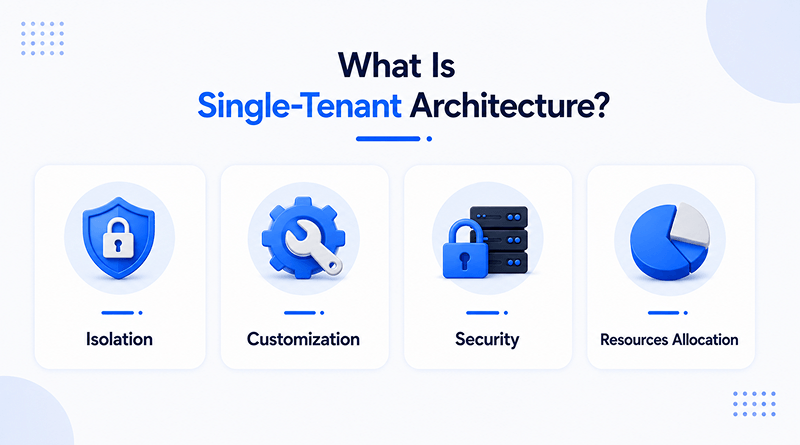
Single-tenant architecture is a client-server model where cloud instances are dedicated to a single user. The setup includes isolated data resources, ensuring the application environment for single tenants does not impact each other. Such complete isolation offers a higher customization and granular control for each client.
Also Read: Best Free Cloud Hosting Provider
What Is Single-Tenant Architecture?
- Isolation: Each tenant has its own application instance and database.
- Customization: The ability to customize the applications according to specific requirements.
- Security: Better security through data isolation, limiting the impact of data breaches between tenants like dedicated servers.
- Resources Allocation: Each tenant has some allocated resources which can result in better performance suited to the tenant’s requirements.
How Single-Tenant Hosting Works?
How Single-Tenant Hosting Works
One dedicated instance, start to finish.
🏗️
Step 1
Provision Instance
A dedicated database and software instance is created exclusively for this tenant.
🔒
Step 2
Isolate Environment
Data and application run independently, with zero exposure to other tenants.
⚙️
Step 3
Deploy for Tenant
The instance is purpose-built and installed specifically on this tenant’s server.
🎨
Step 4
Customize UI
Tenant adjusts settings and UI post-installation — no access to underlying code.
✅
Step 5
Operate in Isolation
Performance and security stay unaffected by any other tenant’s activity.
In the single-tenancy architecture, every tenant has a single database and software instance, isolating each tenant’s data from one another. Additionally, the architecture allows each instance per SaaS server.
Each software element is purposely built for the new tenant who can customize the UI post installation. After successful installation, tenants typically customize software to best suit what is needed for their specific environment, but they do not have access to any underlying code.
Pros
- High security to prevent data breaches.
- Dedicated hardware for data isolation.
- Strict compliance for data governance.
Cons
- Expensive computing power.
- Heavy maintenance required.
What Is Multi-Tenant Architecture?
How Multi-Tenant Hosting Works
Shared infrastructure, individually secured.
🤝
Step 1
Onboard Onto
Shared Infra
A new tenant joins the same physical server, application, and database as existing tenants.
🔑
Step 2
Assign Tenant
ID
A unique tenant identification key or distinct database schema separates each tenant’s data.
⚖️
Step 3
Enforce
Resource Limits
CPU and memory caps ensure one busy tenant can’t slow the server down for others.
🎯
Step 4
Serve Tenant-
Specific Data
Access controls and routing ensure each tenant only sees their own data.
📈
Step 5
Scale &
Monitor
Shared resources are monitored and adjusted to maintain reliable performance for every tenant.
Multi-tenant architecture is a way of designing software where multiple divisions of a company (or tenants) can use and access the same infrastructure. This design saves space and resources and allows for cost savings. Multi-tenant architecture also allows for easy scaling. Because tenant divisions are adding to the same infrastructure, it requires minimal alteration to the design.
What is Multi-Tenant Architecture?
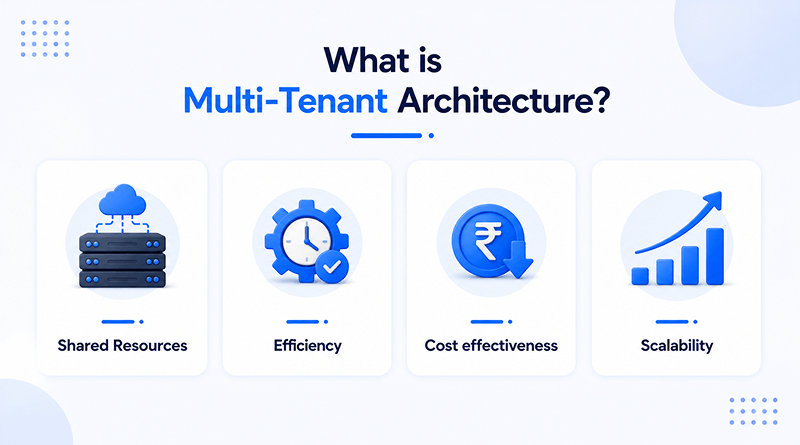
- Shared Resources: Application instances and databases are shared by tenants.
- Efficiency: Sharing the environment among the clients serves them best.
- Cost effectiveness: Using resources efficiently reduces the cost of maintaining supportive resources.
- Scalability: Very easy to scale because of minimal design requirements for multiple configurations.
How Multi-Tenant Hosting Works?
Multi-tenant hosting works by allowing multiple organizations sharing the exact same physical server, software application, and database infrastructure keeping the individual data private and secured from each other.
The mechanism uses unique tenant identification keys or distinct database schemas for each user seeing their own data. Controls CPU and memory limits so one busy user cannot slow down the server for others.
Pros
- Shared resources cut overhead costs.
- Providers update systems simultaneously across all domains.
- Securing data through routing protocols.
Cons
- Limited hardware customization.
- Increases the risk of accidental data leaks.
Also Read: Why is Cloud Hosting Ideal for Scalable Startups?
Single Tenant vs. Multi-Tenant: Key Differences
Factor
ST
Single-Tenant
MT
Multi-Tenant
Infrastructure
Dedicated per customer
Shared across customers
Data isolation
Physical separation
Logical separation
Cost per customer
Higher (dedicated resources)
Lower (shared resources)
Customization
Extensive (full environment control)
Limited (within application boundaries)
Maintenance
Per-instance updates and patching
Centralized, single deployment
Scalability
Scale each instance independently
Pool resources dynamically
Performance risk
Isolated (no neighbor effects)
Noisy neighbor potential
Compliance posture
Stronger default isolation
Requires careful architecture
Verdict: The models presented do not align with your preferences. Optimize your requirements using the criteria: isolation of data, regulations, cloud models performance, and expected levels of performance. Users who prefer complete data isolation will find a good match with single tenancy of cloud models. Dedicated infrastructure options are also comparable to dedicated hosting. However, multi-tenancy will be the preferred choice when many clients have a fast growing customer base.
Single-Tenant vs. Multi-Tenant: Where Each Fits Best
Single-Tenant Use Cases
- Highly Regulated: Certain financial sectors and healthcare industries have strict protocols regarding the data they handle.
- Extreme Levels of Customization: Large corporations have code-heavy projects that can only be done with lots of modification.
- Performance Intensive: Projects that require lots of hardware resources that compete with one another.
Multi-Tenant Use Cases
- Public SaaS: Applications that serve a large number of customers that support a single shared instance (project management apps or CRMs).
- Limited Budgets: Apps that are in the initial development stage that require low levels of infrastructure.
- Rapid Scaling: Projects that require the ability to automatically and rapidly provision new customers.
Also Read: What is Nextcloud?
How to Choose Between Single-Tenant and Multi-Tenant?
Before deciding, you must ask these questions to yourself:
- How sensitive is my data?
- How much control do my customers expect over their environment?
- And how fast do I need to scale?
Single tenancy serves regulated industries like finance, government, and healthcare, demanding data privacy and isolation before considering the budget. Multi-tenancy suits building a SaaS product for a wider market where speed and price matter more than deep customization. Below, we outlined each scenario briefly to help you match where your business sits.
Also Read: Google Cloud Hosting Alternatives for Developers
When Should You Choose a Single-Tenant?
- You’re handling regulated data: Healthcare, finance, and government sectors demand data governance. Hence, achieving data isolation through single tenancy pivots towards exclusivity and complete security. Several single-tenant providers are compliant with HIPAA and SOC 2, PCI-DSS protocols.
- Your customers demand environment-level control: running business operations on shared infrastructure is overwhelming. Hence, single tenancy is suitable for enterprise clients seeking custom integration and on-demand maintenance tasks.
- Performance consistency is non-negotiable: Forex trading software such as MT4 and MT5 needs an isolated environment to process volumes of trading orders. Single-tenancy ensures it is accomplished effortlessly.
When Should You Choose a Multi-tenant?
- Seamless scalability: Accommodating a new user in existing infrastructure does not require premium upgrades. Multi-tenant architecture lets you scale the number of users without operational lag.
- Cost sensitivity matters to your customers: Shared infrastructure distributes costs across the user base and resonates with the perfect cost quotation for a price-sensitive market.
- Faster deployment and shipping: You would like to send out updates quickly, to everybody, concurrently. One deployment for all customers at a time. No mixing up versions, no hundreds of isolated instances.
- No heavy customization is needed: Multi-tenant architecture is not limiting if most customers are running similar features and have a light configuration (non-custom code/infrastructure).
Our Recommendation
After a brief discussion, if you are unsure on which to weigh upon, here is the answer! Multi-tenant cloud architecture is a stepping stone for SaaS businesses for faster deployment and seamless scalability. In contrast, a single tenant is not obsolete but restricted to enterprise demands only. Its premium cost is factored on compliance, SLA, and data isolation infrastructure.
Many SaaS companies adopt a hybrid model to combine the premium security of single tenant and cost-effective scalability of multi-tenant. A multi-tenant is the default architecture, with single-tenant offered as a premium tier for enterprise needs. Empower online presence with our cloud hosting for seamless deployment of this model.
FAQs
1. Is single-tenant hosting suitable for small businesses?
Single-tenant hosting is often suboptimal for small businesses. The costs and demands on resources are too high. Multi-tenant setups are more affordable and offer a faster time-to-configuration to most small teams.
2. Can a business switch from multi-tenant to single-tenant hosting later?
Yes, a business can always shift from a multi-tenant environment to single-tenant hosting, especially in cases when security concerns heighten or when the business is experiencing growth. The three steps in this shift include importing data, setting up new dedicated infrastructure, and setting up the application.
3. Which industries commonly use single-tenant environments?
Single-tenant hosting solutions are generally the preferred choice in the most heavily regulated markets, such as health, finance and government. These are sectors strong on legal compliance and data privacy marks, which single-tenant hosting solutions can cater to.
4. Can multi-tenant applications keep customer data separate?
Coexisting customer data in multi-tenant applications can be accomplished through logical segregation, encryption, and an access control security model. Even where hardware is shared, customer data is visible to the customer and is restricted.