
 Jackson Lane
Hermes Agent and OpenClaw are both open-source, autonomous AI agents with browser automation, scheduled tasks, and delegated workflows. Both AI tools were built with enterprise-grade capability, but their rapid growth on GitHub brought them into the consumer space.
OpenClaw positioned itself as a trailblazing AI agent for WhatsApp and Telegram, but the rise of OpenClaw alternatives and open-source projects has steadily grown. As a result, Hermes Agent is gaining traction while OpenClaw’s growth has stagnated. Now, the developer community uses both extensively across different platforms, and this blog compares both tools to settle the debate: Hermes Agent vs. OpenClaw.
Table of Content
Quick Answer
- Both are free, open-source (MIT licensed) self-hosted AI agent frameworks — but they take opposite architectural approaches.
- OpenClaw is a gateway-first platform with coordinated multi-agent teams, built-in memory, and a mature 40,000+ skill marketplace — best for multi-channel, multi-agent scale.
- Hermes Agent is a self-improving runtime with isolated subagents that compound skill over time — best for long-term, repeated personal automation.
- Setup time differs sharply: OpenClaw is under 30 minutes, while Hermes takes 2–4 hours due to its developer-centric, command-line-first design.
- At heavy usage, Hermes runs cheaper ($50–$150+/mo) than OpenClaw ($100–$400+/mo) — but neither tool is “objectively better,” the right pick depends on what you’re optimizing for.
What is Hermes Agent?
Hermes Agent is a self-hosted and autonomous AI agent framework developed by Nous Research in February 2026. It has an in-built memory that tracks your conversations (like Gemini and ChatGPT) to drive results and execute scheduled tasks autonomously. Hermes Agent functions on a closed-loop learning system that builds reusable skills to save users’ preferences.
Click here to know more about What is Hermes Agent
What is OpenClaw?
OpenClaw is also a self-hosted AI framework that runs on a local server/machine. It was created by the developer Peter Steinberger. The AI assistant tool integrates effortlessly with popular LLMs (Large Language Models) directly to your operating system, files, and the messaging apps you use.
Why Compare Hermes Agent and OpenClaw?
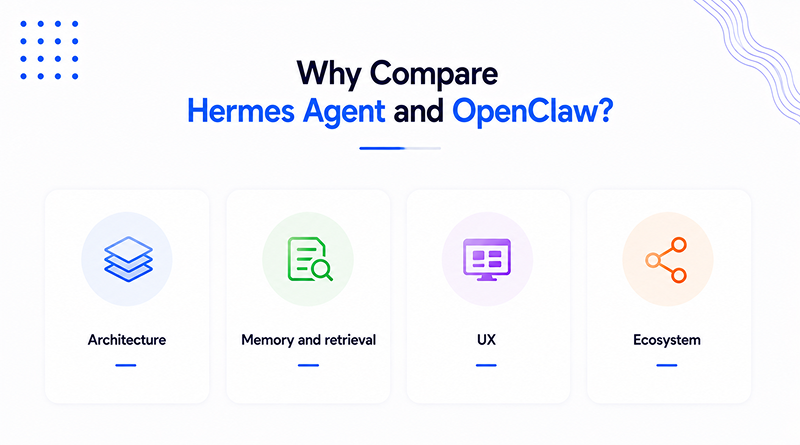
OpenClaw and Hermes Agents have become prominent developer-friendly tools to build self-hosted AI agents. Both deploy browser automation, scheduled tasks, and delegated workflows but have distinct philosophies. OpenClaw routes agents across platforms where you need an orchestration layer. Hermes is a single agent whose learning and skill set compound over time. To make a call between the two, the blog has compared both tools across the underlying areas:
- Architecture: How each handles multi-agent workflows and background execution.
- Memory and retrieval: How each stores and recalls context across sessions.
- UX: Setup time, defaults, and day-to-day usability.
- Ecosystem: Marketplace, integrations, and community support.
Also Read: Top Ollama Alternatives
Hermes Agent vs. OpenClaw: Core Comparison
Feature
HA
Hermes Agent
OC
OpenClaw
Philosophy
Self-improving runtime
Gateway-first platform
Multi-agent model
Isolated subagents
Coordinated agent teams
Memory
Modular, bring-your-own backend
Built-in, works out of the box
Setup time
2–4 hrs
Under 30 min
Ecosystem
Smaller, faster-growing
Larger, more mature
Best for
Long-term personal automation
Multi-channel, multi-agent scale
1. Architecture
OpenClaw operates under a control-plane architecture. In this, a dedicated gateway routes AI agents and communication channels. Its modular codebase simplifies integrations through plugins. Hermes functions on a Python-based runtime loop within applications. It allows developers to understand the workflow and seamlessly integrate into existing ML workflows.
The multi-agent potential of each tool differs. OpenClaw supports persistent multiple agents within isolated workspaces, memory, and channel bindings for long-term deployments. Hermes generates temporary AI agents to streamline tasks into parallel workflows. Overall, OpenClaw manages independent AI assistants, while Hermes is well-suited for task delegation and parallel execution.
2. Memory and Retrieval
OpenClaw has a strong memory and retrieval system that makes it an intriguing choice for developers. It stores every interaction as a separate session and maintains a record of the conversation history. In contrast, Hermes compresses conversations and stores them in a searchable database. Moreover, it stores user preferences and agent information, reducing their learning curve.
Both AI tools differ in their information retrieval processes. OpenClaw runs a background search of conversation history, which may produce vague outcomes. Conversely, Hermes generates organized output prioritizing relevant information during active tasks. If you want a conversation to resonate with your context, Hermes Agent is a stronger choice, while OpenClaw generates a cumulative summary of the conversation.
3. User Experience
OpenClaw and Hermes have distinct user experiences and design philosophies. OpenClaw’s interface features cross-platform compatibility for AI agents on Slack, WhatsApp, and Discord. Users browse and install pre-built skills for manual configurations. Hermes follows a developer-centric design as it is oriented towards command-line users. Its feature-rich terminal interface presents a steep learning curve.
Their daily operations also differ. OpenClaw grants maximum control by defining workflow and AI behavioral management across different platforms. Hermes is more autonomous; the agent will be able to review completed tasks, enhance its abilities, and retain useful knowledge for future work. Put simply, OpenClaw is better suited to users who want full control, while Hermes is preferable for users who want an AI agent that gradually improves with automation.
4. Ecosystem and Community Support
OpenClaw’s ClawHub marketplace is powered by 40,000+ community–built skills that assist users in deployment, content workflows, and customer support. The vast ecosystem saves weeks of development time if someone has already built what is required.
The Hermes agent has a limited resource library but grows autonomously from your work. This AI model is trained in several skill sets, including research paper summarization and prompt-related output.
Also Read: Best Hermes Agent Hosting Providers
Hermes Agent vs. OpenClaw: Which One Should You Use?
Also Read: What Is Agent Zero AI
Hermes Agent vs. OpenClaw: Latest Release
- Hermes Agent: v0.18.2 (2026.7.7.2)
- Release date: July 7, 2026
What’s New?
Released with minor patches. It fixed the WhatsApp dependency issue that disrupted the Docker development cycle.
- OpenClaw: openclaw 2026.6.11
- Release date: June 30, 2026
What’s New?
Its new release focused on reliability, with message delivery/reconnect issues across Telegram, WhatsApp, Matrix, Google Chat, and other channels, plus safer admin defaults.
Also Read: What is Agenta AI
Hermes Agent vs. OpenClaw: How Much Do They Cost to Run?
Both tools are free and open-source, but running them isn’t. Here’s what to actually budget for:
Cost Category
HA
Hermes Agent
OC
OpenClaw
Software license: $0 — both are free, MIT-licensed open-source projects.
Base infrastructure
$0 – $5/mo (supports pay-per-use serverless)
$5 – $24/mo (requires persistent hosting)
API costs at light use: $5–$15/mo for both tools.
API costs (heavy use)
$50 – $150+/mo
$100 – $400+/mo
Costs scale with usage and chosen LLM provider — figures are estimates, not guaranteed pricing.
Final Verdict
Hermes Agent and OpenClaw solve the same problem from opposite directions. OpenClaw is a gateway-first platform, built for developers who want full control, multi-channel routing, and a massive skills marketplace to lean on. Hermes Agent is the newer, self-improving runtime, built for developers who want an agent that gets sharper at specific workloads where it is used.
Neither is objectively better. The right pick depends on what you’re optimizing for:
- Choose OpenClaw if you need persistent multi-agent teams, broad messaging integrations, and a fast, batteries-included setup.
- Choose Hermes Agent if you’re creating long-term, repeated automations and you want an agent that grows in skill over time.
But, with both projects releasing new software, security updates, and welcoming new community members each month, it’s not the best idea for most developers to choose a side. Instead, try them in a real workflow, observe which one best fits your requirements, and re-evaluate as both tools continue to evolve.
FAQs
1. Is Hermes Agent better than OpenClaw?
Hermes wins for self-improving memory and compounding capability. OpenClaw wins for platform breadth, battle-testing, and security governance. They solve different problems.
2. Can I migrate from OpenClaw to Hermes Agent?
Yes. The Hermes documentation describes migration from OpenClaw as taking only a few minutes. Several community users also run both tools together, using OpenClaw for messaging execution and Hermes for memory and skill-building.
3. Which is more secure — Hermes or OpenClaw?
OpenClaw has a security-first VISION.md and foundation governance but also has a documented high advisory rate. Hermes is MIT-licensed with community auditing. Neither platform should be granted unconstrained file system access in production environments without proper review and safeguards.
4. Does OpenClaw have a learning loop like Hermes?
No. OpenClaw is reactive by design; it executes tasks when prompted but does not generate skills, refine its own memory, or improve between sessions. This is an intentional architectural choice rather than a missing feature.