

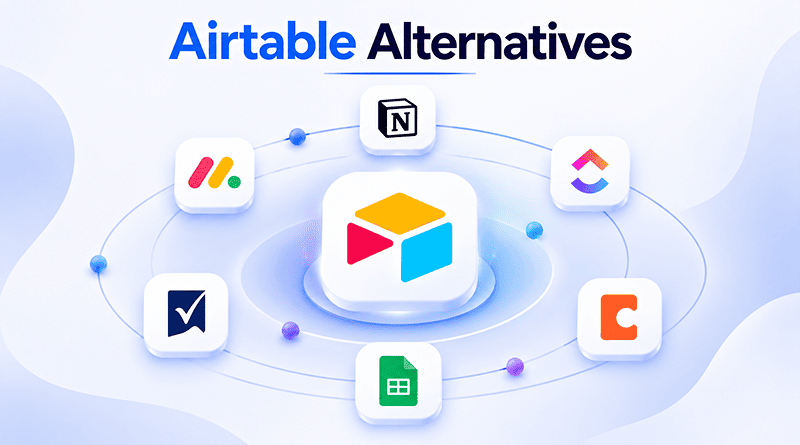
Airtable is a cloud-based database management platform to manage spreadsheets and projects. It is a user-friendly app for organizing data and linking records. Moreover, the platform fosters team collaboration to manage databases remotely. The premium costs hinder the team’s growth and disrupt productivity.
The blog breaks down top Airtable alternatives and offers built-in features like project tracking and an interface builder without requiring database workarounds. Choose the right one from the list to ship your next project.
Table of Content
Quick Answer
- There’s no single best Airtable alternative — the right pick depends on whether you need documents, spreadsheets, automation storage, or a real backend.
- NocoDB is the top pick if cost matters most: it’s free, self-hosted, and removes Airtable’s row limits entirely.
- For document-first teams, Notion and Coda outperform Airtable by combining wikis, docs, and lightweight databases in one workspace.
- Xano, Retool, and Zapier Tables aren’t true replacements — they solve different problems (backend infrastructure, app-building, and automation storage) rather than competing directly with Airtable.
- Starting prices span a wide range, from free (NocoDB, Google Sheets) to $85/mo (Xano) — match the tool to the job, not just the price tag.
What is Airtable?
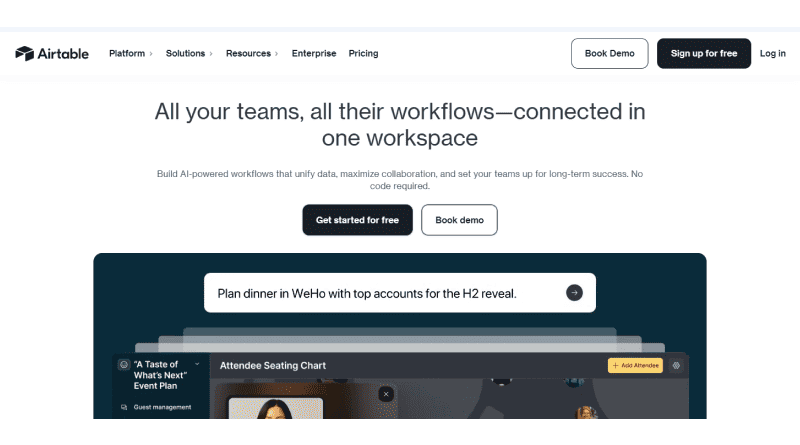
Airtable combines a spreadsheet UI and relational database in a no-code, cloud-based solution. Airtable lets you track your CRM, build your internal business applications, and manage your projects without writing a single line of code.
Best Airtable Alternatives: Quick Comparison
Tool
Best For
Starting Price
Key Difference vs Airtable

Docs + DB in one
$10/user/mo
Page-first wikis with embedded DBs

Doc-based mini-apps
$10–$12/doc-maker/mo
App-like docs with buttons & Packs

Self-hosted Airtable
Free (self-hosted)
Your own SQL DB with Airtable-style UI

Spreadsheet PM at scale
$9–$12/user/mo
Advanced sheets + Gantt, less app-builder

All-in-one work OS
$7–$10/user/mo
Broad PM suite; DB is one feature

Automation workflows
$19.99/mo
Tables built for Zaps & AI, not general apps

Low-cost Airtable clone
$4.20/user/mo
Very similar UI, lower pricing

Simple collaboration
Free
Pure spreadsheet, no relational DB

No-code backend/APIs
$85/mo
Backend platform, not end-user app builder

Internal tools for developers
$10/builder + $5/user/mo
Code-friendly UIs over existing DBs/APIs
1. Notion
User Base: 100 million+
Pricing: Free and paid plans (Plus Plan) start at $10 per month.
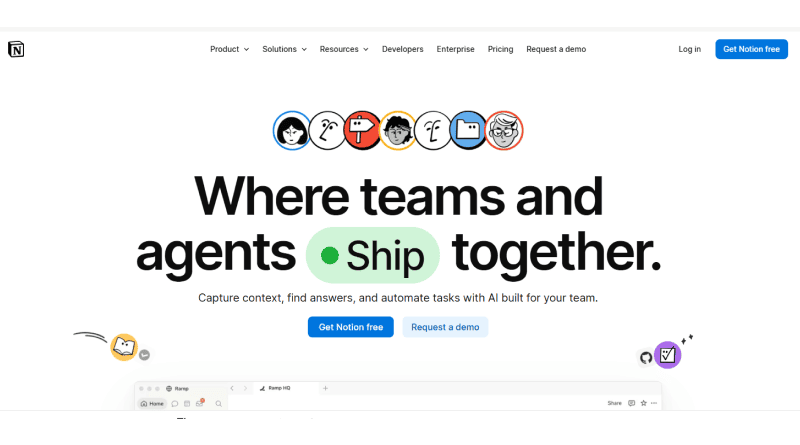
Notion is a versatile workspace combining documentation, project management, and lightweight databases into a single customizable workflow. It functions on a distributed architecture where the database is part of the core component, not the standalone ones. Every page of the interface comprises blocks, a to-do task list, images, code snippets, and embeds that facilitate team collaboration effortlessly.
Furthermore, Notion’s extensive system for managing knowledge integrates documentation that supports thousands of templates. It has an ideal architecture, making Notion well-suited for knowledge-first teams. Developers using Notion’s API for two-way sync report a rate-limit throttling of around 180 requests per minute.
👍 Pros
Extreme Customization
Powerful Connected Databases
Deep AI Integration
⚠️ Cons
Steep Learning Curve
Lightweight Project Execution
2. Coda
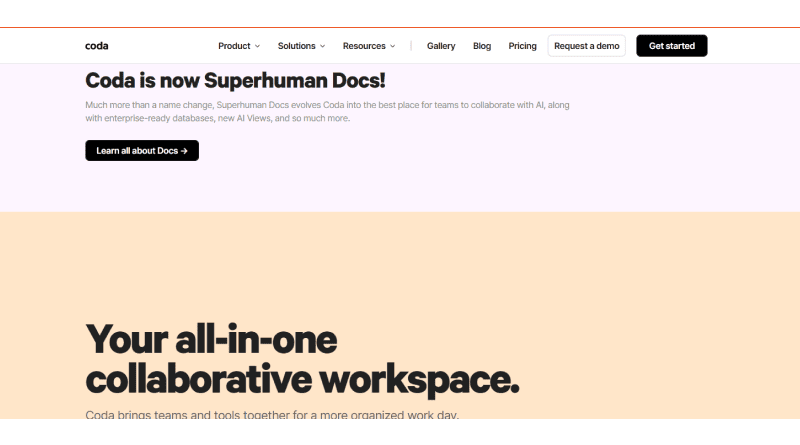
User Base: 50,000+ teams
Pricing: Free and paid plans start at $10.23 per month per Doc Maker.
Coda and Airtable follow distinct operational philosophies. Coda prioritizes a document-first approach, while Airtable operates on a database-first workflow. Coda offers immense creative freedom to users, but its data-scaling limits hinder the processing efficiency of highly complex, heavy datasets.
Coda complies with strict global security protocols like HIPAA, SOC 2, and GDPR to maintain absolute data privacy. Moreover, it clocks 99.9% uptime for enterprises to prevent performance throttle commonly experienced during heavy data calculations. Developers report write-rate limit throttling at around 100 requests per minute for heavy-data synchronization. It encourages them to structure batch updates and optimal backend delivery.
👍 Pros
“Doc Maker” Billing Economy
Superior Formula Language
The Packs Ecosystem
⚠️ Cons
Lighter Mobile Experience
Weak Inter-Document Search
3. NocoDB
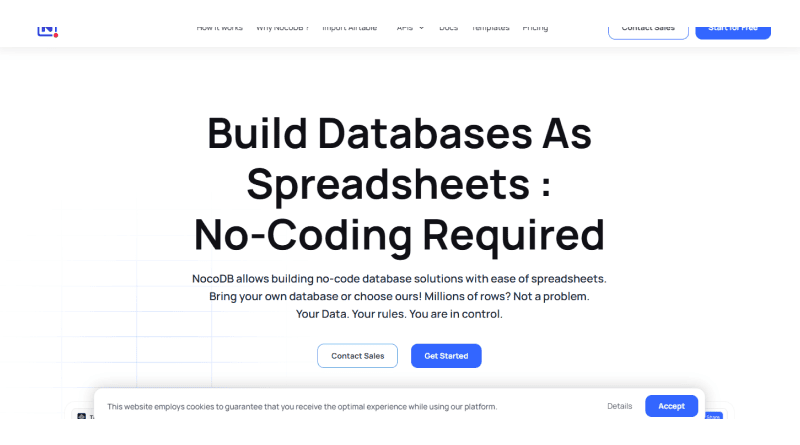
User Base: 20+ Million (On Docker)
Pricing: Free (self-hosted); paid plans start at $12 per user per month (cloud environment).
NocoDB is an open-source Airtable alternative that allows users to create databases from spreadsheets. It also has a zero-code interface to design database applications. It offers both cloud-hosted and self-hosted environments with robust API access for external integrations.
NocoDB connects an existing MySQL, PostgreSQL, MariaDB, MSSQL, or SQLite database with a locally stored spreadsheet on the device. It ensures seamless accessibility across team members. This platform frees you from Airtable’s record limits. The database is scaled to millions of rows depending on the underlying database capacity. Developers can execute heavy database transactions (around 5 requests per second / 300 per minute) without hitting the API multiple times using a single token.
👍 Pros
Seamless Database Integration
Instant APIs
Versatile Views
⚠️ Cons
Lacks Advanced Automations
No Native Interface Builder
Also Read: PostgreSQL Alternatives
4. Smartsheet
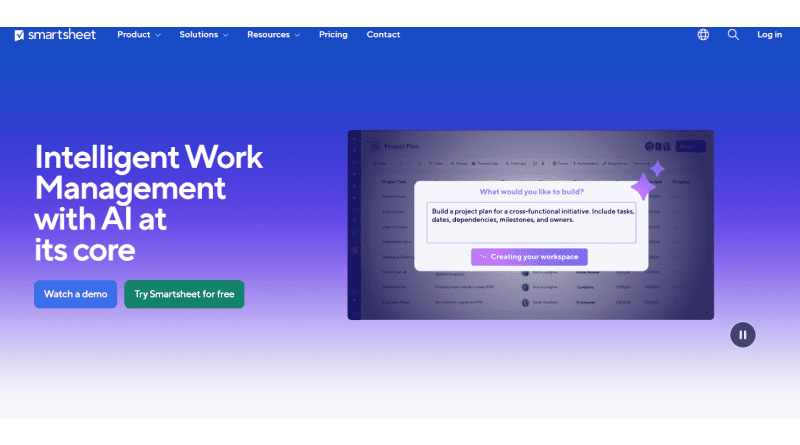
User Base: 85% of Fortune 500 companies, 22,000+ corporate clients
Pricing: Starts at $9 per member per month
Microsoft Excel or Google Sheet users find the Smartsheet platform responsive and user-friendly. It outshines Airtable with Gantt charts, resource allocation, and traditional hierarchical subtasking, making project management highly structured.
Its built-in AI tools store and process information in a manner similar to Airtable. However, its core framework is engineered for rigid project management and portfolio governance, unlike Airtable and Coda. Similar to NocoDB, Smartsheet matches the same execution time for data transactions of 300 requests per minute using an API token. Besides, they can send a single array payload containing hundreds of row changes in a single API call.
👍 Pros
Simplest Code
Real-Time Delivery
Fewer 429 Errors
⚠️ Cons
Endpoint Requirement
Memory Management
5. ClickUp
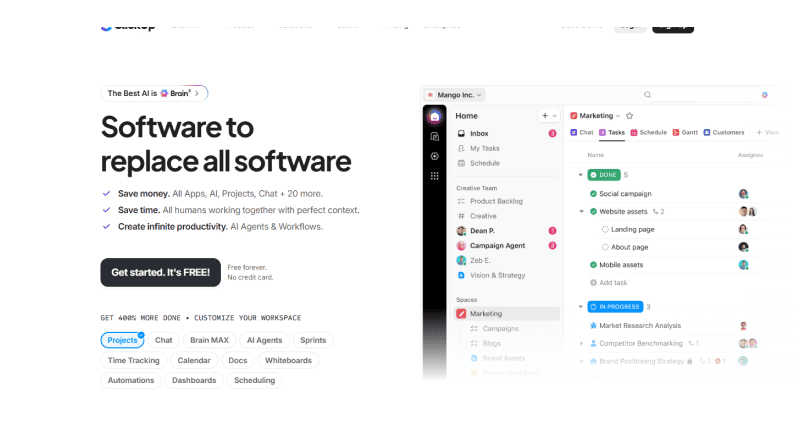
User Base: 5+ million teams
Pricing: Free and paid plans start at $7 per user per month.
ClickUp provides standard project management software with extensive customization features. While Airtable and ClickUp both seek to enhance productivity, their software integrations differ. ClickUp employs sophisticated task management to handle complex projects and meet deadlines.
The tool customizes task views and bulk edit tasks, which is perfect to manage large teams with diversified workflows. ClickUp uses an AES-256 encryption mechanism and complies with GDPR and CCPA and provides absolute data governance. It provides comprehensive tutorials and templates to help new users get started quickly and easily. It operates under a standard limit of 100 requests per minute per API token across all plans.
👍 Pros
Easy Processing of Intricate Tasks
Multiple View Types
Powerful Automation
⚠️ Cons
Not a True Database
Feature Bloat
6. Zapier Tables
User Base: 3.4 million businesses worldwide
Pricing: Free and paid plans start at $19.99/mo.
Zapier Tables is an ideal platform to retrieve and transfer data across your entire software stack at just a click of a button. It’s a data layer built for the Zapier ecosystem to store and trigger data that feeds your automations, rather than a place to run projects or build apps from scratch. Zapier Tables offer uncapped automation with conditional paths, data formatting, and trigger scheduling for sophisticated cross-platform workflows.
Moreover, you can use natural language prompts in Zapier Tables to build intricate automations and volumes of product workflows. It operates in a cloud environment and has a broader range of app compatibility. Developers can route up to 150 requests every 5 seconds, enabling them to execute tasks without exhausting monthly limits.
👍 Pros
Native Action Buttons
High-Throughput Applications
Polished AI integration
⚠️ Cons
No native, complex formulas
Cost scaling
7. Stackby
User base: 70,000+ companies worldwide
Pricing: $4.20 per user per mo
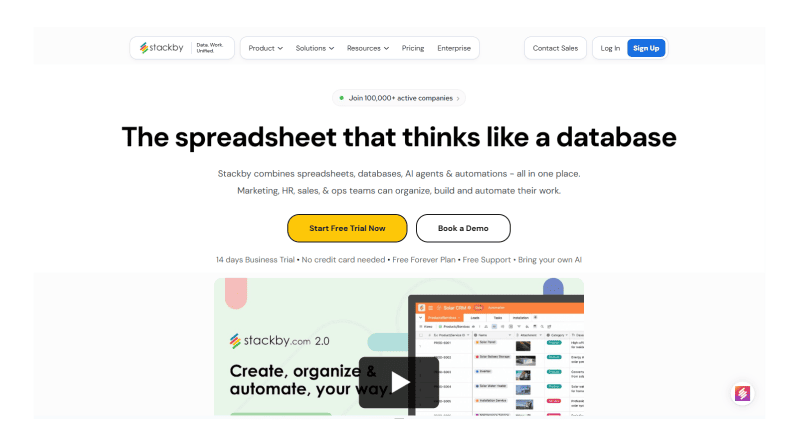
Stackby integrates AI automation, project management, team data, and workflows in one no-code package and combines all of them with Airtable alternatives. A deep API connector and integrators allow for quick and easy structuring of workflows. A customer-supporting, issue-handling CRM is included, and Stackby supports field types such as Checklists and Signatures.
Stackby is engineered to migrate data from Airtable at a breeze through the built-in Airtable Importer. Its external collaborator policy is a key differentiator against all alternatives mentioned in the blog. The policy allows unlimited read-only guests and shareable public-facing links to databases. Stackby has limited request throughput, with only 5 requests per second. Exceeding the limit would trigger error 429.
👍 Pros
Native API Integrations
Responsive Support
User-Friendly & Affordable
⚠️ Cons
Occasional Bugs & Glitches
UI Can Be Cluttered
Also Read: PostgreSQL vs MongoDB
8. Google Sheets
User Base: 3 billion active users
Pricing: Plans start at $7.00 per user per month.
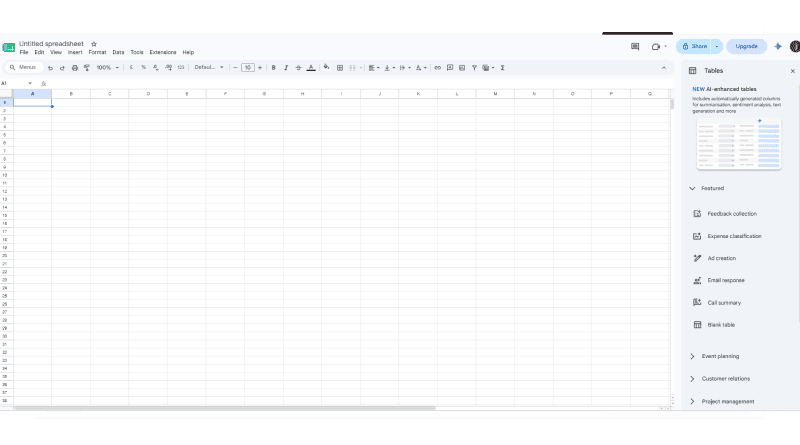
The cloud-based Google Workspace platform, ‘Google Sheets,’ is considered the web replica of MS Excel. Both platforms share similar functionality and even shortcut keys to execute tasks. Comparing Google Sheets with Airtable, the traditional spreadsheet is designed for basic calculations and data entry. It uses a flat grid to validate data where you can use $VLOOKUP$ to connect data across tabs.
For beginners working with data, finances, and budgets, Google Sheets is very easy to use. It has many tools to quickly calculate numbers and create organized tables to present data. Google Sheets is much easier to use than Airtable because there is no extensive complicated coding or dynamic interfaces used to navigate the database. The Sheets API has no maximum number of API requests, but Google recommends a maximum payload of 2 MB to reduce strain on resources.
👍 Pros
Real-time Collaboration
Cloud Accessibility
Automated Version History
⚠️ Cons
Security & Permission Risks
Fewer Advanced Analytics
9. Xano
User Base: 100,000+ developers and creators
Pricing: Free and paid plans start at $85 per month.
Xano is a developer-centric platform allowing users to switch from spreadsheet-styled “databases for teams” to a powerful, no-code relational backend. Unlike Airtable, it features a scalable PostgreSQL backend providing higher row limits and native database abstractions. Xano empowers developers to build scalable backends through custom APIs, advanced scalability features, and enterprise-level certifications.
Xano supports the rigorous software development lifecycle of large production applications in a no-code environment. Moreover, it has one-click Airtable import for data migration. Unlike Stackby, Xano does not enforce stringent requests-per-second limits. The rate limiting totally depends upon the plan you choose or the logic you build in coding syntax. The free plan processes 10 requests every 20 seconds, while paid plans have no restriction on request processing.
👍 Pros
Visual API Builder
No-Code to Pro-Code Synergy
Frontend Agnostic
⚠️ Cons
Steeper Learning Curve
No Real-Time by Default
10. Retool
User Base: 36,000+ companies
Pricing: Free and paid plans start at $10 per builder and $5 per user per month.
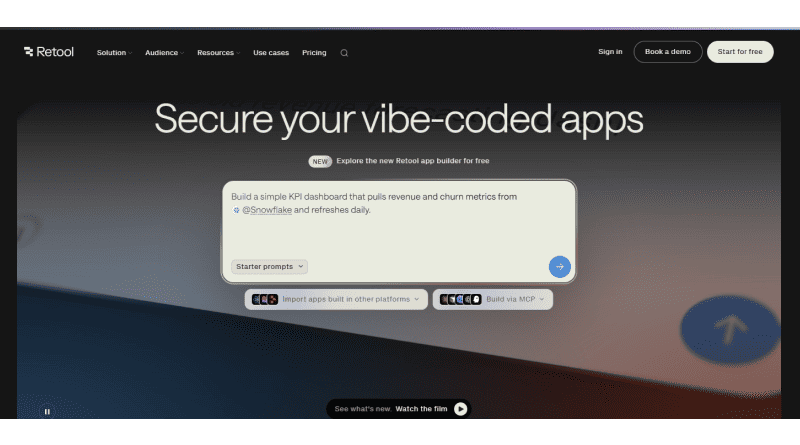
Retool is a UI/app builder that connects to databases you already have. It fetches data from existing database management platforms like Postgres, MySQL, MongoDB, REST APIs, GraphQL, and SaaS tools. Retool has added AI features for instant layout generation.
Retool offers native Git syncing, CI/CD pipelines, and robust Role-Based Access Control (RBAC) to maintain absolute data security. The tool auto-schedules jobs and triggers actions when data updates in the database. It offers dedicated form components and a sandboxed application environment to build custom interfaces of applications. Retool is restricted to a default rate limit of 1,000 requests per minute, and exceeding it will trigger a 429 rate-limit error, which impacts unthrottled loop queries.
👍 Pros
Configurable Self-Hosting
Predictable Concurrency
Generous AI Token Allocations
⚠️ Cons
Aggressive Global Blocks
Low RetoolDB Ceiling
Also Read: PostgreSQL vs MySQL
Which is the Best Airtable Alternative?
There is no standalone best alternative for Airtable. It depends on specific solutions to problems adjacent to Airtable that remain unsolved.
- Notion: Opt for it when your team primarily works with documents over data. Notion serves as a single platform for a wiki, project tracker, and lightweight database, making it ideal for a knowledge-first team rather than a team that relies heavily on transactional data.
- Coda: Choose it for document flexibility with the power of apps and small to mid-size datasets.
- NocoDB: If you prefer Airtable’s UI without any commitments, you’ll find NocoDB to be the choice for you. It’s self-hosted, can connect to your SQL database, and is scalable beyond Airtable’s limits.
- Smartsheet: If your team already works in Excel and is looking for more than a flexible database, then choose Smartsheet, which offers Gantt charts, resource allocation, and the traditional project hierarchy.
- ClickUp: If you’re looking for a project management tool and the database isn’t your main objective, then ClickUp is the right choice.
- Zapier Tables: Choose it only if automation is integrated in your core workflow and you need lightweight storage to support it.
- Stackby: If cost is an important consideration and you’re looking for an Airtable clone with a little extra for free, then choose Stackby.
- Google Sheets: If your requirements are truly simple, such as budgeting, basic tracking, or collaborative and quick work, you should opt for Google Sheets.
- Xano: When you’ve reached the point where you don’t want a visual database anymore, and you need actual backend infrastructure that will scale with API support, you should go with Xano.
- Retool: If you have an existing database and need to create internal tools or applications on top of it, opt for Retool.
👨💻
From the Developer’s Desk
Tools mentioned — Zapier Tables, Xano, Retool, and Notion — are not absolute replacements for Airtable. Xano is a backend infrastructure platform for teams that have outgrown a visual database entirely and need a real API layer. Retool is an app-building tool that works on top of an existing database, rather than as a database itself. Zapier Tables is a lightweight storage layer for automation workflows, not a system of record. Notion is a tailored, AI-powered workspace best suited for skilled developers building personalized dashboards and overseeing projects. If you’re hitting a resource ceiling and need stronger automation, these are the go-to platforms for project and database management.
✍️ From MilesWeb’s Development Team
API Throughput
API Rate Limits, Compared
Requests allowed per minute, normalized from each platform’s published limits.
Zapier Tables
1,800req/min
Retool
1,000req/min
NocoDB
300req/min
Smartsheet
300req/min
Stackby
300req/min
NotionTwo-way sync
180req/min
Coda
100req/min
ClickUp
100req/min
XanoFree tier
30req/min
XanoPaid tiers
No fixed cap
Scales with plan and custom logic
Google Sheets
No fixed cap
Payload-limited (2MB/request) rather than rate-limited
Figures reflect each platform’s published or reported limits at the time of writing and are normalized to requests/minute for comparison. Actual throughput can vary by plan tier, endpoint, and implementation — verify current limits on each provider’s developer docs before building against them.
The Closing Line
Choosing the right Airtable alternative is subject to high-growth agency demand for robust client-facing dashboards, such as SmartSuite and ClickUp, and the developer-first teams prioritizing open-source, self-hosted solutions like NocoDB. Our expert testing indicates that choosing the right platform depends on balancing database performance with specialized needs for security, scalability, and API extensibility.
FAQs
1. What is the cheapest Airtable alternative?
NocoDB is a self-hosted, low-cost alternative to Airtable and is among the most affordable options available. If you’re looking at cloud-based solutions, Smartsheet is the most affordable option with a powerful free version and paid pricing much lower than Airtable.
2. Can I self-host a no-code database for free?
Yes, you can, and you will be able to self-host tools like NocoDB completely free by running them locally on your computer through Docker. The software can be deployed using the “Always Free” tiers of cloud providers, such as Oracle Cloud or AWS, to host your database in the cloud for free.
3. Is there a completely free, unlimited no-code database?
Commercial SaaS providers offer free unlimited storage, but open-source SaaS providers, such as NocoDB, offer unlimited rows and bases at no cost when self-hosted. If you are looking for a fully managed cloud solution, then Google Sheets is the best free option, with a maximum of 10 million cells per spreadsheet.

The Author
Popular on MilesWeb
Back when Amazon had yet to begin its remarkable ascent to the lofty position it has now held for years, did those in the retail industry already have some idea…