

 Jackson Lane
Over 50% of domains are registered through the .com TLD, while only 4% use .net. Both these TLDs were launched in 1985, but the .com domain gained more popularity with time. [Source: Wikipedia] As the internet evolved, most businesses chose .com because it scaled with industry demand, while .net lagged behind.
After 41 years, the commercial TLD has become the core product of the web hosting providers and domain name providers. .net stays confined to specific business verticals. This guide gives you the perfect answer to this split.
Key Summary — .COM vs .net
- 1 Both TLDs launched in 1985, but .com became the commercial default — over 50% of domains use it, versus just 4% for .net.
- 2 .com was built for general commercial activity; .net was built for networking infrastructure — ISPs, hosts, and network providers.
- 3 With 163M+ .com domains registered, short names are scarce — .net’s smaller pool means your exact name is more likely available.
- 4 Google treats .com and .net equally for rankings — content quality and EEAT signals decide search performance, not the extension.
- 5 Choose .com for businesses, brands, and blogs; choose .net for tech, SaaS, and networking companies.
💡
This article comprehensively discusses .com vs .net, covering trust, pricing, SEO impact, and how to choose.
Table of Content
What is a .com domain?
A .com domain, abbreviated as “commercial” was introduced in 1985. Most websites choose this default TLD for their business to extend their global reach.
Many companies choose a .com domain because it conveys professionalism, credibility, and trust. Consumers often perceive businesses with a .com domain as more established and reliable, which can contribute to increased website traffic, stronger brand recognition, and improved domain authority over time.

Key features:
- High recognition and user trust
- Preferred for global commercial presence
- Seen as the standard web domain
What is a .net domain?
The .net extension, launched in 1985, was targeted at organizations in the networking space. Over the years, it has been widely used by tech companies and innovative brands looking for an alternative to .com.

Key features:
- Reflects with tech and networking branding
- Higher availability than .com
- Helps distinguish a tech-forward brand
.com Availability
The .com domain extension is widely used and trusted, so there is an increased demand for premium .com domain names which consequently increases their cost. The domain market is flooded with a few short and easy-to-remember .com domains that are brand-friendly.
You can check the availability of a domain name with MilesWeb’s domain name checker. Securing a .com domain in the beginning saves you from rebranding, buying an expensive domain later, or settling for a challenging name to recall.
.net Availability
The .net domain has been labelled as a go-to alternative to the .com domain. Several tech firms and network providers use this domain extension to create a distinct digital identity. It signals the technical credibility of businesses and digital orientation.
Due to its passive availability and limited demand, users don’t incur heavy expenses for it. Mostly, SaaS brands create a strategic choice to use this domain name reflecting their technical orientation.
.com vs .net: Key Differences
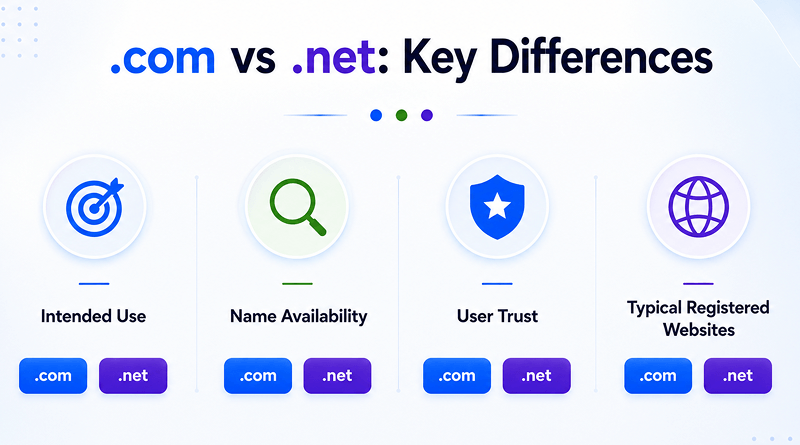
1. Intended Use
Both domain extensions possess distinct approaches and functions in mind. .com was engineered for generic commercial activity such as buying, selling, advertising, or running an online business. Whereas .net secures online identity for organizations, keeping the internet running: ISPs, web hosting providers, and network infrastructure companies. That distinction explains why .com became the catch-all, and .net stayed closer to its technical roots.
2. Name Availability
The popularity of .com is driven by the high demand. With over 163 million .com domains registered, most short and memorable names are gone [Source: Verisign]. In comparison with .com, the .net TLD .net has a much smaller pool of registrations, so the exact name you want is still likely to be available.
Feature
.com
Commercial.net
Network
Both launched in 1985 — same starting line, different paths.
Popularity
User trust
Brand recall
Equal SEO impact — Google ranks neither extension higher than the other.
Availability
Often taken
More available
Best for
3. User Trust
Customer trust has been more on the .com domain for the past four decades. People assume it, type it, and have cognitive bias. .net carries the real credibility, but ideally it is suitable for the tech-savvy audiences who understand the extension.
4. Typical Registered Websites
While .com is a default choice for nearly any online venture, from personal blogs to large ecommerce sites, .net has found a unique niche and is the extension of choice for SaaS companies, tech startups, network providers and IT service providers.
.com vs .net: SEO Benefits
It is essential to implement the right SEO strategies to be competitive in the digital ecosystem. We all want our brand websites to attain higher search engine ranks.
The good news is that there is no concrete evidence that .com or .net extensions directly impact search engine rankings. In fact, many of MilesWeb’s domains attained top ranking on Google through .net and .com domains equally.
So, does .com or .net make any difference in SEO?
In short, not really.
Here’s why:
Many people ask whether or not choosing the right domain name for a website affects search engine results. There are many factors to consider, including schema markups, keywords, content quality, credibility, EEAT signals and intent. The .com is the common domain name of the high ranking sites, but it is more expensive and competitive.
When to Choose .com?
A .com domain name is a good option for a memorable domain name, as people are more likely to remember and type it correctly. Additionally, it can be among the most search engine-friendly domain extensions, given that smartphone keyboards have a dedicated .com key, which makes web addresses much easier to type.
Your .com domain name will not only make your website easier for users to navigate, it can also lend your site credibility and make people remember your website. Whether you’re building a business website, personal portfolio, blog, or online shop, a .com domain is the ideal option for achieving a strong online presence and reaching international customers.
When to Choose .net?
Although .com remains the most popular domain extension, .net continues to be a relevant and valuable choice. The right domain extension depends on your business niche, with .net being suitable for technology companies. For example, the cloud storage service websites can have .net in their suffix.
But here, let’s try thinking outside the box!.
If your goal is to build an online community around a specific interest or niche, a .net domain can be an excellent choice. Well-known platforms such as Slideshare.net and Behance.net have successfully established themselves as thriving community-driven websites, catering to knowledge sharing and creative professionals, respectively.
.com vs .net: Which One Is Better for You?
.com is a popular domain extension that many businesses choose by default. The highly registered TLD is easy to familiarize with and ideal for businesses to augment their online visibility.
Domain Quick Tip
💼 .COM or 🌐 .NET — which fits your project?
Both TLDs launched in 1985, but .com became the commercial default — over 50% of registered domains use it today. .net was built for networking and infrastructure, and now suits tech and SaaS brands looking for a clean, available name.
.COM
Best for businesses, brands, and blogs
.NET
Best for tech, SaaS, and networking companies
💡 Google treats .com and .net equally for rankings — the difference is what your domain signals to a first-time visitor, not your search visibility.
Many experts believe the .com domain is the best available option.
The .com domain is the most recognized and popular domain suffix, and it can help your business get off to a good start. But it is a good idea to register other domain extensions, such as. app,. shop, .store, and .org that define the brand name or a specific market.
Summing Up
Ultimately, the right choice depends on your business goals and the type of website you want to build. If you’re looking to expand business on the global landscape, .com is still the best domain extension to browse in web browsers.
Having said that, .net isn’t a consolation prize. If your work is based on different networks, tech infrastructure, or you’re building a platform rather than a storefront, .net can actually feel more fitting, and it gives you a shot at securing a clean, memorable name when the .com version is long gone or being squatted on by someone else.
A great domain on .net will always beat a mediocre one on .com. Focus on picking a name that’s short, easy to say out loud, and easy to spell after hearing it once.
FAQs
1. What is the difference between .com and .net?
The .com is the standard domain extension for all businesses, e-commerce websites, and branding. The .net extension is used by technical infrastructure, SaaS platforms, and Internet service providers.
2. Should startups choose .com or .net?
For startups, .com is the best domain extension to use, as it is easier for users to remember and avoids being directed to a competitor’s website. If the company is a tech-infrastructure business or the desired .com is too expensive, it is recommended to use a .net domain.
3. Does .net rank lower than .com in Google?
Google’s algorithm treats .net and .com completely equally from a technical ranking perspective. However, .net can suffer indirect SEO impacts if users accidentally link to a competitor’s .com or click on it more frequently in search results.
4. Which domain extension is more trusted by the users?
The .com extension is significantly trusted as the default extension by global users. The tech community has the utmost respect for .net, but .com has become the mainstream TLD for domain admins.