
 Jackson Lane
Most administrators view the domain suffix as a trivial administrative afterthought, a quick checkbox exercise before getting into the actual work of building a server. Your Top-Level Domain (TLD) is basically the final part of your web address, like .com or .net. While it doesn’t directly dictate your website’s ranking in search results, it acts as a signal for both users and search engines in a few key ways.
This isn’t about picking a name that “sounds cool”; it is about selecting the structural foundation for your entire digital identity. If you are starting a new web hosting project, your TLD is the first variable in a long equation of SEO, trust, and brand clarity. This guide eliminates the marketing noise to show you exactly how different extensions function and which ones will actually serve your goals in 2026.
Summary (TL;DR)
Think of a TLD as the final, functional signifier of your web address; it tells browsers and search engines exactly what the website aims to be. You have the universal legacy options like .com for broad reach, and then you have specific country-code or industry-restricted extensions that force search algorithms to view your website through a regional or niche lens. It is not just a suffix; it is an architectural setting that determines how your domain resolves and how users qualify your website’s legitimacy the moment they see the URL.
Table Of Content
How Does a TLD Fit into a Domain Name?
Knowing how your domain is built helps you manage your infrastructure with more control. A domain maps to a specific server, and the TLD identifies the registry responsible for that path.
https:// | www. | example | .com
Protocol | Subdomain | Second-level domain | TLD
When a connection hits the server, the browser pulls the TLD to find the registry governing that extension. For a .com domain, the system checks the global registry to locate the name servers handling your domain. Without this path, the network cannot resolve addresses, which leads to dead links and 404 errors for visitors. Understanding this technical layout remains a basic requirement for anyone managing infrastructure—like a large-scale WordPress network—where stable DNS determines if your website actually stays online.
Related Read: What is Domain Name and How does it work?
What Are the Primary Categories of TLDs?
The Domain Name System classifies these extensions based on their administrative control, intended audience, and registration requirements. Before you settle on a name, you need to understand that these categories define the rules for who can register a domain and what that domain represents to the world.
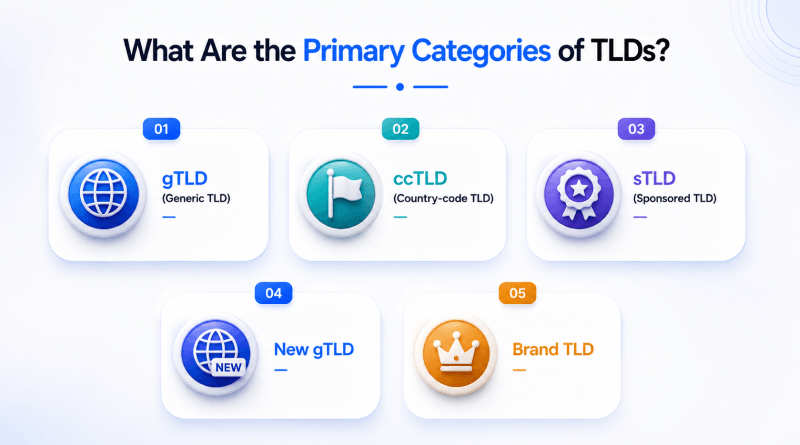
- gTLD (Generic TLD): You see these TLDs everywhere—.com, .net, .org. Because there are no residency requirements or paperwork traps, these TLDs remain the default choice for almost every project.
- ccTLD (Country-code TLD): These are locked to specific regions, such as .in, .uk, or .de. Using one flags your website’s location to users and search crawlers, which works well when you target a specific local market.
- sTLD (Sponsored TLD): Private groups manage these, not the general public. Extensions like .edu, .gov, or .mil mean you are dealing with a verified institution, since you cannot get one unless you actually represent that government body or school.
- New gTLD: A newer batch of extensions like .tech, .store, .ai, .shop, or .dev. Registries released these to help clear out the naming bottleneck, giving people more ways to grab a domain that actually describes what they do.
- Brand TLD: Large companies run these internally—examples include .google or .microsoft. You will never see these on the open market, as they exist solely to support the company’s private network.
Related Read: What Is a TLD? A Clear Guide to Its Meaning, Types & Examples
Which TLDs Are Dominating in 2026?
Traditional domain extensions still dominate, but newer labels have become much more common over the last few years. Picking an extension that provides actual value is more effective than following generic advice when you select a name for your next project.
1. .com—Universal Business Standard
It is the clear choice for professional credibility. Users lean into it because they have seen it for decades, which builds immediate confidence in the website. By securing your brand’s .com domain name, you also stop potential customers from accidentally landing on a competitor’s page if they happen to own that version of the name.
Core Benefits
- Unmatched brand recognition and user recall.
- The go-to choice for running e-commerce websites or managing heavy traffic.
- These domains hold their resale value better than almost anything else when you are liquidating digital property.
2. .cn — China Market Access
If you are doing business in China, you need a .cn domain. It is the most common extension in the country, and having one is the only way to establish the local presence needed to actually reach a Chinese-speaking audience.
Core Benefits
- Essential for local market entry
- Massive regional registration volume
- High trust for local entities
3. .de—Germany’s Trusted TLD
This extension is the go-to pick for German business. Local users there trust it for transactions, and it acts as the primary signal for anyone trying to rank or operate effectively across Europe.
Core Benefits
- Trusted by German users
- Reliable for European operations
- Boosts local SEO relevance
4. .xyz —Modern and Flexible
You will see this domain pop up everywhere once the .com version of a name is taken. Because it does not lean toward any specific industry, it works as a generic placeholder for almost anything.
Core Benefits
- Fits any industry type
- Go-to for Web3 and startups
- High market adoption rates
Related Read: Why .XYZ Domain Is The Most Trending Thing Now?
5. .net—Internet Industry Classic
This one is usually the go-to solution when you cannot find a .com that works. It has been around since the start, so people take it seriously. It is still the standard for hosting providers, ISPs, and anyone else working in network infrastructure.
Core Benefits
- Retains legacy internet trust
- Ideal for infrastructure providers
- Recognized by technical professionals
6. .org—Purpose-Driven Presence
This extension remains the standard for NGO’s and non-profit organizations. People recognize it as the place for information rather than sales, and the high renewal rates show that the organizations using these websites are in it for the long haul.
Core Benefits
- Signals community-driven focus
- High user retention rates
- Standard for informational websites
7. .shop / .store—Built for Selling
These extensions are what you pick for retail. They tell a visitor exactly what to expect before they even click, and because they are newer, it is much easier to grab a clean, descriptive name compared to the older options.
Core Benefits
- Signals clear buying intent
- More available naming options
- Modern feel for e-commerce
8. .tech—Technology First
Use this TLD for your dev tools and engineering projects when you want to attract only the right people. Because the name acts as a filter, you reduce random traffic from people looking for something else.
Core Benefits
- Highlights technical focus
- Perfect for developer tools
- Attracts industry-specific audience
Related Read: Domain Name Trends: .com vs .tech vs .io for Startups
9. .dev—Developer Preferred
This extension has effectively become a badge of honor for developers. Because it forces you to use HTTPS, your website is technically more secure right out of the box, which is a great starting point for any project.
Core Benefits
- Enforces HTTPS
- Shows technical skill
- Clear branding for developers
10. .ai—AI-Focused Identity
This TLD has become the standard choice for anyone launching an artificial intelligence project. Startups grab it to signal their focus immediately, which is useful when trying to catch the eye of people in the tech investment space. It acts as a quick tag to show your business is built around the latest trends.
Core Benefits
- Instant industry alignment
- High value in tech investment
- Builds credibility with investors
Related Read: Why Hosting on a .io Domain Is a Strategic Branding Move
Who Actually Manages the TLD Ecosystem?
ICANN runs the central database that links your domain name to the right IP address. They don’t manage the internet itself, but they set the rules for the registries that control each TLD to keep the whole system from breaking.
When you buy a domain, you are basically renting an entry in their database. You should only use an ICANN-accredited registrar to ensure your name stays locked to your account and under your legal control. This matters just as much when you are using free web hosting for a side project as it does when you scale up to a professional server.
Closing Insight
Selecting a TLD is a functional decision that dictates your brand’s placement in the global registry. Different extensions carry different weight, and skipping over those details can impact your search traffic and how users view your website.
Forget the hype of temporary trends and pick an extension that actually fits your setup. Your domain is the anchor for your online presence; treat it that way, and you will have a better base to build on later.
FAQs
1. How many TLDs are there in 2026?
There are over 1,500 TLDs currently available. This number isn’t fixed, as new options keep increasing in the root zone as registries push for more variety.
2. What is the most popular TLD?
.com is the default, mostly because of muscle memory. It has been around forever, so users just expect it. Nothing else has even come close to those install numbers.
3. Is .com better than other TLDs?
.com is the most recognizable option. Users tend to click it instinctively, while you often have to do more explaining when using newer or niche extensions to show they are legitimate.
4. Can I change my TLD after launching my website?
Changing it is a nightmare of website migrations and redirects. You end up risking your search rankings and confusing your repeat visitors, so you are better off getting it right the first time.