
 Jackson Lane
Starting an e-commerce store? It’s good to choose the right tool between the debate of Shopify vs. WooCommerce. These are two popular e-commerce platforms that elevate the online shopping experience for shoppers and buyers. Now, the most challenging decision to make is, ‘Which is the right e-commerce platform, Shopify or WooCommerce?’
Investing in the right e-commerce platform will skyrocket your sales. The article solves your queries and saves you from switching to the right e-commerce platforms. Before selecting an e-commerce platform, let’s start with the factors you must analyze.
Table Of Content
What is WooCommerce?
WooCommerce was launched in September 2011 by WooThemes. It is a WordPress plugin that has millions of active downloads to date. Integrating it into your WordPress website will turn it into an online store. But like Shopify, it is not a standalone e-commerce platform.
Installation is easy, as it is an open-source plugin. WooCommerce is a suitable option for restricted budget users. You access a long list of extensions and integrations of the WooCommerce marketplace.
What is Shopify?
Shopify is a standalone and open-source e-commerce platform offering a wide range of features with customized needs. It costs a fixed monthly fee and draws commission on every sale. With Shopify, beginners easily build an online store from scratch with zero coding skills.
However, customization may require professional assistance. As an e-commerce platform, Shopify is known for its intuitive interface and is considered the benchmark.
WooCommerce: Pros and Cons
WooCommerce Pros
- Open Source: Users without technical knowledge can access this platform and perform as much customization as they want. The active developer’s community releases regular updates for plugins.
- Cost-Effective: Less investment and higher expected returns. It is one of the best WordPress plugins for free, where you only have to pay for WooCommerce hosting and a domain.
- WordPress Integration and Plugins: WooCommerce is a WordPress-compatible plugin with lots of content management capabilities. Also, there is a vast plugin/theme library that is accessible with the WooCommerce store. It works on areas like security, SEO, backups, payment gateways, etc.
- Customizable: It is possible to create a highly customized online store with access to code and a vast community of developers. It may require some technical assistance, however.
WooCommerce Cons
- Customizable: You can build a highly customized online store that has access to code and an enormous community of developers. A certain level of technical support might be needed.
- Needs Technical Skills: The minimum level of programming skills needed to create a store with WooCommerce is at the beginner level. This should be supported by professional development or technical advice.
- Maintenance: The store owner will be responsible for making updates, backups, and security because the solution is self-hosted.
- Potential Compatibility Issues: Sustaining website modules is a time-consuming activity. The system might be uncooperative with updates when a specific update on the plugins has the potential to negatively impact the store.
- No Customer Support: WooCommerce lacks in offering customer support due to the absence of an in-house technical support team. However, active forums can assist in technical issues.
Shopify: Pros and Cons
Shopify Pros
- User-Friendly Interface: Shopify’s dashboard is user-friendly. Even beginners can set up a store and manage it.
- A Decent Range of Themes and Templates: Customizable templates are easier to download and cater to several types of businesses.
- Integrated Payment Gateway: Shopify Payments accepts credit cards as well as other payment gateways. A simple solution is available to merchants who do not want to complicate matters by integrating payment gateways.
- 24/7 Customer Support: Shopify provides round-the-clock customer support via phone, chat, and email. This means if you ever get stuck, help is readily available.
Shopify Cons
- Transaction Fees: Be ready to bear additional transaction fees if you are not using Shopify Payments. It will be an issue for stores that can’t afford these additional costs.
- Customization Limitations: Shopify has advanced customizations for e-store building. To do more complex customizations, users have to gain expertise in ‘Liquid’ (the templating language used by Shopify).
- Cost: Shopify can be an expensive platform due to the monthly fee, transaction fees, and paid-out apps or themes. Specialized customizations might need a developer and will increase the total cost.
- Platform Lock-in: It can be challenging to migrate away from Shopify to another platform, especially if you have used many Shopify-specific features or apps.
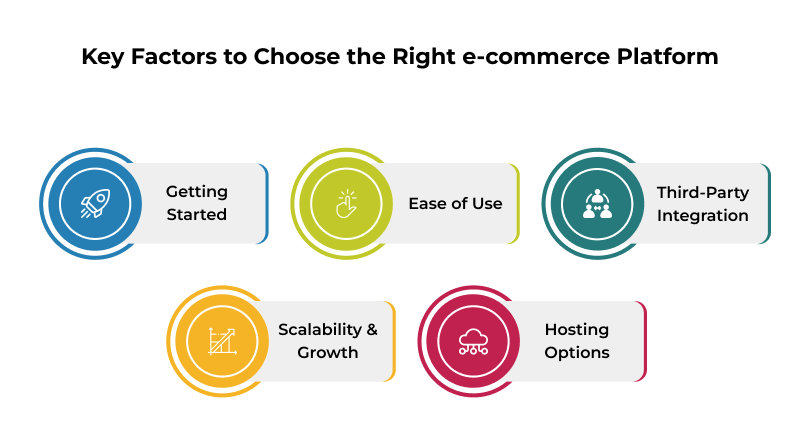
Key Factors to Choose the Right e-commerce Platform
1. Getting Started
If you are familiar with WordPress and its ecosystem, WooCommerce is a go-to choice. There are several online tutorials and guides available to build a store quickly.
Shopify is the reliable platform to begin with. It guides you through creating an e-commerce store without any technical skills required.
2. Ease of Use
Online store owners must focus on business operations rather than CRM, generating order invoices, or negotiating with vendors.
Both WooCommerce and Shopify have features to make such tasks easier, but WooCommerce has an edge. It eases the e-commerce payment processing for users who prioritize ease of use.
3. Third-Party Integration
It is necessary to use multiple tools and services to run an e-commerce store, including email marketing and social media marketing. Choose an e-commerce platform that integrates easily with these tools. WooCommerce, for example, integrates with MailChimp.
4. Scalability and Growth
The e-commerce platform you choose should support your business’s growth without limiting it. Make sure your e-commerce platform allows customization and scalability so you can grow your business as you see fit.
5. Hosting Options
For e-commerce stores that experience traffic spikes during sales and special offers seasons, web hosting is crucial. As a proprietary platform, Shopify hosts your e-commerce store on its servers.
To ensure your e-commerce store remains operational regardless of traffic spikes, WooCommerce provides the ability to choose the provider to host your store.
The Closing Line
Simplicity and version control are two major considerations for the right e-commerce platform. New-age entrepreneurs prioritize ease of use, minimal maintenance, and rapid scaling with a higher recurring cost. Shopify is the perfect choice for them. WooCommerce demands total ownership, deep customization, and leveraging WordPress flexibility, provided they have the necessary technical expertise. Thus, the “perfect” platform is not a universal constant but the one that precisely aligns with the store owner’s technical skill, budget, and long-term business vision.
FAQs
1. Does WooCommerce or Shopify provide better built-in SEO capabilities?
Shopify provides simpler, more effective built-in SEO for beginners, but WooCommerce (through WordPress plugins like Yoast) offers far deeper and more advanced control.
2. Is it easier to set up a store with Shopify or WooCommerce?
Shopify is significantly easier and faster to set up because it’s an all-in-one, hosted platform.
3. Which platform is better suited for dropshipping, Shopify or WooCommerce?
Shopify is generally favored for dropshipping due to its simple, dedicated app ecosystem and seamless integrations.
4. How do the availability and cost of themes and extensions compare between the two?
WooCommerce boasts a vast number of free themes and plugins, while Shopify’s curated App Store is generally more polished but often carries higher recurring costs.