Jackson Lane

If you have purchased the domain recently, you may have come across the billing cycles. Multi-year terms sound suitable for established businesses, or domains, but are not the right fit for everyone. If you are testing the pilot project, running a short campaign, or trying a domain registrar for the first time, annual registration keeps your costs and commitments lower, and you always extend it later.
The guide explains when a one-year term is sensible and when a longer one is the better choice, determining the project’s future. We have discussed the hidden costs to watch for, such as renewal price spikes, and how to manage a short term so you never lose a domain by accident. Weighing a holiday season sale, our Black Friday deals guide briefs you on whether you should purchase the domain or not.
Table of Content
What is Short-Term Domain Registration?
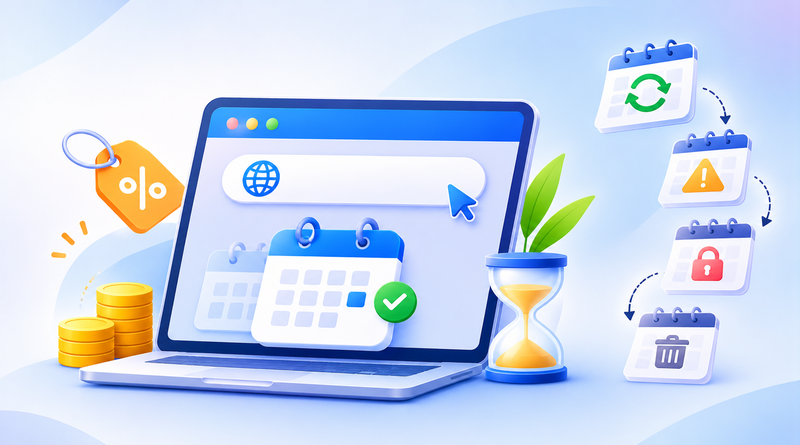
A short-term domain registration means registering a domain for one year, which is the minimum term at most registrars, instead of committing to a multi-year term of two to ten years. When the registration term ends, you can renew the .in domain, .com or any other to keep the name, but most registrars will charge a standard renewal rate that is higher than the introductory price you initially paid.
If you miss the renewal data, the domain doesn’t vanish immediately. It just migrates through a grace period, then a redemption period with extra recovery fees, and finally a pending delete stage before it is released to the public. We explain in our guide what happens if the domain is not renewed. That makes a one-year flexible, but it also means you will want auto-renewal or reminders in place so the name doesn’t lapse by accident.
Also Read: 1-Year vs Multi-Year Domain Registration: How to Decide
When Does a 1-Year Term Make Sense?
1. Testing a Business Idea or Side Project
If you are unsure an idea will take off, a one-year term lets you test it without tying up money in years of registration you never use. You get the complete year to build the website, find an audience, and see whether the project status is active or not. If it works, you extend the registration, and if not, you can let the name expire or move on.
2. Short Campaigns, Events, or Product Launches
A domain created for a campaign, conference, or product launch has a limited lifespan. One-year registration covers the run-up, the event, and the follow-up, with room to spare. Thereafter, you can redirect the domain to your main website or let it lapse, rather than paying for years of a name that has done its job.
3. Trying a New or Unfamiliar Extension
Unfamiliar extensions are bundled up with exclusive features, such as stricter eligibility rules, higher renewal prices, or a reputation that affects email and trust. A one-year term allows you to test how an extension performs for the audience before commitment. It is especially helpful during a trend, since domain extensions like .icu or .art are unpopular.
4. Tight Budget or Uncertain Cash Flow
If you are launching with the limited funds, paying only for 1 year lowers the upfront costs and keeps cash free for hosting. It helps when income is unpredictable, such as for freelancers or early-stage startups. Just set a reminder or auto-renewal so a busy month doesn’t cause you to miss the renewal date.
5. Domains You May Sell or Drop
If you are holding a domain you might sell, or you are not sure it is worth keeping, a one-year term limits the risk. You pay renewal costs only for names providing value or utility, rather than locking in several years on one that doesn’t. This is a common approach for people testing names for future projects.
Does Registration Tenure Affect SEO or Credibility?
Google said fairly directly that it doesn’t give a ranking boost just because a domain is registered for ten years instead of one. The system looks at things like content quality, helpfulness, backlinks, and the user experience of your website.
A 10-year registration on a thin, copied website will still struggle, while a one-year registration on a helpful website ranks well. That said, a domain’s age and history do matter in a different sense. An established domain has earned trust over time by publishing high-quality content. A domain’s value is based on its quality, not how long it has been paid for.
Also Read: What is Domain Investing?
Conclusion
A one-year registration is not just a red flag or a mistake but the sensible choice when the situation calls for it. Testing a new business idea, launching a short-term campaign, or running an event website are perfect scenarios for 1-year domain name registrations. In those cases, committing for a decade would mean paying for time you may never use.
The key is to match the term to your plans, not to guess about SEO. Search engines won’t reward or penalize you for how long you have paid ahead, so choose length that suits your budget and the timeline. Whatever you pick, enable auto-renewal, keeping contact details updated so a missed reminder never turns into a lapsed domain. And once your project proves itself, you can always extend the registration and give it the longer runway it deserves.
FAQs
1. Does a 1-year domain registration hurt my website’s SEO?
Search engines like Google do not penalize websites for having a short-term registration period. Your search rankings depend on content quality, site speed, and backlinks rather than how many years you paid for upfront.
2. Can I easily upgrade to a multi-year plan later on?
es, you can extend your domain registration at any time through your registrar’s billing dashboard. You can simply add extra years onto your current term whenever you feel confident in your project’s long-term future.
3. Why is the second-year renewal price much higher than my first year?
Most registrars offer steep introductory discounts for the first year to attract new customers. Once that initial 12-month promotional period ends, your domain automatically renews at the registrar’s standard retail rate.
4. How can I prevent my 1-year domain from accidentally expiring?
Turn on the auto-renewal feature in your account settings immediately after purchasing your domain. You should also keep your billing card details updated and ensure your primary email address receives renewal reminders.