
 Jackson Lane
Somewhere between a founder sketching a logo and registering the first domain, a quiet migration happens. A company that never even launched already claimed the obvious .com name years ago. So the search shifts, almost without anyone deciding it consciously, toward two letters that were never meant to mean anything at all: .io. What started as a workaround has turned into a preference of its own, one that now shapes how an entire generation of tech products introduce themselves.
The two letters earn attention on their own. Everything that keeps the domain safe still has to be built separately. Turning that attention into something lasting means finding a registrar that renews fairly, secures the domain properly, and pairs cleanly with dependable web hosting once the product needs more than a landing page. This guide maps out what a .io domain actually represents, why founders keep reaching for it before anything else, and which five registrars in 2026 are worth comparing.
Table Of Content
What Is a .io Domain?
British Indian Ocean Territory. That’s the actual namesake behind .io, a detail most founders discover only after they’ve already registered one. Somewhere in the 1990s, developers noticed the letters spelled out “input/output,” and the coincidence stuck harder than the geography ever did. Anyone can register the .io domain tld today: no residency, no business license, and no waiting period. That openness is precisely why the registrar matters more than the extension itself: the same two letters, sold by five different companies, come with five very different ownership experiences.
What Are the Benefits of a .io Domain?
The moment a startup switches to .io, six things change, whether founders notice them immediately or not.
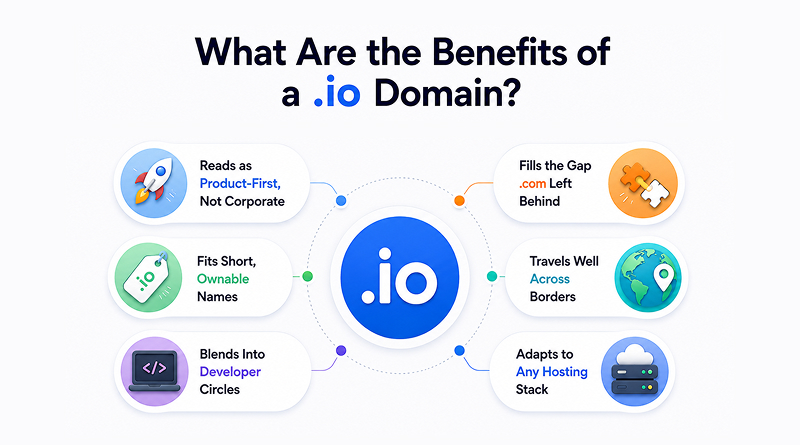
Reads as Product-First, Not Corporate
An .io website carries a startup accent before a single feature loads. Visitors assume software, not a sales pitch.
Fits Short, Ownable Names
Two letters leave more room for a sharp brand name, instead of stretching it across three-letter alternatives.
Blends Into Developer Circles
GitHub repos, API docs, and open-source tools already lean toward .io, so new products blend in immediately.
Fills the Gap .com Left Behind
Most clean, single-word .com names disappeared years ago. Their .io equivalents often remain available instead.
Travels Well Across Borders
Nothing ties the extension to one country’s audience, which suits a product built for users well beyond India.
Adapts to Any Hosting Stack
Shared servers, VPS, and containers, regardless of the backend, .io does not require a specific setup.
Who Are the Top 5 .io Domain Name Providers?
Every registrar looks similar at checkout. The real differences show up months later, in renewal prices, support tickets, and how easily the setup scales. Here’s how five common choices actually hold up.
1. MilesWeb
Scaling tends to expose a weak registrar quickly, which is where MilesWeb earns its name. Domain checkout here isn’t the whole product; it’s the entry point into infrastructure that scales without a migration headache. WHOIS privacy comes free by default. DNS changes run through a dashboard built for people who actually administer servers, not just billing pages. When a product moves past a single landing page, upgrading to VPS hosting happens without re-pointing nameservers or losing uptime mid-switch. Data centers based in the region keep response times low for a user base close to home, useful long before international traffic shows up. Renewal pricing is disclosed upfront, at the time of purchase, and support operates 24/7 through a team equipped to diagnose server-level issues.
Technical Edge
- Free WHOIS privacy by default
- Dashboard-level DNS control
- One-click VPS upgrade path
- Global data centers for lower latency
- Round-the-clock, engineer-led support
- Renewal pricing visible at signup
Related Read: Best .Org Domain Name Providers
2. GoDaddy
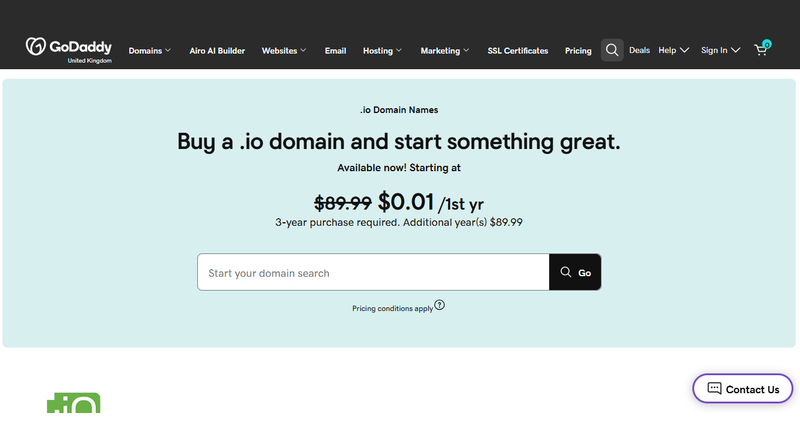
Most people know GoDaddy before they know what a registrar even does, and that brand recognition carries real weight. The catalog covers dozens of extensions beyond .io, alongside country-specific options through various .in domain name providers partnerships. That range helps founders lock down a name across several platforms in a single purchase. Setup takes minutes through either the mobile app or the browser dashboard. The catch shows up at renewal, when prices often climb past what the first-year offer suggested. Support runs continuously, though response times stretch when queries land during GoDaddy’s busiest US hours.
Quick Snapshot
- Broad extension catalog beyond .io
- Fast setup via app or browser
- Introductory pricing available in year one
- 24/7 support coverage
- Domain privacy available as an add-on
3. Hostinger
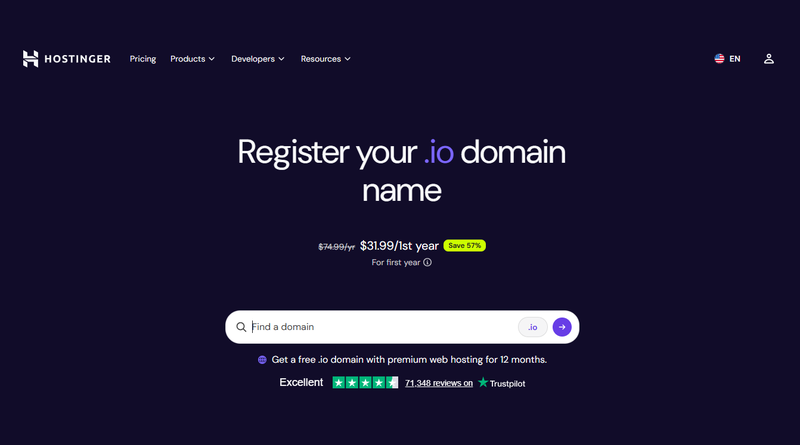
Founders bootstrapping their first product tend to land on Hostinger through word of mouth, not marketing spend. Entry pricing on .io registration runs lower here than most competitors, and hosting bundles sweeten the deal further. Stores built with WooCommerce hosting specifically benefit, since the platform tunes plugin performance and checkout speed for that exact setup. Free SSL ships with every plan, and the control panel stays simple enough to configure without a developer on standby. What’s missing is depth. Advanced DNS routing and infrastructure scaling aren’t the focus here, and that gap shows once a product needs more than shared hosting can offer.
Why Founders Pick It
- Lower entry pricing on .io domains
- Free SSL included on all plans
- WooCommerce-tuned hosting bundles
- Simple, beginner-friendly control panel
- Advanced DNS options
Related Read: Top WooCommerce Hosting Providers
4. HostingRaja
HostingRaja skips the global positioning entirely and builds for one market only, India. Billing runs in rupees from checkout through renewal, with no conversion math involved. Servers run out of Indian data centers, which is relevant for a product built around a domestic user base. Support picks up during regular Indian business hours instead of routing through a distant time zone, and web hosting bundles here often come cheaper than buying the two pieces separately. Documentation stays practical, covering setups Indian developers actually build rather than every theoretical configuration. The trade-off appears once a startup scales past a regional audience, since enterprise tooling and advanced infrastructure aren’t really on offer.
Where It Fits Best
- India-only data centers
- Rupee-based billing throughout
- Business-hours regional support
- Practical, India-specific documentation
- Bundled domain and hosting discounts
Related Read: Free Web Hosting Providers
5. Namecheap
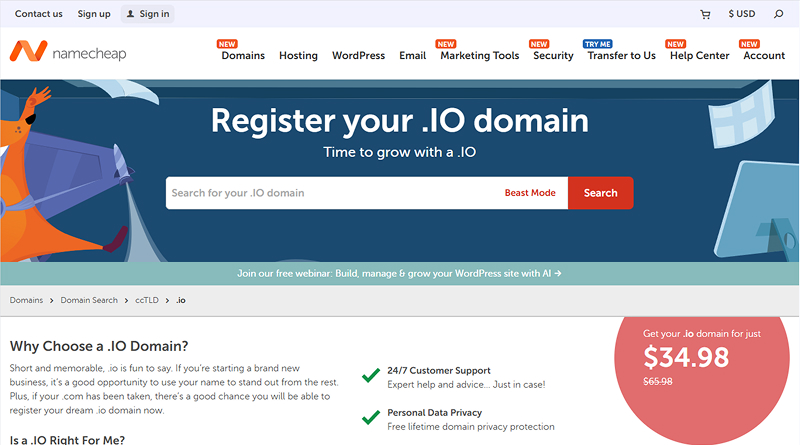
Namecheap built a following by doing one thing without the usual sales pressure: showing the real price before asking for a card number. First-year and renewal costs line up side by side at checkout, no fine print required. WHOIS privacy comes included instead of costing extra, unlike some competitors. A founder can add a .email domain in a few clicks, getting a professional inbox in place before the product even releases. Live chat handles most questions fast, but a trickier technical issue can mean waiting for a second reply. Beyond domain and business email, hosting stays fairly basic, so a startup with heavier infrastructure needs will likely outgrow it at some point.
Core Highlights
- Transparent first-year and renewal pricing
- Free WHOIS privacy included
- Quick .email domain setup
- Responsive live chat support
- Limited hosting infrastructure beyond domains
Related Read: Best Business Email Hosting Providers
How Do These Providers Compare at a Glance?
The table below lines up how each provider actually handles the domain itself, from pricing to privacy to renewal terms.
| Provider | Strongest At | Renewal Pricing | Best Fit |
|---|---|---|---|
 |
Free WHOIS privacy, transparent renewals | Stays honest after year one | Startups planning ahead |
 |
Widest extension selection | Jumps after year one | Buyers registering multiple domains |
 |
Lowest entry price on .io | Barely moves at renewal | Bootstrapped founders |
 |
Rupee billing, India-based support | Flat, rupee-based | India-only startups |
 |
Upfront pricing, free WHOIS privacy | Listed clearly at signup | Founders wanting simple registration |
How Should a Founder Actually Weigh These Options?
A low price at signup hides most of what actually shapes a product’s first year. A solo builder testing a weekend idea has different needs than a funded team gearing up for a real launch. Early on, the cheapest reliable option makes sense, as long as SSL security isn’t the thing being skipped to save a few rupees. Once real users show up, infrastructure depth becomes more important than the sticker price, since switching hosts mid-growth costs far more time than paying slightly more from day one. The right choice isn’t the cheapest name or the most familiar one. It’s whichever registrar still makes sense a year from now, not just at checkout.
Related Read: Top 10 Best SSL Certificate Providers
What Common Mistakes Should You Avoid While Choosing a Provider?
The domain rarely causes trouble on its own. Most of the pain comes from decisions made around it, ones that only surface months later.
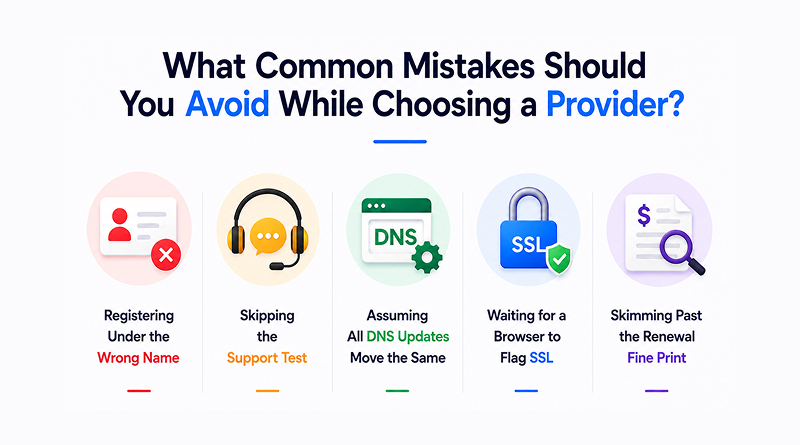
Registering Under the Wrong Name
A co-founder or agency that holds the account can complicate a straightforward transfer, leading to legal disputes later on.
Skipping the Support Test
A slow first response during evaluation usually predicts how every future ticket gets handled.
Assuming All DNS Updates Move the Same
Some registrars update nameservers in minutes; others take a full day, and that gap matters during a launch.
Waiting for a Browser to Flag SSL
Visitors notice a security warning long before anyone on the team does.
Skimming Past the Renewal Fine Print
A discount that looks generous in year one can double, and sometimes triple, once it ends.
Closing Insights
The right .io registrar matches where a product actually stands, not whichever deal happens to look the flashiest. GoDaddy suits founders wanting variety in one account; Hostinger fits a tight early budget; HostingRaja serves a startup staying local, and Namecheap keeps pricing transparent from day one. MilesWeb stands apart from all four once real growth enters the picture, backed by VPS-ready infrastructure, engineer-led support, and renewal pricing that stays honest well past the first year.
Every registrar on this list can hand over a working .io domain today. Only one of them is built to keep up with a product that outgrows its first version, its first hundred users, and its first big traffic spike. That’s the difference worth paying attention to, and it’s precisely what turns a viable idea into something built to last.
Frequently Asked Questions
1. Who should use a .io domain?
Tech founders, product teams, and developers who prioritize software-first solutions benefit the most from it. Anyone whose brand needs to signal “built for the internet” before a visitor reads a word of copy fits naturally here.
2. Is a .io domain suitable for AI and SaaS businesses?
Yes, and arguably more than most other extensions. AI tools, SaaS platforms, and developer-facing products already cluster around .io, so a new company entering that space fits right into an audience that already trusts the extension.
3. Which .io domain provider offers the best value for money?
It depends on what the startup actually needs beyond registration. A founder chasing the lowest checkout price will land somewhere different than one who needs infrastructure that scales, so “best value” changes based on how far the product plans to grow.
4. How much does a .io domain cost?
Pricing varies by registrar and shifts over time, so it’s worth checking current rates directly with whichever provider is under consideration rather than relying on a number that may already be outdated.