

 Jackson Lane

Launching a new project usually starts with a late-night search for no-cost servers, but the reality of free web hosting websites rarely matches the marketing pitch. Most creators experience directly that an unverified, entry-tier free web hosting server stays online until you actually try to show your work to a client or stakeholder. The moment several people click your link at the same time, the connection drops, leaving you with a generic timeout error instead of a working website. Securing a reliable web hosting environment before you begin deployment is the only way to protect your code from these sudden, unexpected interruptions.
Nobody browses the web hoping for a slow loading screen, yet thousands of live websites run on hardware that can barely handle three simultaneous visitors. If a spike in traffic leaves your audience staring at a timeout error, your hosting environment has failed you. Nobody wants to micromanage server limits every time a piece of content gains traction. If you want your website to stay online consistently, your setup needs to grow on demand. Choosing scalable cloud hosting guarantees that sudden traffic jumps won’t trigger resource errors or knock your website offline.
Table Of Content
Why Is Free Web Hosting So Popular?
Thousands of students and bootstrapped developers drive the massive demand for free web hosting, seeking merely to push source code online without a bill. Testing an app or showcasing a portfolio requires a live URL, but standard monthly hosting costs do not fit into a student budget. Most global platforms require a credit card just to unlock a basic trial. That requirement excludes a significant segment of local talent relying entirely on UPI or debit cards. By dropping the price tag and skipping those rigid signup blocks, free web hosting services let you start experimenting immediately.
What Should You Check Before Choosing Free Web Hosting?
Before choosing any free hosting provider, it’s worth checking a few important things because the overall experience can vary a lot from one platform to another.
- Real Uptime: Select infrastructure backed by a formal availability commitment so your pages stay online when multiple users browse simultaneously.
- Forced Ads: Most zero-cost platforms inject intrusive banners or pop-ups to monetize your traffic, which compromises your layout design.
- Resource Ceilings: Check to ensure you do not exceed the limits of both RAM and CPU designated for your account, as running a script with slightly too much processing power could get your account suspended instantly.
- Backup Access: Ensure you know how to get data out of your free host; if automated snapshots are not available, exporting all your databases will be very time-consuming.
- The Interface: Finding cPanel free website hosting options makes a massive difference because managing file directories and databases stays familiar and straightforward.
Who Are the Best Free Web Hosting Providers?
1. MilesWeb
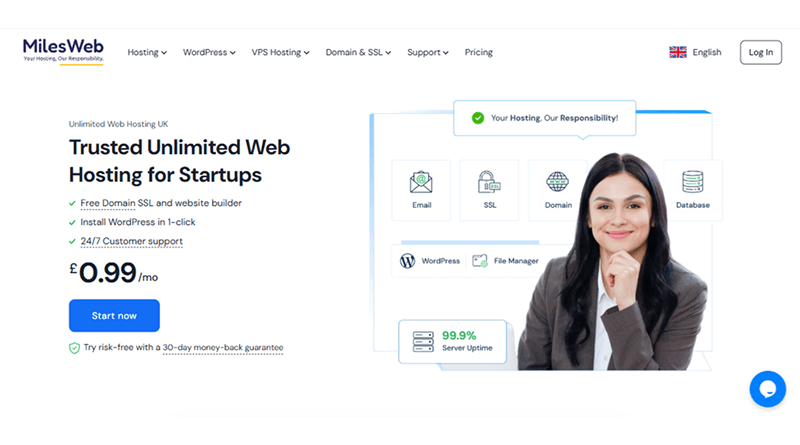
MilesWeb changes the expectations around complimentary infrastructure by offering a high-performance environment built on the exact same architecture as its premium services. This platform delivers a seamless, ad-free environment equipped with lightning-fast NVMe storage and robust data protection protocols to secure your files. Because this solution targets users who plan to scale smoothly, the environment supports automated daily backups and free professional email accounts right out of the box.
MilesWeb avoids the usual slowdowns of crowded shared servers by tuning the infrastructure from the start. You get free website hosting with cPanel setup right out of the box, making it simple to drop in files, spin up databases, and link your domain without a headache. The system runs on SSD NVMe disk storage to deliver ultrafast website speed, while built-in server caching speeds up delivery so your visitors across the region don’t deal with lag. MilesWeb’s fully optimized WordPress environment ensures rapid site deployment, enabling you to build and customize your pages efficiently with the website builder.
Key Features
- Lightning-Fast NVMe Storage
- Automated Daily Backups
- Free Website Migration
- Advanced Server-Side Caching
- 30-Days Money Back Guarantee
2. Hostinger
Hostinger captures the attention of web newcomers by offering a specialized setup built for those looking for free web hosting for students aiming to master website creation. The service eliminates financial friction for learners who want to practice building layouts using modern design frameworks. By utilizing an intuitive, custom-built hPanel, the platform helps users upload media files and organize directories without overwhelming technical jargon. It works beautifully as a stepping stone for individuals learning the fundamentals of website architecture.
The server configuration handles low-volume traffic cleanly, ensuring that your portfolio stays visible while you share it with peers or prospective clients. Resource allocations stay locked at entry-level metrics, which teaches users to write clean, unbloated code to maximize performance. Many consider it the best free web hosting option for complete beginners who just want to practice UI layouts.
Key Features
- Custom-Built Control Panel
- Intuitive Media Upload Tools
- Low-Volume Traffic Optimization
- Minimal Interface Advertisements
- Framework Learning Support
3. Namecheap
Namecheap introduces users to the online space by tying temporary introductory server space to its mainstream domain registration platform. This arrangement allows students and budding developers to link a new free web hosting domain to a functional testing environment within a single dashboard. The platform keeps the user interface remarkably clean, focusing on helping beginners deploy basic web layouts without configuration issues. It provides a direct setup for users who want to deploy a basic website quickly.
The backend servers handle basic PHP scripts and light databases easily, giving you an easy environment to test standard content management systems. You handle domain registration and DNS routing directly inside the dashboard, pointing your name servers within moments. If you need reliable free web hosting with domain configuration for a small project, this setup functions as a great sandbox for learning the mechanics of deployment.
Key Features
- Integrated Domain Management
- Clean Deployment Interface
- Basic PHP Script Support
- Simplified Name Server Updating
- Modest Database Storage
4. Ultahost
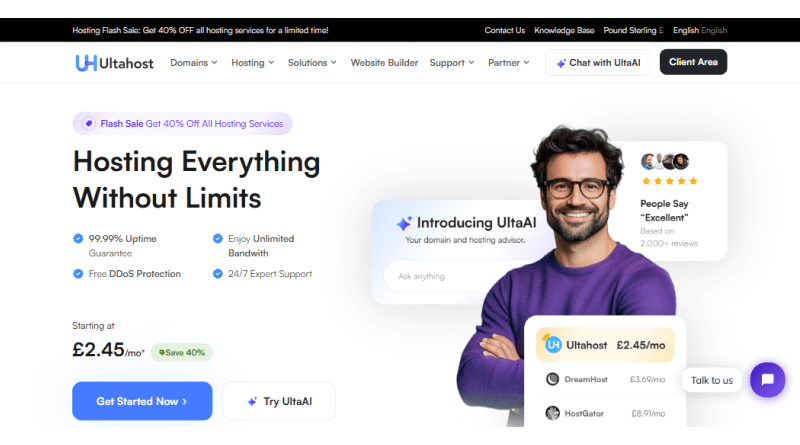
Ultahost targets the technical segment of the market by offering specific options for student free web hosting setups where users need to deploy complex applications. This platform focuses on providing a highly secure environment where users can write code without worrying about immediate cross-site vulnerabilities. Ultahost offerings include basic malware scanning and firewall protection, which is rare for zero-cost tiers in the current market.
This setup runs scripts smoothly, allowing you to easily test application code or lighter web apps before deploying assets to production. Management is straightforward too, with a clean dashboard for handling directories that feels surprisingly close to a premium cloud platform. You do have to track the restrictive bandwidth limits, but it remains a top free web hosting choice for quiet, secure testing.
Key Features
- Basic Malware Scanning
- Automated Firewall Protection
- Streamlined Dashboard Controls
- Optimized Script Execution
- Secure Multi-Tenant Isolation
What Are the Benefits of Free Web Hosting?
Free web hosting lets creators establish an immediate online presence, allowing you to channel your entire budget into content and product development instead of upfront server costs.

- No Financial Risk: If a project goes in a different direction, you can test as many different website concepts and ideas for development without losing your money.
- Perfect Learning Environment: You receive a live environment to test code, manage a database, and configure directories safely.
- Faster Deployment: Most hosting companies will approve your account instantly so that you can have your files live on the internet in a few minutes.
- Domain Integration Testing: You can learn how to link a free web hosting and domain configuration to understand network traffic routing.
- Real Resource Testing: Free tiers let you monitor memory use and database limits, showing exactly what hardware you need before paying for an upgrade.
- No Long-Term Contracts: There are no restrictions for you to move your data without paying cancellation fees at any time.
Free Web Hosting vs Paid Hosting: What’s the Difference?
The difference between free and premium hosting providers is determined by the separation of resources and level of operational guarantee. Free hosting uses servers that have many people utilizing the same server resources, which can cause problems if one of the other websites generates a high level of traffic and causes latency or a server error to your pages. This crowded environment means a traffic spike on an unrelated website can instantly slow down your pages or trigger server errors. With premium hosting, you will have dedicated resource allocations for your project, so you can count on consistent page loads and reliable data transfer, regardless of what is happening on the network external to your hosting facility.
Furthermore, free hosting tiers rarely come with reliable support or advanced configuration rights. If you are experiencing an outage on your database or if there is an update that breaks the configuration of your free account, you are responsible for managing the technical resolution. Premium hosting provides the features of having dedicated support, free web hosting with domain, and advanced security settings. By investing in a premium hosting plan, you will transition your website from a struggling experiment to a strong, stable asset that has been developed to grow for the long term.
Which Free Web Hosting Providers Deliver the Best Technical Performance?
Here is a direct technical comparison of top hosting options available in the global markets. These platforms provide distinct hardware setups and essential features to support your web application development.
| Provider | Storage Type | Daily Backups | Free SSL | Advanced Caching | Technical Support |
|---|---|---|---|---|---|
 |
NVMe SSD | Included | Yes | Built-in | 24/7 Chat |
 |
SSD / NVMe | Optional | Yes | Built-in | 24/7 Chat |
< |
SSD/td> | Weekly | Yes | Basic | 24/7 Live |
 |
NVMe | Included | Yes | Advanced | 24/7 Chat |
When Should You Upgrade From Free Hosting?
Your website requires an upgrade from free web hosting as soon as traffic generates consistent business revenue. This shift is also necessary when your platform handles any sensitive data. Free environments lack the processing depth, memory allocation, and advanced encryption tools required to process transactions securely. So if visitors to your website are complaining that pages are taking too long to load, or you are beginning to reach the storage limits, your website has outgrown its free hosting service. Upgrading ensures your growing audience encounters a fast, professional, and completely seamless user experience.
Final Thoughts
In summary, requiring zero financial investment, free hosting packages serve as testing grounds to develop code and test server configurations. This is an excellent opportunity to easily deploy small applications while monitoring live traffic during the development process.
As a web application grows in scale, its technical needs shift toward features like root access, automatic data replication, and enhanced computing power. Thus, it’s vital that you work with providers that have an infrastructure capable of providing seamless upgrades without causing degradation of performance due to concurrent users.
MilesWeb has a unique technical benefit by providing a system and build structure that maximally supports scalability. Additionally, by incorporating products like server management tools and NVMe storage systems, you’ll structure your databases and directories optimally from day one. This early development of a robust infrastructure layer will help provide low latency and greater availability as you continue to expand in the future.
FAQs
1. What is free web hosting?
Free web hosting provides a complimentary server environment for small, personal websites. With MilesWeb, you get a standard control panel, allowing you to learn server management at no cost. If the service does not meet your expectations, you are eligible for a refund within 30 days.
2. Are there any limitations to free web hosting?
Free plans offer a secure test area for students and coding beginners. Choosing free web hosting websites means your website operates with less memory and shares server space with other accounts.
3. Can I use my domain name with free web hosting?
Most providers force you to use their brand name in your web address. To use a custom URL instead, users must look for platforms that allow a free web hosting and domain connection.
4. Is free web hosting suitable for a business website?
E-commerce steady uptime to take sales. Commercial businesses avoid free web hosting services to prevent data leaks and keep pages loading quickly.