
 Jackson Lane
Building a Python application is one of the most satisfying experiences a developer can have—watching your logic come to life and seeing complex data transform into a functional tool. But that “win” usually hits a roadblock the moment you try to move your code from your local machine to a live server. Suddenly, the environment that worked perfectly on your laptop produces errors because the web host lacks the necessary Python configurations.
The good news is that the right infrastructure turns that transition into a victory lap rather than a troubleshooting marathon. When you host Python website projects on a platform built for developers, you get the freedom to experiment, the speed to scale, and the reliable web hosting support that keeps your code running exactly how you intended.
Summary (TL;DR)
The best Python hosting providers combine pre-configured Python environments, scalability, performance, and developer-friendly tools to simplify deployment and management.
Leading options like MilesWeb and other top hosts offer support for frameworks such as Django and Flask, along with features like SSD/NVMe storage, free SSL, automated backups, and 24/7 expert support.
When choosing a python hosting provider, prioritize uptime reliability, speed, ease of deployment, and pricing transparency to ensure your Python applications run efficiently without operational overhead.
Table Of Content
How Do WSGI, SSH, and PIP Improve Python Hosting?
To deploy Python app versions successfully, your server needs a specific set of tools. When these are pre-configured, you can focus on building features instead of fixing server-side library conflicts.
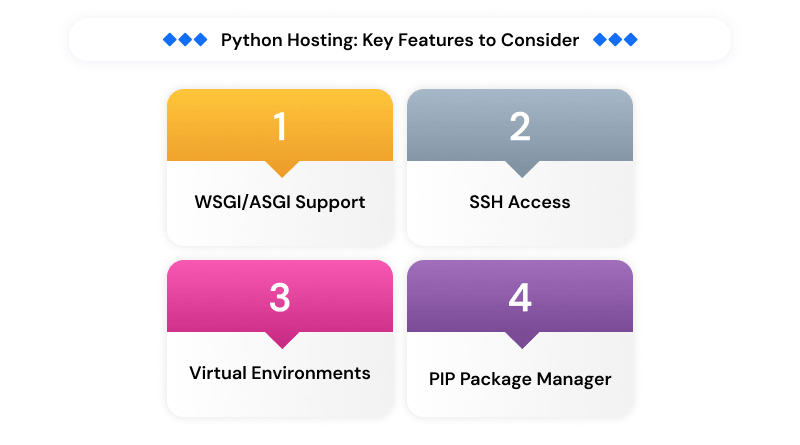
- WSGI/ASGI Support: This acts as the essential handshake between the web server and your Python code. Your host needs to support Gunicorn or Uvicorn to actually map your code to a live URL.
- SSH Access: Managing a professional app requires more than a file uploader. Managing your environment requires a secure command line to execute scripts, configure your Linux VPS hosting setup, and push real-time updates.
- Virtual Environments: To keep your projects functioning properly, isolation is key. A quality host lets you create venv or virtualenv spaces so different projects never clash over specific library versions.
- PIP Package Manager: Your workflow depends on dependencies. Running pip install -r requirements.txt on the server ensures your live environment matches your local setup exactly.
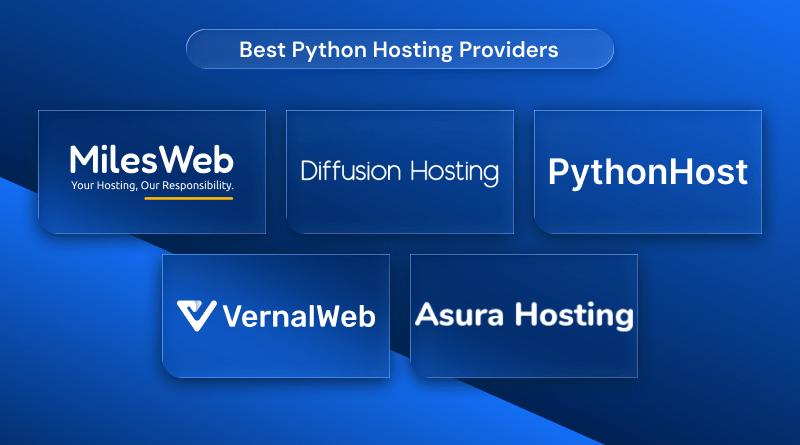
Top 5 Python Hosting Providers: A Comprehensive Technical Review
1. MilesWeb
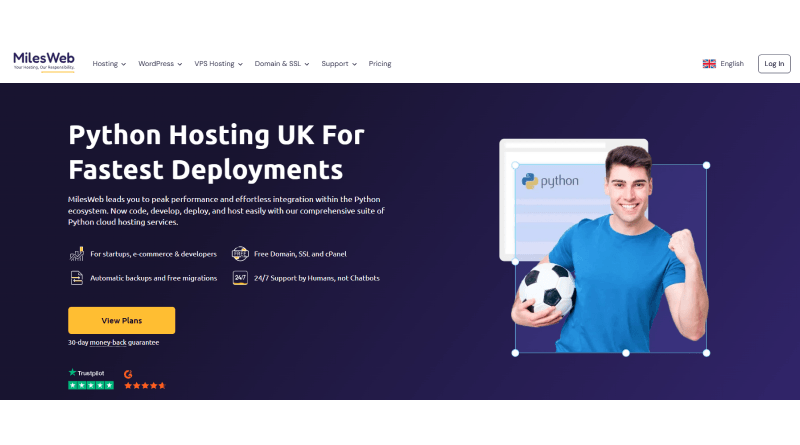
MilesWeb provides a welcoming environment for developers with a server setup that truly reflects a Python-first mindset. The infrastructure manages the resource demands of Python scripts natively, which eliminates the friction of a generic server setup. This proactive approach removes the technical friction that often stalls new deployments.
MilesWeb includes a built-in Python selector in the dashboard, allowing you to pick your version and map your application root with a few clicks. With LS Cache keeping your response times low and a support team that actually understands error logs, MilesWeb provides a reliable Python infrastructure that feels like a natural home for your code. This platform provides a “set it and forget it” experience for developers who prioritize high-tier performance without the manual overhead.
Technical Execution Highlights
- Python-Optimized Server Stack
- Integrated PIP Package Management
- LS Cache for High-Speed Delivery
- 24/7 Active Python Support
- 1-Click Application Installer
2. Diffusion Hosting
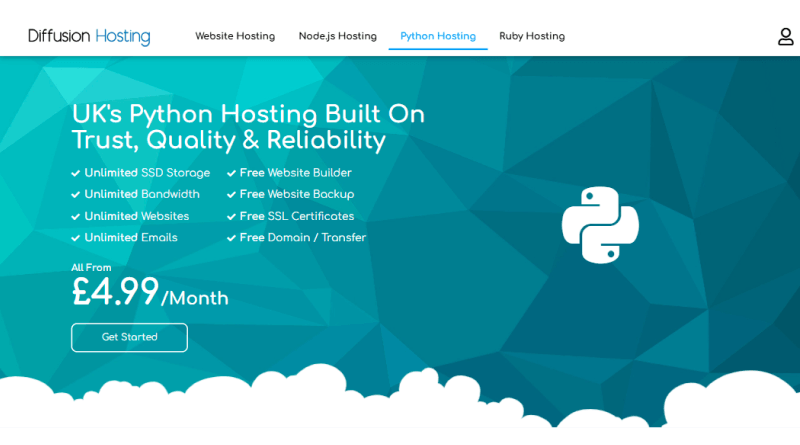
Diffusion Hosting builds its reputation on providing high-concurrency environments that don’t slow down under pressure. This setup handles multiple Python versions and connects with databases like PostgreSQL or MySQL right out of the box. The architecture supports the high-speed demands of modern frameworks while keeping latency to a minimum.
If your project relies on n8n alternatives, their infrastructure handles the background processes without pushing your server to its limits. The environment manages asynchronous tasks natively, making it a practical choice for real-time applications. Since the stack comes preconfigured, you can skip the manual setup of web server gateways and move straight to deployment.
Technical Execution Highlights
- Nginx and uWSGI Web Stack
- Support for Multiple Python Versions
- Built-in Database Integration
- High-Performance Reverse Proxy
- Optimized for Asynchronous Tasks
Related Read: n8n Vs Make: Which Platform Fits Your Business Automation Needs?
3. PythonHost
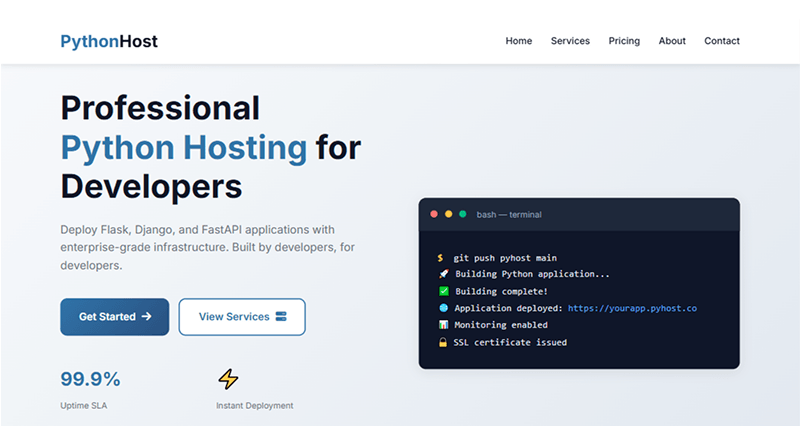
PythonHost delivers a specialized hosting environment by pairing NVMe SSD storage with an intuitive control panel. You can manage your project dependencies and schedule cron jobs directly through the interface, which saves you from dealing with local installations. This straightforward approach keeps your workflow clean and ensures your updates go live without any server-side hurdles.
The platform works well for both quick prototypes and long-term projects. Your workspace handles the server-side configuration in the background, which lets you stay focused on writing your application code. This setup keeps the technical heavy lifting out of your way so you can move from a local script to a live URL faster.
Technical Execution Highlights
- NVMe SSD Storage
- PIP Module Installation Support
- Multiple Python Version Selection
- Web Application Firewall (WAF)
- cPanel Hosting for Project Management
4. VernalWeb
VernalWeb uses NVMe storage combined with LiteSpeed and LSCache to provide a fast foundation for resource-heavy Python frameworks. Their cloud-optimized plans offer dedicated resources and root-level control, which helps when deploying applications that need consistent hardware output.
The advanced caching layers help Python-driven sites load quickly even when processing heavy loads. This infrastructure offers a reliable way to scale your applications without the bottlenecks common in standard shared hosting.
Technical Execution Highlights
- NVMe SSDs (RAID 10)
- LiteSpeed + LSCache
- Dedicated CPU and RAM
- Complete Root Access
- 5 Data Center Choices
5. Asura Hosting
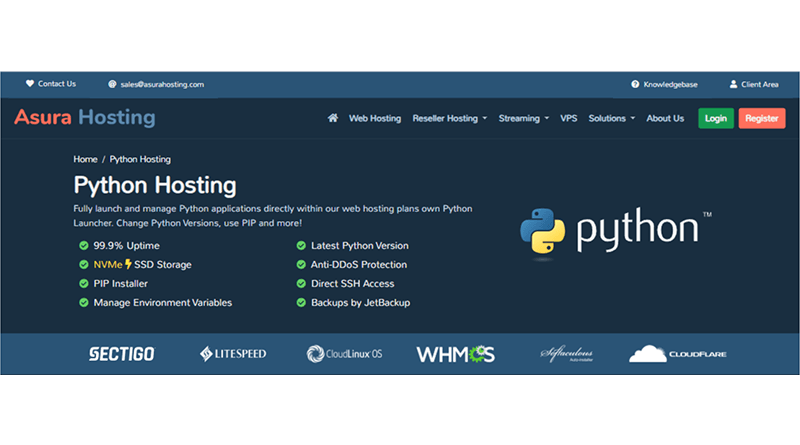
Asura Hosting includes a built-in Python Launcher to handle your versioning and environment variables in one place. They back their service with 10Gbit/s ports and Imunify360, keeping your applications fast and well-guarded against threats.
The high-bandwidth environment prevents network congestion during traffic spikes. Asura Hosting automates your environment setup so you don’t waste time on manual configurations. This gets your code live in minutes instead of hours. It simplifies the transition from local development to a production server.
Technical Execution Highlights
- Integrated Python Launcher
- 10Gbit/s Network Ports
- Real-Time Imunify360 Security
- Automated Environment Variables
- Direct SSH Access
How to Host Python Application Projects Successfully?
Moving your code to the web is an exciting milestone. A clean, professional workflow ensures your application remains stable and secure from its initial launch.
Static File Configuration: Python is brilliant at logic, but it shouldn’t be wasted on serving images or CSS files. Directing your web server—like Nginx or Apache—to serve your /static/ folder lets your Python app focus on processing logic instead of handling basic file requests. This minor adjustment reduces lag and accelerates loading times for every visitor.
Map Your Requirements: Before you push your code, run pip freeze > requirements.txt on your local machine. This file acts as the blueprint for your server, ensuring it installs the exact library versions your code needs to run. This one step prevents the “it works on my machine but not the server” headache.
Create a Virtual Environment: Think of a virtual environment as a private sandbox for your app. Running python -m venv venv on the server isolates your project libraries, which keeps the environment clean and prevents different applications from clashing over version requirements.
Deployment via Git: Move past the era of dragging and dropping files over FTP. Using Git to push your code to a repository and then pulling it to your server via SSH is faster, more secure, and lets you “undo” a bad update in seconds by rolling back to a previous commit.
Comparison of Best Python Hosting Providers
| Provider | Core Strengths | Python Support & Environment | Storage & Speed |
|---|---|---|---|
 |
Fully Managed & Scalable | 1-click installers, SSH/Terminal access, optimized for DIY devs | NVMe SSD, 1 Gbps Network, LSCache |
 |
AI-Specific Infrastructure | Support for Stable Diffusion, Jupyter Notebooks, and TensorFlow | NVMe SSD, High-performance GPU options |
 |
Specialized Performance | Integrated dependency management, Cron job scheduling through UI | NVMe SSDs, RAID 10 Redundancy |
 |
Security & High Uptime | CloudLinux isolation, LiteSpeed enabled, Python-optimized setup | NVMe Storage, Built-in CDN |
| Asura Hosting | Budget-Friendly Developer Tools | Built-in Python Launcher, PIP installer, environment variable management | NVMe SSD, 10Gbit/s Network Ports |
Final Takeaway: Your Path to Python Hosting Excellence
The hosting you choose today is the foundation for everything you build tomorrow. A specialized host doesn’t just give you a place to store files; it offers the infrastructure that understands the technical nuances of your code. When your infrastructure is technically ready for Python from the first login, you can stop troubleshooting and start creating.
MilesWeb delivers a streamlined deployment process. Their pre-integrated PIP installer and optimized environment take care of the server-side work, so you can just focus on your code. It provides a high-speed home for your application that scales as fast as your ideas do.
A professional, Python-ready setup provides the reliable foundation your business needs to stay competitive. By choosing a partner that prioritizes technical precision and active monitoring, you are securing the future of your digital assets.
FAQs
1. Can I host multiple Python websites on one hosting account?
Absolutely. Most professional plans let you run several websites at once, provided you have the disk space. The best approach is to use a separate virtual environment for each website to prevent any dependency conflicts. This is the most efficient way to host Python website projects side-by-side without one site’s update breaking another.
2. How to choose the right Python hosting plan for my project?
It really comes down to your app’s resource requirements. For a script test, a basic plan is sufficient. However, if you run a framework like Django with high traffic, the dedicated RAM of a VPS is necessary. You want enough overhead to deploy Python app versions without the server lagging during the process.
3. What are the benefits of using a Python hosting service?
The real win is skipping the manual server setup. Instead of dealing with path errors or installing compilers yourself, you get an environment that’s already built for your code. It’s the most straightforward way to host Python application projects because you can just log in, hit the terminal, and start running your scripts without the typical configuration issues.
4. Is shared hosting good for running Python applications?
Shared hosting is a fine starting point for small scripts or personal portfolios, but it has limits on processing power. If your application handles a lot of data or requires custom server modules, you might find the shared environment too restrictive. For professional projects, moving toward a more robust setup is usually the better path to maintain speed.