
 Jackson Lane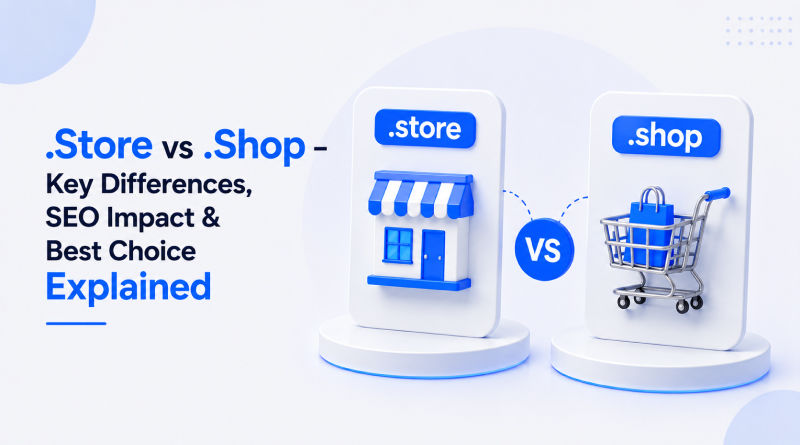
Almost every new eCommerce brand discovers the same thing early on: the .com name they wanted was taken years ago. What’s changed is what happens next: .store and .shop have stepped into that gap, giving retail brands a domain that fits the business instead of settling for whatever .com left behind.
Industry-specific extensions now play an important part in determining how a domain significantly impacts the choice of a domain for a new online store. Both .store and .shop are effective for eCommerce, but they diverge in terms of branding and audience, making it essential to understand this distinction before registering either one.
In this post, we will explore what separates .store from .shop at a definition level, where each one wins on branding, whether either affects search rankings, and which extension fits which kind of retail business.
Table Of Content
What Is a .Store Domain?
.store is a generic top-level domain built specifically for retail and eCommerce use. Unlike .com, which carries no inherent meaning, .store tells a visitor exactly what kind of website they’ve landed on before they read a single line of content. That clarity matters more than it seems, since a confused first impression costs conversions before a product page even loads.
The extension has grown fastest among brands that outgrew a crowded .com namespace or wanted a name that reads as retail-first from the address bar. A short, ownable domain that confirms what the business sells often beats a longer, compromised .com domain forced by name unavailability.
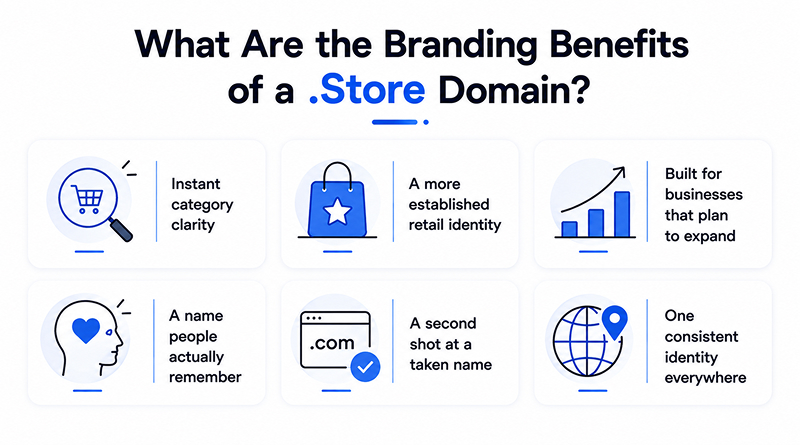
What Are the Branding Benefits of a .Store Domain?
A .store domain shapes perception before a visitor scrolls past the homepage. A few clear advantages consistently show up for retail brands weighing this extension against .com or .shop.
Best Use Cases for .Store
- Fashion retailers building a brand meant to last beyond a single season
- Electronics sellers carrying multiple product categories under one name
- Beauty brands aiming for a premium, established market position
- DTC brands launching their first dedicated retail presence online
Related Read: Best .In Domain Name Providers
What Is a .Shop Domain?
The .shop domain takes a warmer, more conversational approach that clearly conveys commercial intent, whereas the .store domain tends to sound more corporate. The shop reads as personal, closer to a small independent store than a retail chain. A visitor reads “shop” and understands it in an instant; the rest of the page doesn’t need to explain a thing.
This extension appeals to smaller sellers chasing an approachable domain, one that doesn’t feel institutional. A handmade jewelry business or a single-founder skincare brand often fits .shop more naturally than the retail-scale tone .store carries.
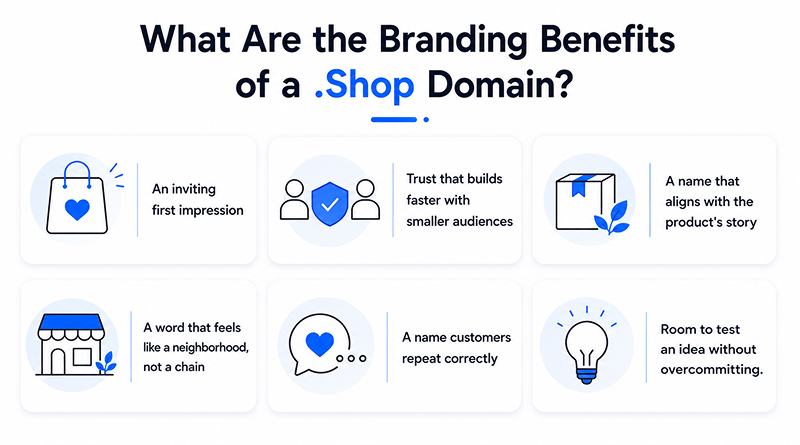
What Are the Branding Benefits of a .Shop Domain?
A visitor senses accessibility in a .shop domain before reading anything else on the page. That works well for businesses selling directly to individual customers, not ones trying to look like a large retail chain.
Best Use Cases for .Shop
- Small online businesses just getting off the ground
- Handmade product sellers building a personal, founder-led brand
- Dropshipping stores testing new niches before committing long-term
- Local retailers serving a specific city or regional customer base
Related Read: Top PrestaShop Themes For High-Converting Online Stores
.Store vs .Shop: Detailed Comparison
Branding tone separates the store or shop difference far more than any technical factor does. The table below breaks down how each one performs across the areas that actually influence a buying decision.
Related Read: Best .Org Domain Name Providers
Online Store vs Shop: Which Sounds Better for eCommerce?
Word choice shapes perception long before a visitor reads a single product description. “Store” tends to carry the sound of scale, wide inventory, warehouses, and a real operation running behind the name. “Shop” carries something smaller and more personal, the sense that an actual person might answer if a customer called.
Audience expectations play into this as well. Some shoppers associate “shop” with local, community-rooted businesses, while “store” reads as more broadly commercial regardless of where the customer is browsing from. A perfume brand poured by hand earns more trust with “shop” attached to its name. An electronics retailer carrying dozens of categories earns more with “store.”
Related Read: Top WooCommerce Hosting Providers
SEO Impact: Does .Store or .Shop Rank Better?
Google doesn’t rank one extension above the other. Neither one carries a built-in advantage over the other, or over legacy extensions like .com domain.
01
No Direct Ranking Boost
The extension itself has no weight in Google’s algorithm, so choosing .store over .shop won’t move a page up or down in results.
02
Content Quality Decides Outcomes
Well-researched, original product and category content consistently outranks a better-sounding domain, regardless of which extension backs it.
03
Backlinks Carry More Influence
Links earned from relevant, credible websites move rankings more than anything printed in the domain bar. A generic extension with strong links beats a perfect-sounding one without them every time.
04
User Experience Shapes Real Performance
Page speed, mobile responsiveness, and dependable cloud hosting infrastructure influence rankings more directly than any domain decision made at registration.
Related Read: Top .Io Domain Name Providers
What Is the Keyword and Relevance Advantage?
Google’s official stance confirms generic top-level domains; it treats generic top-level domains and legacy extensions equally identically to legacy extensions within its ranking system. Neither .store nor .shop receives a penalty or a boost purely for being a newer category of domains.
Where these extensions genuinely help is relevance signaling at the search results stage. Having “store” or “shop” directly inside the URL gives searchers an immediate contextual clue about commercial intent, which can lift click-through rate even without touching actual ranking positions. A descriptive domain often earns the click over a generic one, simply because it tells the searcher what to expect before they arrive on the page.
Potential Drawbacks and Challenges to Consider
A newer extension comes with a few practical challenges, since many customers still expect .com without thinking.
Habit & Recognition
Instinct still favors .com
Some visitors type .com automatically, even right after seeing a business advertised under a different extension.
Deliverability & Security
New extensions need proof of legitimacy in the inbox
Spam filters sometimes flag unfamiliar extensions harder at first, so getting SPF, DKIM, and DMARC authentication configured early matters more than it seems.
Marketing & Reinforcement
The brand has to say its name often
Packaging, social handles, and marketing materials all need to repeat the extension consistently until returning customers stop needing the reminder.
Infrastructure & Integration
A few third-party systems still expect .com by default
Certain payment processors and business directories require an extra verification step for newer extensions that .com businesses skip entirely.
Closing Insights
Brand tone and audience decide the real choice between .store and .shop, not search rankings. A retailer building toward scale and a polished, long-term identity fits better under .store. A founder-led or niche business earns trust faster through the approachable tone of .shop.
What matters more than the extension itself is what gets built on top of it. A well-secured, fast-loading store on solid hosting will always outperform a perfectly branded domain sitting on weak infrastructure. Get the technical foundation right, and either extension gives a new business everything it needs to grow.
Frequently Asked Questions
1. Is .store better than .shop?
Neither carries an inherent advantage. .store fits a brand chasing a polished, established retail image. .shop fits a founder-led or niche business that wants to feel approachable. The right pick depends on what the brand actually represents.
2. Does .store rank higher than .shop?
Google runs both extensions through the exact same ranking checks. A website climbs or drops based on content quality, backlinks, and performance. None of that depends on which extension sits after the business name.
3. What is the difference between a .store and .shop?
A corporate sound defines .store, which is built for a brand with a wide product range or big scaling plans. A personal sound defines a .shop instead, which is an ideal fit for a handmade seller or a founder trying to stay close to their customers.
4. Which domain extension is better for eCommerce?
Both perform equally well in search results, so the decision becomes a branding one. .store suits a business heading toward an established retail presence, while .shop suits something smaller and more personal.