
 Jackson Lane
With roughly 1,600 top-level domains now available, admins have more choice than ever but for anyone seeking legitimacy against mission-driven trust [Source: TLD-LIST.COM]. Yet, the .org vs .com decision still comes down to the same core question: what impression do you want your address to make before a visitor even clicks?
The guide walks you through a comprehensive discussion of .org and .com. Discover how each TLD influences consumer trust, shapes user expectations, and impacts your brand’s online presence and search visibility through web hosting.
Also Read: What Is a TLD?
Table of Content
Key Summary — .org vs .com
- 1 The choice is about first impressions — .com signals commercial credibility, .org signals mission-driven trust.
- 2 .com leads with ~151 million domains and 95% awareness, versus ~10 million for .org.
- 3 Google confirms neither extension is a ranking factor — content and backlinks decide that.
- 4 .org lost its price cap in 2019; .com has the stronger resale history — Business.com sold for £258.56M.
- 5 Pick .com for commercial brands, .org for non-profits — or own both to protect your name.
💡
This article comprehensively discusses .org vs .com, covering trust, pricing, SEO impact, and how to choose.
.ORG vs .COM: Quick Comparison
Feature
.com
Commercial.org
Non-profit & educationRegistered domains
~151M
~10M
Consumer awareness
Awareness95%
Lower overall
Strong in non-profit & education
Trust score
★★★★★
★★★★★
3.5 / 5
★★★★★
★★★★★
3.3 / 5
Memorability score
Memorability44%
Memorability32%
Registration requirement
None
None
SEO ranking impact
No direct advantage
No direct advantage
Mobile keyboard shortcut
*.org awareness is lower overall but stays strong within non-profit and education audiences.
Also Read: Best TLD Options: How to Choose the Right Domain Extension
What is a .com domain?
A .com domain replicates the commercial intent of the business. The widely trusted and recognised domain extension is easy for visitors to remember your website. Over time, the .com TLD has become the favourite of several business verticals. The domain held over 37.12% of the total market share till December 2025 [Source: Domain Name Stat]. It is ideal for capturing traffic for commercial and e-commerce websites, personal branding and portfolios, and media websites.
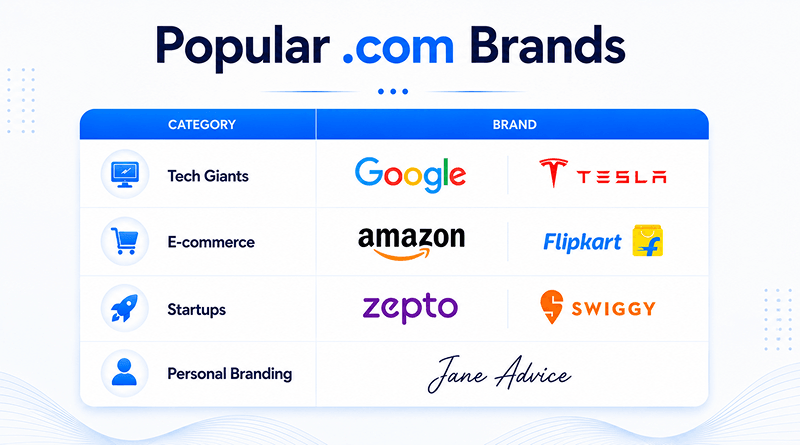
Examples
Renowned Tech Giants
- Google: Popular search engine platform.
www.google.com
- Tesla: The world’s leading automaker
www.tesla.com
E-commerce Stores
- Amazon: One of the leading digital marketplaces.
www.amazon.com
- Flipkart: India’s leading e-commerce platform.
www.flipkart.com
Startups
- Zepto: India’s leading quick commerce platform.
www.zepto.com
- Swiggy: India’s leading food delivery brand.
www.swiggy.com
Personal Branding
- Jane Advice: A personal consulting portfolio website.
www.janegoodadvice.com
What is a .org domain?
The .org, originally known as “organisation”, has traditionally been used to reflect its non-commercial roots. Charitable trusts, non-profit organisations, and open-source projects widely use this domain extension to reflect their philanthropic intent. Compared to .com, .org has a limited market share of merely 2.55% as of December 2025 [Source: Domain Name Stat]. As .org evokes a mission-driven cause, it fosters a charitable image.
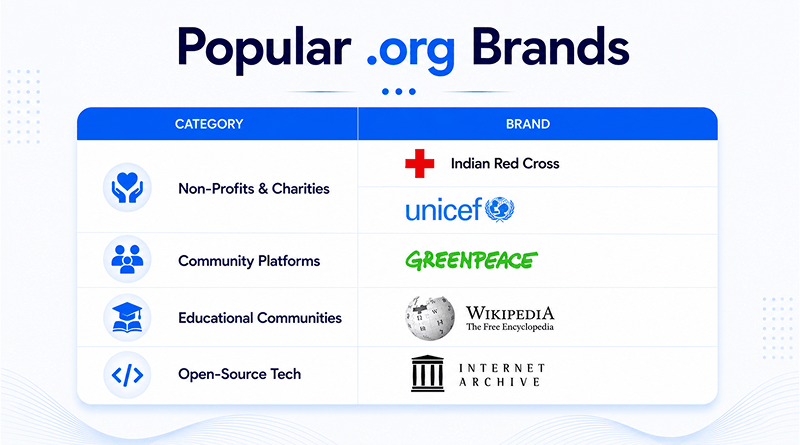
Examples
Non-Profits and Charities
- Indian Red Cross: India’s largest humanitarian network.
www.indianredcross.org
- UNICEF: A special United Nations agency for charities and humanitarian aid.
www.unicef.org
Community Platforms
- Greenpeace: A community platform driven by environmentalists.
www.greenpeace.org
Educational Communities
- Wikipedia: World’s largest open-source educational website.
www.wikipedia.org
Open-Source Tech Communities
- Internet Archive: A non-profit library of web files.
https://archive.org
.ORG vs .COM: Detailed Comparison
.com: Universal Credibility
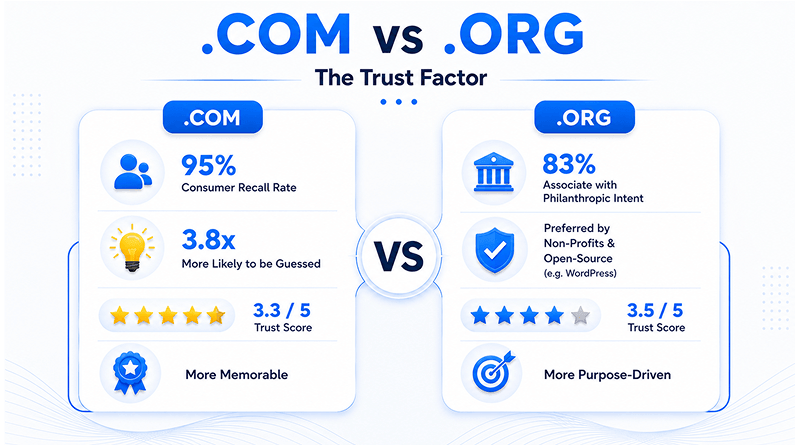
The .com extension’s dominance serves a noble purpose for people. An ICANN report in 2016 found that 95% of consumers easily recall the .com domain. It scored the highest awareness rating of any extension in the study.
Another experiment by GrowthBadger in 2022 found that a .com domain is 33% more memorable and 3.8x more likely to be guessed by users. The same research recorded trust level ratings across major domains:
- .com: 3.5/5
- .co: 3.4/5
- .org: 3.3/5
- .NET: 3.2/5
These statistics illustrate that .com is rooted in consumer psychology and habit. Users build an instinctive trust with the .com suffix in a URL; it serves as an invaluable foundation driving organic traffic, CTR, and long-term customer retention and loyalty.
.org: Maintaining Consumer Trust
Industry research, including studies conducted around ICANN in 2016, has shown that 83% of consumers associate the .org extension with philanthropic intent. Although it is lower than .com’s 95%, it still helps non-profit organisations and charitable trusts to outrank the competition.
In recent times, beyond non-profit organisations, entities such as WordPress also use the .org domain extension. The open-source CMS community built a global identity, easing the website development journey of technical and non-technical users alike.
.org vs .com: Brand Recognition
Users instinctively type .com domains due to the conditioned habit developed over decades. Nearly all smartphones have a dedicated key that reduces typing fatigue. This mobile-first measure heavily conditions brands to use the .com domain extension as their suffix. Thus, many startups in recent times, including ChatGPT, function through .com domain extensions.
The .org successfully signals charitable or non-profit intent; using it for a commercial website often causes brand confusion. It advocates educational initiatives where users build community trust.
SEO Impact: Does .ORG or .COM Rank Better on Google?
According to official Google updates, the search algorithm doesn’t explicitly rank based on gTLDs (generic Top-Level Domains). Instead, content quality, backlinks, website performance, and mobile responsiveness are major ranking factors.
SEO Quick Tip
💼 .COM or 🎓 .ORG — which one fits your site?
If you’re running a business, store, or anything commercial, .com is still the default people trust and remember — it has the widest recognition and the largest number of registered domains. If you’re running a non-profit, charity, or educational project, .org carries built-in credibility for that specific audience, even though its overall awareness is lower.
.COM
Best for commercial, business, and general-audience sites
.ORG
Best for non-profits, education, and cause-driven projects
💡 Neither extension gives a direct SEO ranking boost — pick based on audience trust and intent, not search advantage.
However, users are conditioned to search for commercial intent keywords or URLs. Hence, the probability of click rates or search impressions weighs towards the .com domain extension. Guest bloggers often prefer linking to trusted websites, and .com domains are generally seen as more credible.
On the other hand, .org gets limited exposure due to the limited Total Addressable Market (TAM). Thus, lower click rates and impressions could lead to less online visibility on search engines.
.com vs .org: Which has Higher Availability?
Technically, both .com and .org have identical availability. The perceived scarcity of the .com domain puts competitive pressure on registrants, resulting in dynamic pricing. Consequently, .org maintains a mission-driven valuation, resulting in a lower registration invoice.
As .com is a universal standard domain extension for commercial businesses, it has a massive user base. Over 150 million .com domains are registered worldwide. The .org count is limited to approx. 10 million, showing a significant buyer gap between these TLDs.
Also Read: Multilingual Website: How Subdomains Can Affect Your SEO Performance
.com vs .org: Pricing Comparison
Domain type
.COM
.ORG
Registration cost
£14
£13.5
Renewal cost
£16
£15
Prices shown in USD.
.org vs .com: Pros and Cons
.com — Pros
- Best resale value out there — Business.com sold for £258.56 million back in 2007, and nothing on .org compares.
- No history of ownership drama — same registry, same rules, no surprises.
- Wide open for renewals and transfers; no non-profit-style contract disputes to worry about.
.com — Cons
- Good short names are mostly taken or priced high, since demand’s been building since the 90s.
- Standard registry pricing; no non-profit discount programmes are tied to it.
.org — Pros
- Often required for non-profit discount tools like Google for Nonprofits and TechSoup.
- Prices have stayed modest in practice — PIRs kept increasing around 3% a year. The price of .org domains has risen by 3% annually, far below the 10% price cap.
- More short, brandable names are still available since demand’s lighter than .com.
.org — Cons
- Lost its price cap in 2019: ICANN removed price caps from the Public Interest Registry’s .org registry contract, which had limited PIR to 10% annual increases — no hard limit on future hikes anymore.
- Nearly got sold to a private equity firm for £824.40 million. The Internet Society announced plans to sell PIR (Public Interest Registry) to a private equity firm for £850.63 million before the deal collapsed — an odd footnote for a domain known for stability.
.com vs .org: Which One to Choose for Your Domain?
Most smartphone keypads have a built-in .com button to mitigate typing friction. This small measure contributed to its extensive market share. In total, 159.4 million domains were registered as of Q3 2025 [Source: Verisign Domain Name Industry Brief].
The .com TLD has strong brand positioning compared to its alternatives for marketing commercial products globally. The statement is backed by the trust score of the GrowthBadger study mentioned above.
The .com TLD is widely recognised and known for its brand association and is popular with e-commerce stores, service businesses, and SaaS products. But mission-based for-profit businesses and consulting firms focusing on community or social benefit might be better served by an .org domain, even though both domain extensions have high levels of public trust.
The extension is especially good for targeting multiple demographics or if you are creating a brand with a potential international roll-out. As is the case with country-code domains, .com is geo-unrestricted, meaning it is not limited by geographic boundaries and can serve the needs of global ambitions.
Conclusion
If you have a product-market fit ready and you’re aiming for global expansion, choose a .com domain. It is the standard domain extension that people type by default and holds the higher resale value, building identity for businesses.
The .org domain is suitable for promoting your non-profit community or open-source projects. It signals eligibility for non-profit tools and discounts. Although it won’t match the resale value or recall of a .com, it holds a strategic value for mission-driven organisations.
Neither extension alone ensures success. Google has made it clear: domain extensions don’t create a difference in rankings. What they do move is the split-second decision a visitor makes before he/she reads a single word on your website, your business, or someone asking for donations. That is the true choice that you’re making when you choose one over the other.
FAQs
1. Is .org better than .com?
Both domain extensions have various purposes. While .com is the universal domain for business and general websites. Specifically, .org is known for its involvement with non-profit organisations, open-source projects, and community initiatives.
2. Does .org rank better than .com?
Domain extensions are not considered ranking factors for Google and other search engines. Whether you’re on Page 1 or not depends on the quality of your content, the website’s authority, and how well you meet the user’s search intent.
3. Can a business use a .org domain?
While you are legally permitted to use a .org for a for-profit business, it is generally discouraged. Most users have been trained to associate .org with non-commercial entities, which can sometimes lead to confusion or missed sales.
4. Can a non-profit use a .com domain?
Many non-profits decide to opt for a .com as it is the most recognisable TLD. It makes it easier for them to attract a larger audience that may simply guess about typing.com when they look for their organization online.
5. Which domain extension is more trustworthy?
Trust is built by the content you publish, not the suffix you choose. A ..com often feels more professional for corporate interests, whereas a . ORG builds trust specifically by signalling that your site is mission-driven rather than profit-driven.
6. Should I buy both .com and .org?
Having both is a recommended practice in order to safeguard your brand. If you have the budget, it’s It is not possible for anyone to squat on your name, and you can easily have a redirect to your main domain.