
 Jackson Lane
A domain outlives almost every other early decision a founder makes. Logos go through redesigns, taglines shift with each rebrand, and pricing pages change every quarter, yet the domain typically stays fixed from day one. That permanence is precisely why the choice between .io and .com deserves more thought than a quick availability search.
This guide breaks down what separates .io from .com at a practical level, covering branding impact, search visibility, and long-term availability. In this post, we will explore where each domain extension earns its reputation and which one fits a specific kind of business best. This approach to the .io vs .com decision simplifies the final call compared to relying solely on intuition.
Table Of Content
What Is a .io Domain?
The .io extension began as the country code for the British Indian Ocean Territory, a tag with no real connection to technology. Developers picked it up regardless, drawn less by geography and more by the letters themselves, since “IO” mirrors input and output, a phrase baked into nearly every corner of computer science. That coincidence turned an obscure ccTLD into one of the most recognisable extensions in the startup world, especially once early SaaS companies, gaming studios, and developer tool makers started registering it publicly.
A domain that resonates with engineering culture holds significance for a technical audience even before any features are displayed on the page. The registry behind the extension has also kept domain pricing and renewal terms fairly stable over the years. That stability removed one of the early hesitations founders had about building a brand on top of it.
What Are the Branding Benefits of a .io Domain?
A .io domain shapes how a product feels within seconds of a visitor landing on it. A handful of advantages show up consistently for founders weighing this extension.
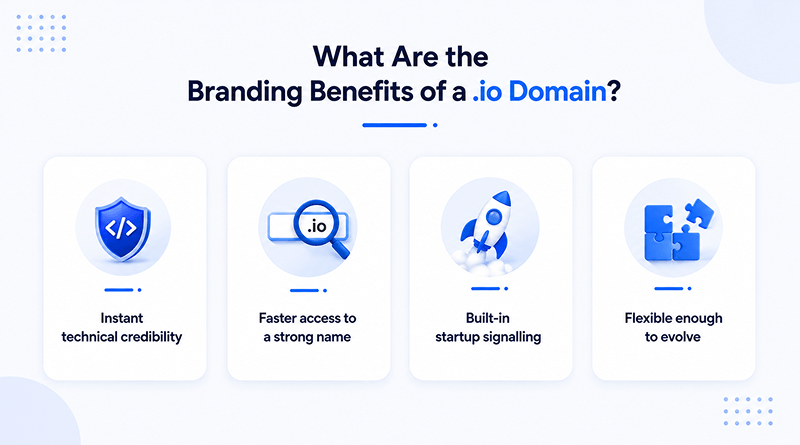
Instant Technical Credibility
Engineers and early adopters read .io as a signal that the team understands software.
01
Faster Access to Strong Names
Popular one and two-word combinations missing from .com remain available under .io.
02
Built-in Startup Signalling
Investors and customers associate the extension with fast-moving product teams.
03
Flexible Enough to Evolve
Carries no rigid expectations about business type, leaving room to pivot anytime.
04
Best Use Cases for a .io Domain
- SaaS platforms building tools for developers
- Gaming studios launching a title-specific website
- Developer tool companies and API providers
- Early-stage startups still finding their market fit
Related Read: Top .io Domain Name Providers
What Is a .com Domain?
The ‘.com’ extension has held significant commercial value since the early days of the web, when it represented its original meaning, ‘commercial’. Decades of consistent use have turned it into the extension people type by instinct, often without consciously choosing it over any alternative. That familiarity means a .com name rarely needs an explanation.
Visitors, investors, and search engines alike treat it as the default choice, which keeps domain prices for competitive .com names higher than almost any other extension on the market, since demand for the safest option never really slows down. Even businesses that operate mostly through social platforms or apps still register the matching .com domain purely to protect their brand name from being claimed elsewhere.
Related Read: Top .com Domain Name Providers
What Are the Branding Benefits of a .com Domain?
A .com domain borrows the trust that the internet took decades to build, and that trust transfers instantly to whatever business the domain represents.
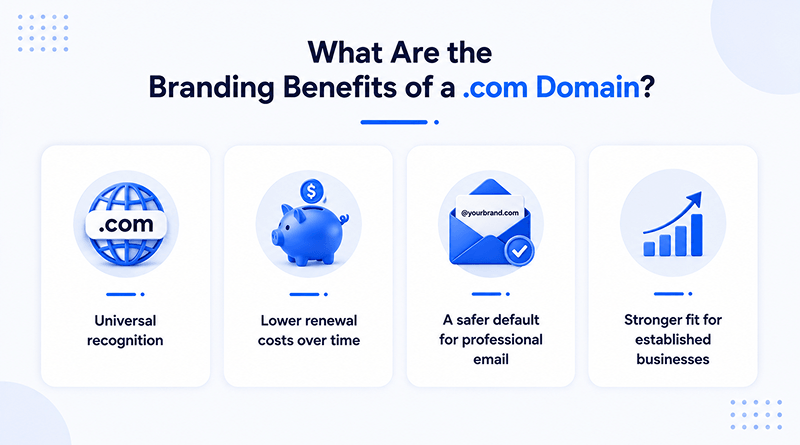
Universal Recognition
Customers everywhere instantly recognise .com unlike newer or region-specific options.
01
Lower Renewal Costs
Standard renewal pricing remains predictable year after year compared to premium extensions.
02
Safer Email Delivery
Business emails sent from a .com address tend to face less spam filter scrutiny.
03
Stronger Business Fit
Established ventures look entirely legitimate without needing extra effort in new markets.
04
Best Use Cases for a .com Domain
- Brands making a first move into unfamiliar territory
- E-commerce stores where building trust is essential for closing sales.
- Service businesses rely on repeat clients for their success.
- Companies preparing for an acquisition or a funding round
Related Read: Top WooCommerce Hosting Providers
.com vs .io: Which Sounds Better?
People react to how a word sounds before they think it through. Say “.io” aloud, and it sounds closer to a fragment of code than an ordinary word, short and unmistakably technical. “.com” sounds complete and familiar, closer to a spoken sentence than a command. Neither sound is objectively better. A developer tool called “Deploy.io” reads sharp and current. The same product renamed “Deploy.com” reads corporate and slightly generic, less suited to an audience that lives inside a terminal most of the day.
Flip the example to a family-run bakery chain, and the outcome reverses entirely. “Bakery.com” reads warm and trustworthy, while “Bakery.io” sounds like a scheduling app rather than a place that sells bread.
SEO Impact: Does .io or .com Rank Better?
Google has been explicit about the issue for years. Neither extension carries any inherent ranking weight in its algorithm.
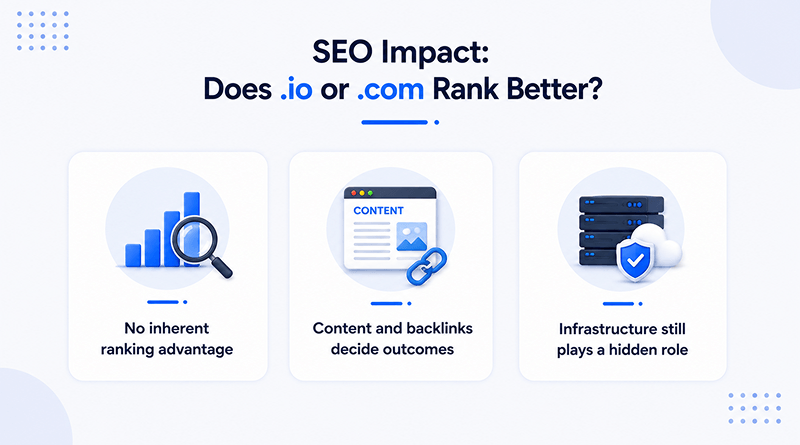
No Inherent Ranking Advantage
A .io and a .com start on identical footing inside search algorithms with no built-in boost.
01
Content and Backlinks Decide
Rankings come from strong links and material, not the three or four letters after the dot.
02
Infrastructure Plays a Hidden Role
Fast VPS hosting and SSL security influence page speed and trust signals far more directly than extensions.
03
Related Read: .Store vs .Shop – Key Differences, SEO Impact & Best Choice Explained
How Do .io and .com Compare Side by Side?
Branding tone and audience expectation separate these extensions more than any technical factor does.
| Factor | .io | .com |
|---|---|---|
| Brand tone | Technical, modern | Universal, established |
| Best suited for | Startups, SaaS, dev tools | Established or scaling businesses |
| Audience perception | Innovative, niche | Trusted, mainstream |
| Renewal cost | Higher | Lower |
| Availability | Wide open for short names | Mostly taken for short names |
| Typical buyer expectation | Cutting-edge product | Reliable, proven business |
Which Extension Offers Better Availability?
Short, brandable .com names disappeared from the open market years ago, and most remaining options require either a premium resale price or a compromise, like adding an extra word or a hyphen. .io flips that scarcity. Two-word and even some one-word combinations remain available right now, which explains why so many startups gravitate towards them during the naming phase. For businesses exploring options beyond both extensions, looking into .in domain name providers or regional alternatives can also widen the pool without sacrificing brand clarity.
Related Read: Types of TLDs Explained: gTLD vs ccTLD vs sTLD
What Is the Keyword and Relevance Advantage?
Neither extension carries a keyword advantage inside Google’s ranking system, but relevance still shows up at the results page itself. A domain that hints at what a business does, even loosely, gives a searcher an immediate contextual clue before clicking through. This matters more for click-through rates than for ranking positions, since a descriptive or recognisable domain often earns the click over a generic one. A good first impression only carries a visitor so far. Fast cloud hosting and a genuinely well-optimised website turn that initial click into a page that actually holds up once a visitor lands on it.
Related Read: Best Free Cloud Hosting Provider
What Are the Trade-Offs Between .io and .com?
Every decision involves a trade, and domain extensions are no exception. Weighing these points against the actual stage and audience of a business makes the final call far more grounded than picking whichever name simply sounds better in a pitch meeting.
.io Domain
Advantages
- •Strong startup and technical credibility
- •Wider availability for short, brandable names
Drawbacks
- •Renewal costs run higher year over year
- •Less familiar to non-technical audiences
.com Domain
Advantages
- •Instant recognition across every audience
- •Renewal pricing stays low and predictable
Drawbacks
- •Desirable short names are mostly acquired.
- •The rare excellent one left often costs a premium to buy
Closing Insights
A technical product built for developers, gamers, or early adopters earns more from .io than it loses in unfamiliarity. A business built around trust, scale, or a broad non-technical audience earns more from .com than it gains from a shorter, trendier name. Neither extension carries a hidden penalty once search engines and real customers get involved. The decision rests entirely on fit.
Either choice works when it matches what the business actually is, not what sounds impressive when pitching investors. Pick the extension that fits the product now, register it, and put the real energy into building something worth remembering long after the naming debate ends.
Frequently Asked Questions
1. Is .io better than .com?
Neither is better in absolute terms. A developer tool designed to impress engineers typically benefits more from using a .io domain. A business selling to everyday customers usually does better with .com. People recognise it without having to think about it.
2. Does Google rank .io domains?
The algorithm doesn’t recognise the extension at all. It weighs the page content and the links pointing to it and stops there.
3. Is .io good for SEO?
It performs exactly as well as any other extension, including .com. SEO outcomes come from content, backlinks, and technical factors like page speed, not from the letters after the dot.
4. Why do startups use .io?
The extension is read as ‘technical’ by default, and shorter, brandable names are far easier to find than on .com. Both factors matter to a founder naming a product for a developer-heavy audience.
4. Is .com still the best domain?
For most businesses, yes, it still is. Customers type it without thinking, investors expect it, and nothing newer has managed to replace that habit yet.