
 Jackson Lane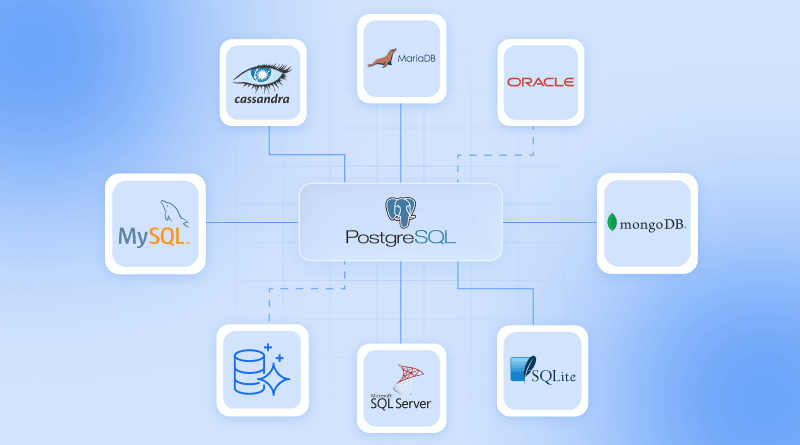
PostgreSQL or Postgres is a versatile object-relational database, engineered for its strong security architecture and flexibility.
PostgreSQL excels at managing both structured and unstructured data, which integrates with a wide array of apps and services such as Panoply. Panoply is a cloud-based data analytics platform that directly connects data sources to BI tools. PostgreSQL VPS is engineered to meet the sophisticated demands of large business applications built on the respective database. For over three decades, it has been known for its stability, feature consistency, and performance. It supports SQL and is built to accommodate a wide range of workloads.
But this established technology has been facing technical limitations for a couple of years. Here is why we have outlined our best PostgreSQL alternatives that redefine your digital journey.
Summary; TLDR
PostgreSQL is a powerful, widely adopted, battle-tested, feature-rich, open-source relational database with community-driven resources.
But it is not always the right tool for every job. Depending on the workload, scale, team’s resources, or infrastructure constraints, you may outgrow it or work around its limitations. In some cases, you may need a solution that is better suited to your specific requirements.
The guide comprises genuine reasons to look for PostgreSQL alternatives, such as NoSQL, NewSQL, and beyond that, which are worth your attention.
Table of Contents
Why Look for PostgreSQL Alternatives?
1. Scalability Limitations
PostgreSQL primarily supports vertical scaling, while implementing horizontal scaling can be complex and often requires manual effort. Citus and other tools add operational overhead. Teams dealing with massive write volumes or multi-region deployments find that the PostgreSQL architecture is limiting.
2. Operational Complexity at Scale
Managing replication, failover, vacuuming, connection pooling (via PgBouncer), and disk cleanup requires significant technical expertise. For smaller teams or startups with a dedicated infrastructure, such overhead could be the real burden.
3. Workload Mismatch
PostgreSQL is a generic relational database. If the workload is fundamentally document-oriented, graph-based, time-series-heavy, and demanding full-text search at a larger scale, a purpose-built database outperforms generic ones.
4. Write Throughput Bottlenecks
High-frequency write workloads, IoT data streams, event logs, and financial tick data push PostgreSQL to its limits. Databases built specifically for write-heavy, append-only workloads handle these scenarios more gracefully.
Key Factors to Consider When Choosing a PostgreSQL Alternative
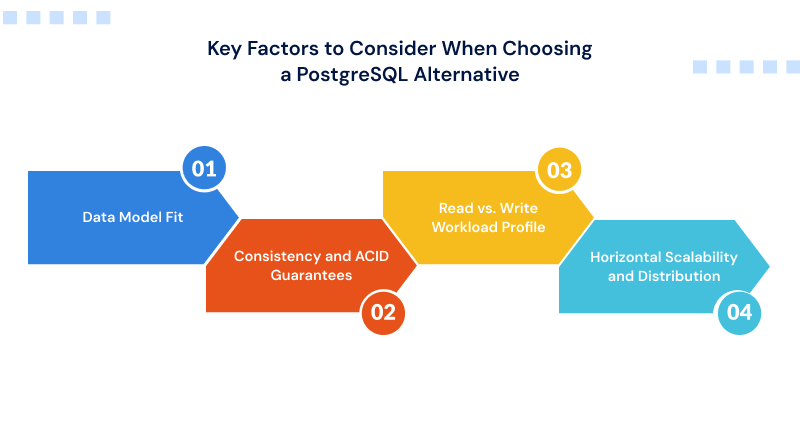
1. Data Model Fit
If you have deeply nested schema-flexible documents, document stores like MongoDB may be more convenient. If you’re running queries that deal with relationships and traversals, a graph database such as Neo4j will be much faster than SQL joins. When the data model matches your domain, you avoid impedance mismatch.
2. Consistency and ACID Guarantees
Not all alternatives support ACID (Atomicity, Consistency, Isolation, Durability) transactions. Some NoSQL databases sacrifice consistency for availability and partition tolerance. Determine if your app—especially those handling money, stock, or user accounts—needs strong consistency or eventual consistency.
3. Read vs. Write Workload Profile
Mission-critical tasks like deep analysis need the right database. ClickHouseDB and DuckDB offer better performance for read-heavy workloads. If your website continuously receives large volumes of data, such as sensor logs or social media updates, databases like ScyllaDB or Cassandra can better handle high concurrency demands.
4. Horizontal Scalability and Distribution
Your database must scale horizontally for seamless expansion of applications worldwide. NewSQL databases such as CockroachDB and Google Spanner scale horizontally. Traditional RDBMS alternatives require significant sharding logic that you own and maintain.
Top PostgreSQL Alternatives
| Database | Primary Type | Key Strength | Best Use Case | Scaling Approach |
|---|---|---|---|---|
 |
Relational | Operational simplicity | Web apps, CMS (WordPress), startups | Horizontal (via Sharding) |
 |
Document | Schema flexibility | Unstructured data, rapid prototyping | Native Sharing |
 |
Relational | Advanced Query Optimizer | Mission-critical enterprise apps | Vertical / RAC (Clusters) |
 |
Embedded | Zero configuration | Mobile apps, IoT, local testing | Single-file (Local) |
 |
Relational | Community-driven innovation | Performance-critical web apps | Multi-master (Galera) |
 |
Relational | Enterprise BI tools | Large corp, Microsoft-stack apps | Vertical / Distributed |
 |
Wide-Column | Extreme write throughput | IoT, activity logs, big data | Native Horizontal |
 |
Cloud-Native | Managed availability | High-traffic AWS environments | Decoupled Storage |
 |
Distributed SQL | Global ACID consistency | Global apps, multi-region finance | Global Horizontal |
1. MySQL

MySQL is a well-known open-source database, used by WordPress websites and Facebook’s initial systems. MySQL can be a good choice as an RDBMS (Relational Database Management System) for teams searching for PostgreSQL alternatives. MySQL has introduced new Windows functions, Common Table Expressions (CTEs), and JSON enhancements, and is a good alternative to PostgreSQL.
MySQL vs. PostgreSQL: Honest Comparison
| Feature | MySQL | PostgreSQL |
| ACID Compliance | Yes (InnoDB) | Yes |
| JSON Support | Good (8.0+) | Excellent |
| Full-Text Search | Basic | Advanced |
| Horizontal Scaling | With sharding | With Citus/extensions |
Managed MySQL Options
- Amazon RDS for MySQL
- Google Cloud SQL for MySQL
- PlanetScale
- TiDB Cloud
Bottom Line: MySQL is the widely recognized PostgreSQL alternative for web applications, content platforms, and teams that prize operational simplicity.
2. MongoDB

MongoDB introduced document-oriented storage into the mainstream, storing data as JSON-like documents rather than relational rows and columns. It became the defining database of the NoSQL movement for an entire generation of developers and was the default choice while starting new projects. MongoDB is a convenient database system for developers with real performance implications. This database system reduces the document’s latency for teams seeking rational power through MongoDB VPS server.
MongoDB vs. PostgreSQL
| Feature | MongoDB | PostgreSQL |
| Data Model | Document (JSON/BSON) | Relational (tables/rows) |
| Schema | Flexible / optional | Strict (enforced) |
| ACID Transactions | Yes (4.0+, multi-doc) | Yes |
| Horizontal Scaling | Built-in sharding | Extension-dependent |
Managed MongoDB Options
- MongoDB Atlas (official, multi-cloud)
- Amazon DocumentDB (MongoDB-compatible)
- Azure Cosmos DB (MongoDB API)
Bottom Line: MongoDB is one of the best PostgreSQL alternatives when your data is document-shaped, and the schema is evolving.
3. MariaDB

MariaDB is not just a MySQL clone, but has evolved into a capable, independently developed database featuring storage engines and an increasingly distinct identity. MariaDB enables easy data migration without changing the connection string. It is particularly for web-based applications, prioritizing high-speed read operations and ease of use. MariaDB publishes all development openly and doesn’t maintain separate “enterprise-only” features behind a paywall; similarly, MySQL does with some InnoDB features.
MariaDB vs. PostgreSQL
| Feature | MariaDB | PostgreSQL |
| MySQL Compatibility | Near-perfect | None |
| Open-Source Commitment | Strong (BSL 1.1 for some) | PostgreSQL License |
| Multi-Master Replication | Galera Cluster (built-in) | Third-party tools |
| Temporal Tables | Native support | Via extensions |
Managed MariaDB Options
- Amazon RDS for MariaDB
- MariaDB SkySQL (official cloud platform)
- Google Cloud SQL for MySQL (MariaDB-compatible)
Bottom Line: MariaDB is suitable for MySQL users seeking a complete open-source, community-driven database with advanced features and zero Oracle dependency.
4. SQLite

SQLite has no database server to install, no network connection challenges, making it a unique PostgreSQL alternative. The entire database comprises an engine, storage, and all data is stored within a single file. It is, quite possibly, the widely deployed database worldwide, running within billions of smartphones, browsers, and desktop applications. It is not a PostgreSQL replacement in the traditional sense. But for the right use cases, it’s not just good enough, it’s the best possible choice.
SQLite vs. PostgreSQL
| Feature | SQLite | PostgreSQL |
| Architecture | Embedded, serverless | Client-server |
| Setup Required | Zero | Moderate |
| Concurrency | Limited (write locking) | Excellent |
| Max Database Size | ~281 TB (theoretical) | Unlimited (practical) |
Managed SQLite Options
- Turso: A managed database platform
- Cloudflare D1: A native serverless database
- SQLite Cloud: A distributed relational database
Bottom Line: SQLite functions on the serverless, minimal, and embedded infrastructure. Suitable for mobile applications, prototyping, and edge computing.
5. Microsoft SQL Server

Microsoft SQL Server has been a cornerstone of enterprise data infrastructure for over three decades. It features an industrial-strength RDBMS that competes directly with Oracle at the top of the market, and increasingly challenges PostgreSQL, even in organizations using the “Microsoft” ecosystem. Organizations already running Azure may consider this database system. Azure SQL Database is among the professional managed databases available, featuring automatic tuning, built-in intelligence, and seamless Azure Active Directory integration.
SQL Server vs. PostgreSQL
| Feature | SQL Server | PostgreSQL |
| Licensing | Commercial (free Developer/Express tiers) | Free, open-source |
| Platform Support | Windows, Linux, Docker | All platforms |
| BI/Reporting Tools | Native (SSRS, SSAS) | Third-party |
| High Availability | Always On (built-in) | Extension-dependent |
Managed SQL Server Options
- Azure SQL Database (fully managed, cloud-native)
- Amazon RDS for SQL Server
- Google Cloud SQL for SQL Server
Bottom Line: SQL Server is a legitimate PostgreSQL alternative for an enterprise environment embedded in the Microsoft stack.
6. Oracle Database

Oracle Database is a premium and proprietary powerhouse designed for large-scale enterprises that need high-availability tools. Users prefer this database for seamless vertical scaling of mission-critical databases. Its sophisticated query optimizer offers features, “hints” for manual execution. Moreover, Oracle’s Container Database and Pluggable Database setup allows managing separate databases as one. It makes patching, backing up, and resource sharing much easier for large IT departments.
Oracle vs. PostgreSQL
| Feature | Oracle | PostgreSQL |
| Licensing | Very expensive (commercial) | Free, open-source |
| Query Optimizer | Best in class | Excellent |
| High Availability | RAC (industry gold standard) | Patroni + external tools |
| Partitioning | Advanced | Good |
Managed Oracle Options
- Oracle Autonomous Database (cloud, self-driving)
- Amazon RDS for Oracle
- Oracle Cloud Infrastructure (OCI)
Bottom Line: Oracle remains the premier PostgreSQL alternative for enterprises with advanced capabilities. Its cost is justified where migration becomes complicated.
7. Apache Cassandra

Apache Cassandra is not a relational database, but was designed to solve sophisticated throughput and other issues. It leverages peer-to-peer architecture, having an equal node in every cluster.
There is no primary node to fail and no performance bottleneck, as the data is uniformly distributed across nodes. When you add a new node, the cluster rebalances. Cassandra’s latest versions comprise features such as automating patching, tuning, and scaling, which significantly reduce the manual workload for Database Administrators (DBAs).
Apache Cassandra vs. PostgreSQL
| Feature | Apache Cassandra | PostgreSQL |
| Type | NoSQL (Wide-Column Store) | Relational (RDBMS) |
| Scaling | Horizontal: Add more nodes to increase capacity. | Vertical: Add more CPU/RAM to a single server. |
| Primary Strength | Extreme write throughput and high availability. | Complex queries, data integrity, and ACID compliance. |
| Consistency | Eventual: Tunable based on your needs. | Strong: Immediate consistency for all users. |
Managed Cassandra Options
- DataStax Astra DB (cloud-native, serverless Cassandra)
- Amazon Keyspaces (Cassandra-compatible)
- Instaclustr Managed Cassandra
Bottom Line: Apache Cassandra is a PostgreSQL alternative only for teams needing write scalability and multi-region fault tolerance.
8. Amazon Aurora

Amazon Aurora is the cloud native database redefining managed relational databases. Launched in 2014, Aurora decouples computing resources from storage, replicating data six ways across three availability zones. It delivers five times the standard MySQL throughput and thrice that of PostgreSQL. Aurora outperforms PostgreSQL on availability, durability, and throughput. It is the right choice when the team doesn’t have dedicated DBA resources.
Aurora vs. PostgreSQL
| Feature | Aurora | PostgreSQL |
| Compatibility | MySQL & PostgreSQL compatible | Native PostgreSQL |
| Throughput | Up to 3x PostgreSQL | Baseline |
| Storage | Auto-scales to 128 TB | Manual management |
| High Availability | 6-way replication, 3 AZs | Setup-dependent |
Managed Amazon Aurora Options
- Aurora Serverless v2 for auto-scaling
- Aurora limitless database
- I/O-Optimized for cost-predictability
Bottom Line: Amazon Aurora is best suited for AWS users seeking maximum availability and minimal operational burden.
9. Google Cloud Spanner

Google Cloud Spanner is different from the others. It’s a distributed, strongly consistent, fully relational database that scales out to millions of transactions per second, with full ACID compliance across regions and continents. According to the CAP theorem, distributed systems can only provide two of the following three properties: Consistency, Availability, and Partition Tolerance.
Spanner vs. PostgreSQL
| Feature | Spanner | PostgreSQL |
| Scale | Global, horizontal | Vertical (primarily) |
| Strong Consistency | Global ACID | Single-region ACID |
| SQL Support | Standard SQL | Full SQL + extensions |
| Schema Changes | Online (zero downtime) | Requires locks |
Managed Google Cloud Spanner Options
- Regional to replicate data across multiple zones
- Multi-Region to replicate data across different geographic regions
Bottom Line: Google Cloud Spanner is a technically impressive database on this list, and the most specialized. It solves issues that no other databases solve at its scale and consistency.
PostgreSQL Alternatives by Use Case
1. Best PostgreSQL Alternative for Startups
Startups need a fast, easy-to-understand database that is familiar. MySQL / MariaDB has all three. They’re simple to install, supremely well-documented, and supported by every hosting company. You won’t waste engineering time on database maintenance – time you can use to develop your product.
MySQL is the safe default. MariaDB is the alternative if you don’t want to deal with a company with ties to Oracle. You get great performance, a huge talent pool, and no license fees either way. And when you need to scale, managed services such as PlanetScale (MySQL compatible) are easy to connect to.
2. Best Big Data Alternative to PostgreSQL
If you can’t handle all your data on a single machine, you need a horizontally scalable database.
Apache Cassandra is the best choice for write-intensive, time-stamped, or event-driven data – IoT data streams, activity logs, and real-time analytics. It’s masterless, so you can scale up and out with no limit, and no risk of failure.
If your big data is unstructured or document-like, go with MongoDB – product catalogs, user profiles, and content management. Its sharding and aggregation pipeline processing makes it a natural fit for big, diverse data without the constraints of the relational model.
3. Best PostgreSQL Replacement for the Cloud
If your environment is fully cloud-based, cloud databases are more available, durable, and manageable than self-managed PostgreSQL.
Amazon Aurora is the choice for AWS users. It’s PostgreSQL-compatible, auto-scaling, and has much higher throughput than managed PostgreSQL with a failover time of less than 30 seconds.
Google Cloud Spanner is better for global apps requiring stringent multi-region consistency. It’s costlier and more focused, but nothing offers its globally distributed ACID.
4. Best PostgreSQL Alternative for Beginners
SQLite is a database you don’t have to install, configure, or rely on a server. You start a file, and you go. That’s a great experience for newcomers to SQL, new applications, or proof-of-concept apps.
It’s also the database that most mobile apps, browsers, and desktop software use. SQLite is great for beginners and useful in real life. You can easily migrate to PostgreSQL or MySQL when the app is ready, as the SQL syntax is similar.
Pros and Cons of Leaving PostgreSQL
Pros
- Better workload fit: A special-purpose database (columnar, document, distributed) will be faster than a general-purpose one if the workload aligns with the database’s architecture.
- Reduced operational complexity: Managed services such as Aurora or PlanetScale handle backups, failover, and scaling, allowing your engineers to focus on the product.
- Cost optimization: Some alternatives cost less, query-for-query or GB-for-GB, depending on your particular use case.
- Horizontal scalability: Cassandra, MongoDB, and Spanner are native, scalable out-of-the-box major undertakings and a set of tools to achieve with PostgreSQL.
Cons
- There is a migration cost: This involves rewriting queries, changing ORM settings, and changing the schema. For large systems, it can be months of work.
- SQL compatibility gaps: Other databases don’t support everything that PostgreSQL does: no user-defined types, no PostGIS, no pgvector, no extensive ecosystem of extensions.
- Team retraining: A change in data models (relational → document → wide-column) is a real paradigm shift, not a syntax change.
- You might not need to: PostgreSQL (with extensions) and good indexing and pooling can do a lot more than you think. Many migrations are premature.
How to Choose the Right PostgreSQL Alternative?
1. Match the Database to Your Data Shape
Don’t pick the database simply because of its popularity. Ensure it aligns with your workload volumes. If the data is structured in a relation, opt for MySQL or MariaDB. MongoDB is suitable for databases that are nested or flexible. The closer the fit, the less friction you experience.
2. Be Honest About Your Scale
Most applications don’t require a distributed, enterprise-grade database. If you are at the early stage with the modest traffic, almost any well-configured database will do the job. Plan for horizontal scaling or multi-region distribution when your actual data indicates the necessity.
3. Consider Who’s Running It
A powerful database in the wrong hands creates unnecessary complexities. If the team is small and doesn’t have dedicated database expertise, go with completely managed options such as Aurora or PlanetScale. If you have infrastructure knowledge that needs complete control, self-hosted open-source alternatives will save you money at scale.
4. Count the Real Cost of Switching
Migration is never about the weekend task. Factor in time to rewrite queries, retrain the team, and do thorough testing. Before switching, optimize the database with better indexes and values.
The Closing Line
PostgreSQL is a tried-and-true champion of data reliability and complex relational queries, but the world of data isn’t monolithic. If you’re building a global application that needs the scalability and replication of CockroachDB, you’re creating a real-time analytics platform with the columnar database ClickHouse, or you want the developer-friendly features of Supabase, there is no “best” alternative; there is only “best” for your specific use case.
FAQs
1. Is MySQL or SQLite better?
MySQL is the right choice for web applications with multiple users that need a client-server architecture, and SQLite is the preferred option for mobile applications or local projects that require a simple, “serverless” database.
2. Is there anything better than PostgreSQL?
PostgreSQL is a very versatile database, but others like MongoDB are better suited for unstructured data, and MySQL is often the preferred choice for read-intensive CMS (content management systems) such as WordPress because of its efficiency and ease of use.
3. What’s new in PostgreSQL alternatives?
The latest trends are Distributed SQL, such as CockroachDB, for global scalability and Serverless SQL, such as Neon, for “scale-to-zero” resource usage and instant database forks for development.