
 Jackson Lane
As a WordPress website development agency, cross-selling hosting plans offers an additional, passive revenue stream. Managed WordPress hosting with support can foster long-term client relationships.
Many agencies see web hosting as an added cost, but it enhances your offerings and creates recurring revenue. This blog provides a blueprint for success.
Table Of Content
The Blueprint to Turn the Agency’s WordPress Hosting Cost into Revenue
1. Resell Premium Hosting Directly
WordPress agencies can step into the web hosting industry through reseller hosting plans. It adds additional revenue to their original WaaS (Website as a Service) business model. It involves bundled hosting plans with ongoing maintenance, security, and support services to generate profits. Agencies gain control over the web hosting account, its management, setup, and installation of core files.
MilesWeb offers white-label reseller hosting solutions that enable clients to market the services under their own brand identity without experiencing downtime, irregular billing cycles and features issues. They do this through managed WordPress hosting provided by agencies like MilesWeb; therefore downtime issues won’t arise either! These hosting agencies also provide technical resources and infrastructure while enabling clients to market the services under their own name brand identity.
2. Offer Value-Driven Plans
Create a comprehensive “care plan” and bundle it up with other essential services that give more value to clients. For example, build plans like Basic, Pro, and Premium to cater to the different budget requirements of users.
3. Essential Package Components
- Managed WordPress hosting offers reliable uptime, speed optimization, and built-in caching capabilities. Security measures include SSL certificates, DDoS protection, server monitoring, maintenance & updates (core updates, theme updates and plugin updates are automatically provided), plus server monitoring services.
- Backups: Automated daily or real-time backups that offer easy one-click restoration capabilities.
- Customer Support: Defined assistant channels with less turnaround time.
4. Price Strategically
Set the pricing structure based on the value and peace of mind you provide. It is not just the wholesale cost, but different factors are included in it.
- Cost involved: It includes human resources, IT infrastructure costs, and the profit margin. The profit margin should be capped maximum at 50%.
- Avoid underpricing: Offer affordable plans, but don’t degrade the hosting quality standards. Clients pay for reliability, and agencies should stay committed to it.
4. Offer Website-As-A-Service (WaaS)
Website-As-A-Service is a monthly subscription model with an advanced billing structure. The package includes everything, like designing, hosting, updates, maintenance, and support.
This is ideal for clients seeking a professional web presence who don’t have the budget or time to manage it. Local businesses, consultants, startups, and nonprofit organisations need a fast and reliable hosting plan. Agencies can meet their demands and get a steady, recurring revenue for a better cash flow.
The WaaS model brings scalability. It has the right tools and resources where you can serve dozens or even hundreds of small businesses using the same IT infrastructure, theme framework, and update routine.
5. Build Tiered Care Plans with Hosting Included
Customised plans created by agencies are the major contributor to the recurring revenue stream. Such customised plans bundled with user-friendly services fit the budget of clients. Offering different tier plans creates a menu of options for them to pick the right choice based on their needs and budget.
This approach works because it matches up the hosting offering with long-term website health performance and business continuity. It also encourages clients to upgrade as their needs grow, creating a built-in path for increasing revenue per account.
Challenges Agencies Face When Offering Hosting
1. Greater Responsibility
Meeting clients’ expectations is the biggest challenge for agencies. They expect consistent uptime, fast-loading pages, and reliable security. Your in-house IT team has to be proactive to maintain the client’s website. They should be well-equipped with bandwidth, expertise, and SOPs (systematic operating procedures). Your team must have the bandwidth, expertise, and processes in place to troubleshoot problems and meet client expectations.
2. Operational Complexity
Running multiple websites with different billing cycles leads to operational complexities. It is the bitter truth of agencies. The process is cumbersome and inefficient for agencies having limited human resources. So, partnering with the right reseller hosting provider becomes inevitable to avoid agencies’ resources being drained from strategic projects.
3. Risks to Reputation
The agency’s reputation and the hosting services are associated. So, the stakes are higher, and agencies can’t risk their reputation by offering low-quality web hosting plans. Or else, customers migrate to other providers as it erodes trust. It prompts customers to post negative reviews across platforms. In extreme cases, hosting problems can undermine the relationships you hoped to strengthen and cost you clients.
The Business Case for Turning Hosting into Revenue

1. Strengthen Customer Relationships
The customer is the king, so you can’t let down their expectations and demands. Bring regular deals for loyal clients, offer them discounts, and fulfil their IT infrastructure demand requests. Clients adore such operational measures and maintain a lifetime brand commitment. It can help you generate more CLV (Customer Lifetime Value) by making renewals and upsells easier.
2. Unlock a New Revenue Stream
Web hosting services function as a profit lever for agencies. They can transform their WordPress hosting packages into a recurring income stream model. Every website they manage becomes an opportunity to generate predictable monthly revenue, strengthening the cash flow of an agency.
3. Enhancing Brand Authority
Agencies offering complete web hosting management are labelled as the holistic digital partners for clients. They don’t just function as an infrastructure expert but also ensure the provision of uptime, speed, and security. This authority instils trust and distinguishes the agency from competitors that rely solely on third-party recommendations without maintaining a direct relationship with the client.
4. Gaining Profit Margins by Scale
While the hosting costs themselves are relatively fixed, the revenue potential expands with every client you gain. Over time, the cost per site decreases and the profit margin per client increases as the business grows and the costs are more widely spread, resulting in economies of scale. Combined with reseller hosting platforms and automation, the compounding revenue from hosting can very quickly become the most profitable of your agency’s services.
How to Market Hosting to Your Existing Clients?
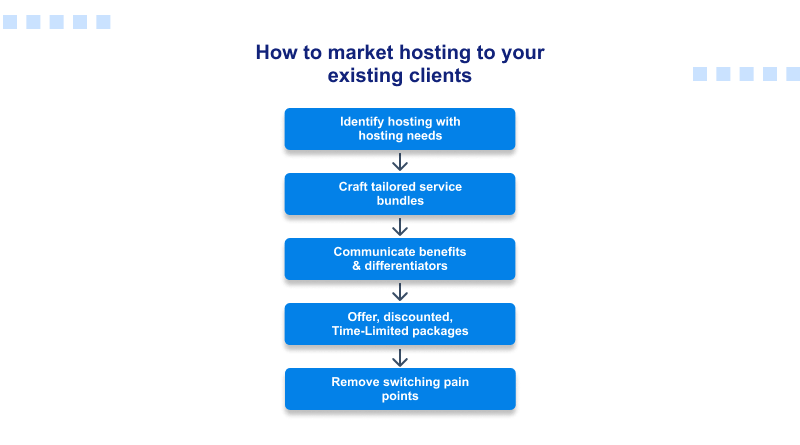
1. Identify Clients with Hosting Needs
Agencies should audit their existing client hosting requirements. If they need more storage, new plans, or new service categories, agencies need to adapt to those requirements. It will be a minor operational change that will bring more profits. Using CRM filters, evaluating past invoices and order history should be in the to-do tasks.
2. Craft Tailored Service Bundles
Don’t market web host services as a standalone product. Instead, bundle it with services your clients already value. Services like website maintenance, security updates, or server monitoring are value-driven solutions for clients. This will look like a natural sale instead of forced upselling.
3. Communicate Benefits & Differentiators
Clients look for better alternatives and distinguish competitors on various aspects. Faster load times, tighter security measures, local support services, and simplified billing are some of the differentiators they consider when searching for the ideal services provider. Email campaigns or calls with clients to clearly articulate these benefits often prove effective at reaching clients in an engaging manner.
4. Consider Offering Discounted, Limited Packages
Offering time-limited discounts like hosting for a reduced fee during the initial months or free migration can create the illusion of scarcity and give clients reason to act quickly on offers tailored specifically to their business needs. To be effective, these limited offers should feel personalized and exclusive in nature.
5. Remove Switching Pain Points
It is, for the most part, understandable that customers switching would feel like a risk. Eliminate friction points through free migration, zero downtime, guarantees, and hands-on onboarding. Position yourself as the safety net that ensures the process is seamless and effortless.
6. Refine Strategy Based on Client Feedback
After onboarding, get feedback on hosting. What did the client like? What was difficult? Use this to tweak the other suggestions and support structure. This feedback loop will enhance the offering and assure the clients that their success is a priority.
Writer’s View
Diversification has become a new normal. Businesses diversify their service portfolio into multiple niches and categories. As a writer, I am witnessing the paradigm shift in the digital business landscape.
But the pace of this transition is quite slow, as many organisations still treat web hosting as a backend technology. They must pitch it as a premium service with their core portfolio. Guaranteed uptime, performance optimisation, and configuring security layers should be added to the plans’ features list.
Bundling essential features like project fees and no-cost renewal will reap more benefits for businesses/agencies. Writers/marketers can make an important contribution here: We do storytelling, create the pitch, and build trust about why going with agency-hosted WordPress is smarter, safer, and more strategic than the DIY option.
Key Takeaways
Turning web hosting services into a revenue stream is an essential technical requirement. By adding another revenue opportunity in the digital server space, WordPress agencies will gain an edge. Repositioning web hosting as a premium value-driven service with high performance, security and support–this builds trust while creating another revenue source from every client onboarded. Hosting becomes more than infrastructure; it becomes a strategic pillar in your agency’s growth model.
FAQs
1. How can agency hosting help increase my revenue?
Your reseller hosting business becomes a steady stream of monthly revenue by selling hosting and maintenance services to clients.
2. What’s the difference between regular hosting and agency hosting?
Regular hosting services deal with a single user/website, while the agency hosting focuses on the management of multiple client websites with other features like premium support and management, extra resources, priority support, and other additional tools.
3. Can I resell hosting services to my clients?
Through a reseller hosting plan, it is indeed possible to buy resources in bulk from a hosting provider and sell them under your own brand to clients at a profit.
4. What are the benefits of white-label hosting for agencies?
Branding is essential when it comes to client loyalty to increase client trust and professionalism.